
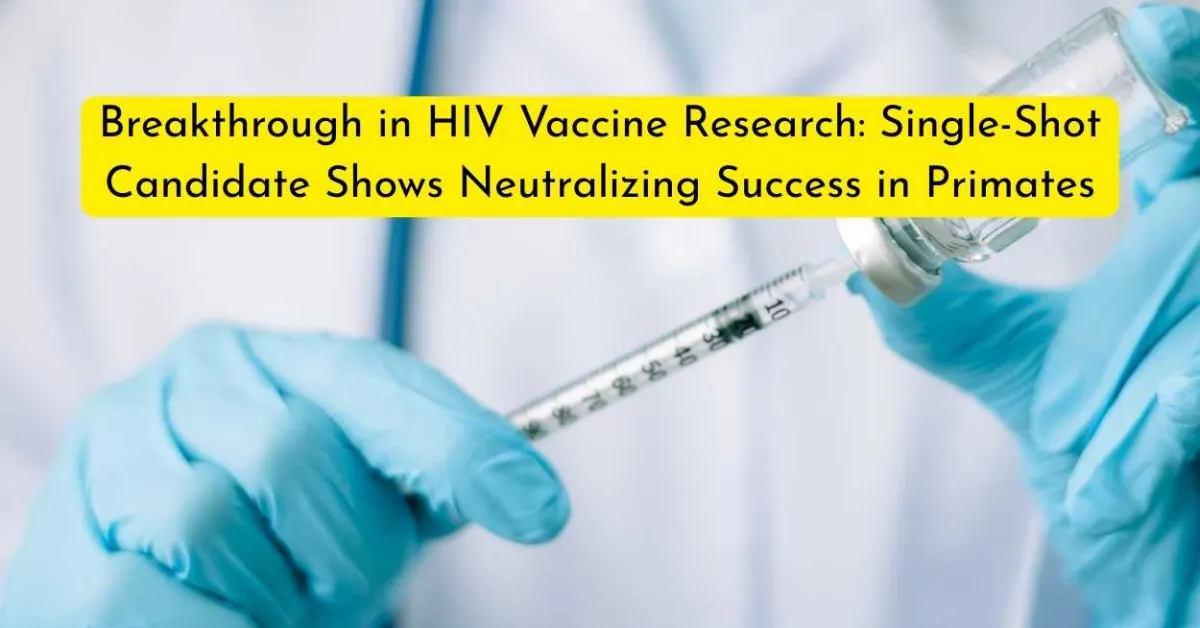
Scientists at The Wistar Institute have reported a major step forward in HIV vaccine development with a novel vaccine candidate that can induce neutralizing antibodies after a single immunization in nonhuman primates, an achievement never before demonstrated in the field.
Published in Nature Immunology, the study centers on an engineered version of the HIV envelope protein called WIN332. Unlike traditional HIV vaccine designs, which often require multiple doses, sometimes seven, eight, or more to generate measurable neutralizing responses, this new candidate showed detectable neutralization just three weeks after one injection. The response strengthened further following a second booster dose, suggesting a potentially shorter and more practical vaccination protocol.
“This represents something that has never been observed before,” said Dr. Amelia Escolano, the study’s senior author and assistant professor in Wistar’s Vaccine and Immunotherapy Center. Typically, HIV vaccine candidates require many more shots to achieve similar outcomes, making this development especially promising for future vaccine strategies.
The breakthrough stems from a bold design choice: researchers removed a sugar molecule (N332-glycan) previously thought essential for effective antibody engagement. This unconventional approach led to the discovery of two distinct classes of HIV-neutralizing antibodies. While one class still depended on the traditional sugar component, the newly identified class did not expand the understanding of how neutralization can be achieved.
Dr. Ignacio Relano-Rodriguez, first author of the paper, noted that if the approach proves successful in further studies, it could enable effective immunity with as few as three total doses, a substantial simplification compared with current experimental regimes. Such streamlined schedules could make vaccines more accessible and affordable worldwide.
The promising results have already attracted interest from major global health organizations seeking to advance WIN332 into human clinical trials. Additional preclinical evaluations are ongoing, and researchers are also working on related immunogens that could enhance neutralization even further.