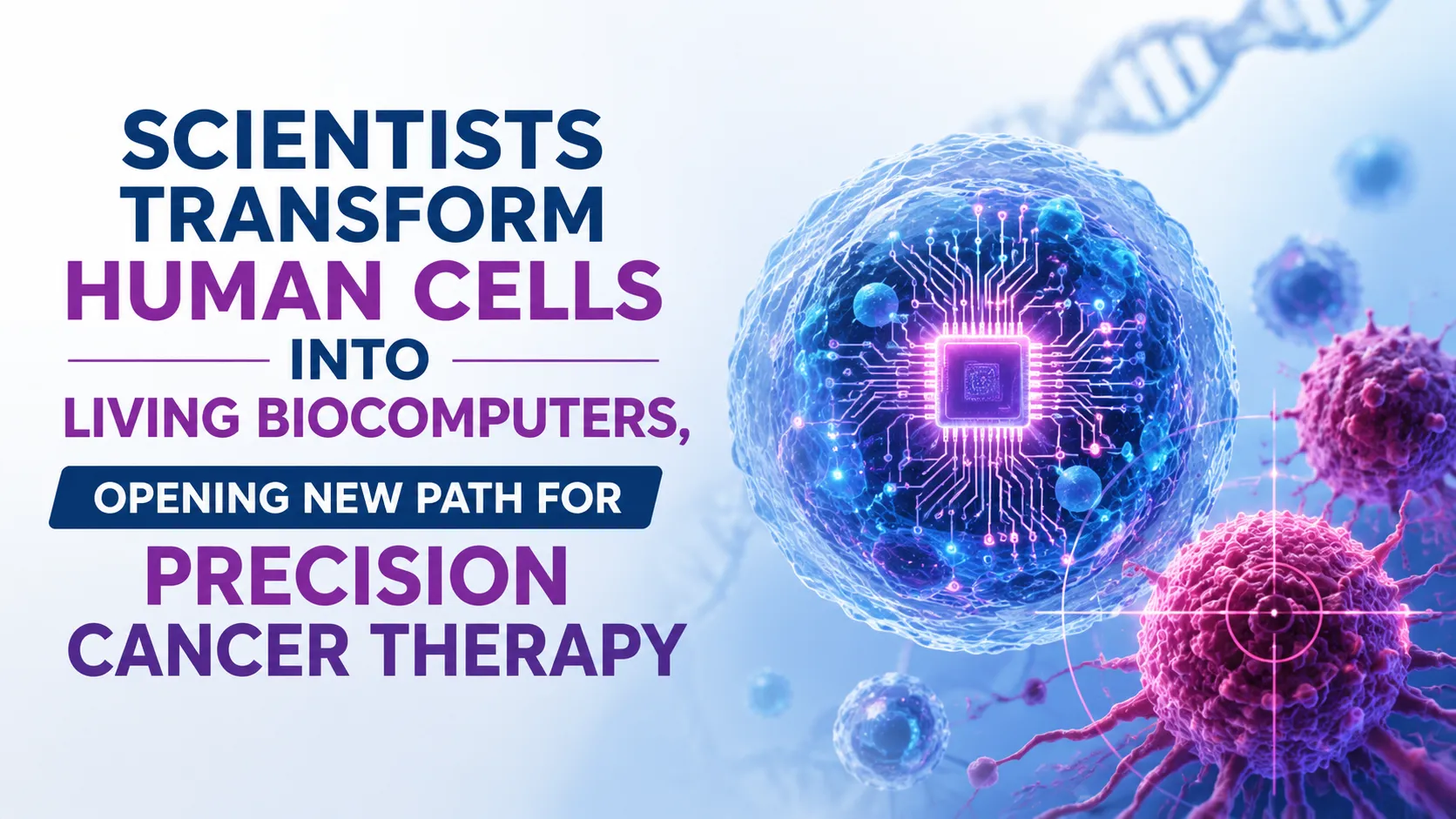
Researchers at the Hebrew University of Jerusalem have developed an innovative genetic programming system that enables human cells to process information and make autonomous decisions, functioning much like miniature biological computers. The breakthrough, published in Nature Communications, could pave the way for next-generation cell therapies capable of detecting diseases and delivering treatment only when specific biological conditions are met.
The study, led by PhD student Keren Roas and Lior Nissim, introduces artificial genetic circuits that allow human cells to process multiple biological signals simultaneously. Unlike conventional genetic circuits, which require several layers of sequential computations and become increasingly inefficient as complexity grows, the new system performs sophisticated cellular calculations using significantly fewer genetic components.
According to the researchers, the technology relies on a naturally occurring process known as RNA trans-splicing, where fragments of RNA are joined together inside cells. By combining this mechanism with engineered regulatory elements, the team created biological processors capable of executing predefined genetic programs with greater efficiency and reliability.
To demonstrate the platform's computational capabilities, the researchers engineered living cells to perform functions similar to electronic computer components. These included a biological full adder, capable of carrying out simple binary arithmetic, and a biological multiplexer, which selects one signal from multiple inputs. Fluorescent proteins emitting different colors were used to visualize and monitor these biological computations in real time.
The system also incorporates an internal safety mechanism. When cells detect an invalid or overloaded computational state, they generate a warning signal, a feature that could eventually improve the safety of future cell-based therapies by activating protective responses before errors occur.
One of the most promising applications of the technology lies in precision medicine. Instead of responding to a single disease marker, engineered cells can analyze several molecular signals simultaneously and initiate treatment only when a specific combination is detected. This approach could greatly improve treatment accuracy while minimizing damage to healthy tissues.
As a proof of concept, the research team programmed cells to produce Interleukin-15 (IL-15), an immune-stimulating protein that enhances the activity of cancer-fighting immune cells. Such programmable therapeutic cells could one day identify cancer-specific molecular signatures and activate targeted immune responses directly at the disease site.
The researchers believe that reducing the genetic complexity and energy requirements needed for cellular decision-making provides scientists with a powerful toolkit for designing advanced cell therapies. In the future, medicines may be programmed much like software, allowing living cells to continuously monitor the body, diagnose disease, and deliver highly targeted treatments with minimal human intervention.
The findings were published in the journal Nature Communications, representing a significant advance in the emerging field of programmable synthetic biology and intelligent cell-based therapeutics.