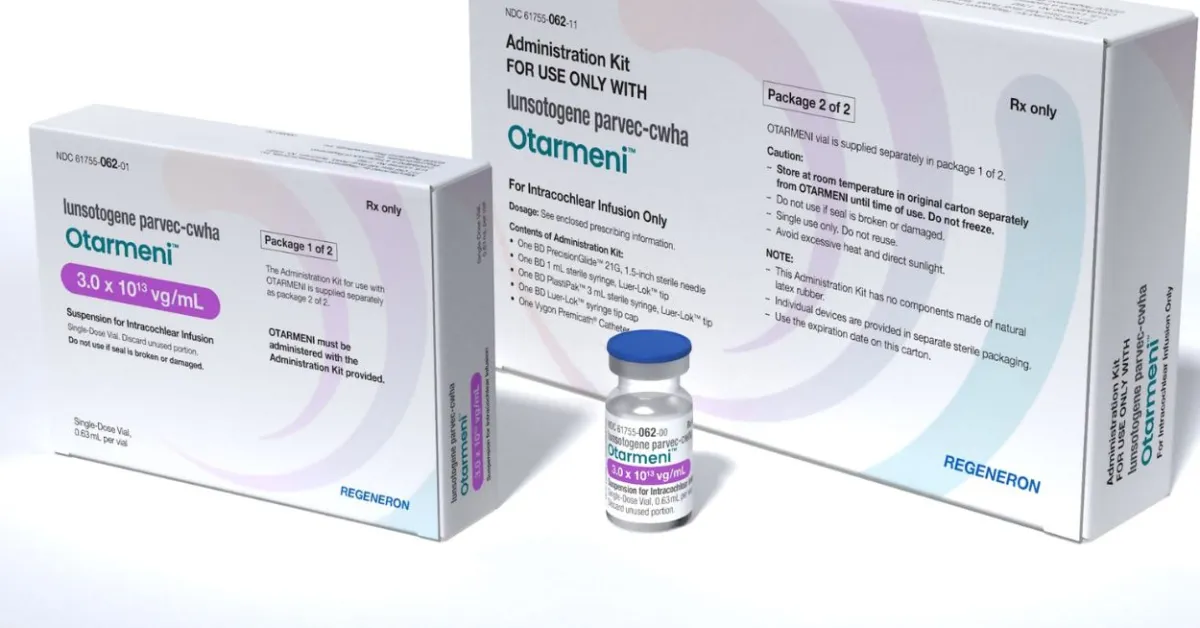
Regeneron Pharmaceuticals, Inc. announced the U.S. Food and Drug Administration (FDA) has granted accelerated approval for Otarmeni™ (lunsotogene parvec-cwha), the first gene therapy and second new molecular entity approved under the FDA Commissioner’s National Priority Voucher program. Otarmeni is an adeno-associated virus vector-based gene therapy indicated for the treatment of pediatric and adult patients with severe-to-profound and profound sensorineural hearing loss (any frequency >90 decibel hearing level [dB HL]) associated with molecularly confirmed biallelic variants in the OTOF gene, preserved outer hair cell function, and no prior cochlear implant in the same ear. Otarmeni, formerly known as DB-OTO, is the first and only in vivo gene therapy for OTOF-related hearing loss and will be made available by Regeneron for free in the U.S.
Otarmeni was granted accelerated approval based on the improvement of hearing sensitivity by average pure tone audiometry (PTA) at week 24. Continued approval for this indication may be contingent upon verification and description of clinical benefit in the confirmatory portion of the CHORD clinical trial. Otarmeni is not recommended in patients in whom preoperative imaging demonstrates that access to the inner ear is not feasible, including those with abnormal mastoid pneumatization or clinically significant anatomic variations of the middle ear and inner ear.
“The FDA approval of Otarmeni signals a new era in the treatment of genetic forms of hearing loss, where reinstating 24/7 natural hearing is now possible,” said A. Eliot Shearer, M.D., Ph.D., otolaryngologist in the department of Otolaryngology and Communication Enhancement at Boston Children’s Hospital, Associate Professor of Otolaryngology-Head and Neck Surgery at Harvard Medical School and a CHORD trial investigator. “In the pivotal trial, the one-time gene therapy demonstrated rapid, meaningful and consistent hearing responses, with most children achieving remarkable hearing improvements. I’ve witnessed firsthand my trial participant responding to their mother’s voice, dancing to music and interacting with the world, and these moments are now possible for more children born with this specific form of hearing loss.”
“Otarmeni is a huge scientific leap and is representative of Regeneron’s approaches to continually push the boundaries of science to benefit humanity,” said George D. Yancopoulos, M.D., Ph.D., Board co-Chair, President and Chief Scientific Officer of Regeneron. “This unprecedented breakthrough in gene therapy has already proven to be life-changing for many of the children in our clinical trial and their families. We are honored to be in the position to be the first company to ever offer such a gene therapy advance for free to those in the U.S. and serves to highlight our belief that the biopharmaceutical industry can be a genuine force for good in the world.”
OTOF-related hearing loss is an ultra-rare condition, affecting about 50 newborns per year in the U.S. Though all structures within the ear are intact, variants in the OTOF gene cause a lack of a functional otoferlin protein, which is critical for communication between the sensory cells of the inner ear and the auditory nerve. Historically, genetic OTOF-related hearing loss was considered permanent and managed with life-long use of devices. While these devices can amplify sound to improve hearing for individuals with a range of hearing loss, they do not currently restore the full spectrum of sound.
“Connection and communication are at the heart of how we experience the world – whether that happens through listening and spoken language, sign language, the use of technology, or a combination of approaches,” said Janet DesGeorges, Executive Director of Hands & Voices. “Families deserve access to balanced information and a range of options when navigating genetic hearing loss. As new treatments and innovations emerge, families can assess available options and choose the approach best suited to their unique circumstances.”
The FDA approval is based on results from the pivotal CHORD trial, in which 20 participants (aged 10 months to 16 years) received a single dose of Otarmeni via intracochlear infusion, either unilaterally (in one ear; n=10) or bilaterally (in both ears; n=10). Among the trial participants, efficacy results found :
• 80% (16 of 20) experienced hearing improvements per pure tone audiometry assessments at a threshold of ≤70 dB HL at 24 weeks, achieving the trial’s primary endpoint; one additional participant achieved this threshold by week 48. This threshold corresponds to a clinical standard that enables natural hearing and typically does not require cochlear implantation.
• 70% (14 of 20) demonstrated an auditory brainstem response (ABR) at ≤90 decibels at 24 weeks, achieving the trial’s key secondary endpoint. ABR is an objective confirmation of hearing function, as measured by recording electrical brainstem signals in response to sound.
• For those followed to 48 weeks, all prior responders maintained a response to therapy, and 42% of all participants (5 of 12) achieved normal hearing that included whispers (≤25 dB HL).
The most common adverse reactions (≥5%) in the safety population of CHORD (n=24) associated with Otarmeni include otitis media, vomiting, nausea, dizziness, procedural pain, gait disturbance, and nystagmus. The surgical procedure to administer Otarmeni uses an approach similar to cochlear implantation and allows use in young infants. Otarmeni should be administered by a surgeon experienced in intracochlear surgery and trained in the Otarmeni administration process and should only be administered using the provided Administration Kit for use with Otarmeni.
Regeneron will provide Otarmeni at no cost to clinically eligible individuals in the U.S. This may not necessarily reflect out-of-pocket costs for administration of this free therapy, which would be outside of the control of Regeneron; individuals should consult with their healthcare provider and/or insurance provider. For more information on access, contact Regeneron’s OnPath with OTARMENI™ patient support program at 1-866-500-GENE (1-866-500-4363).
Otarmeni received Orphan Drug, Rare Pediatric Disease, Fast Track and Regenerative Medicine Advanced Therapy designations from the FDA. The European Medicines Agency also granted Orphan Drug Designation. Regulatory submissions are planned in additional markets.
Otarmeni is an adeno-associated virus vector-based gene therapy indicated for the treatment of certain pediatric and adult patients with severe-to-profound and profound sensorineural hearing loss caused by variants of the OTOF gene that produce non-functioning otoferlin protein. The treatment is designed to restore durable, physiological hearing to individuals by delivering a working copy of the OTOF gene through a modified, non-pathogenic virus that is delivered via an infusion into the cochlea under general anesthesia (similar to the procedure used for cochlear implantation). In this gene therapy, the newly introduced OTOF gene is under the control of a proprietary cell-specific Myo15 promoter, which is intended to restrict expression only to hair cells that normally express the otoferlin protein.