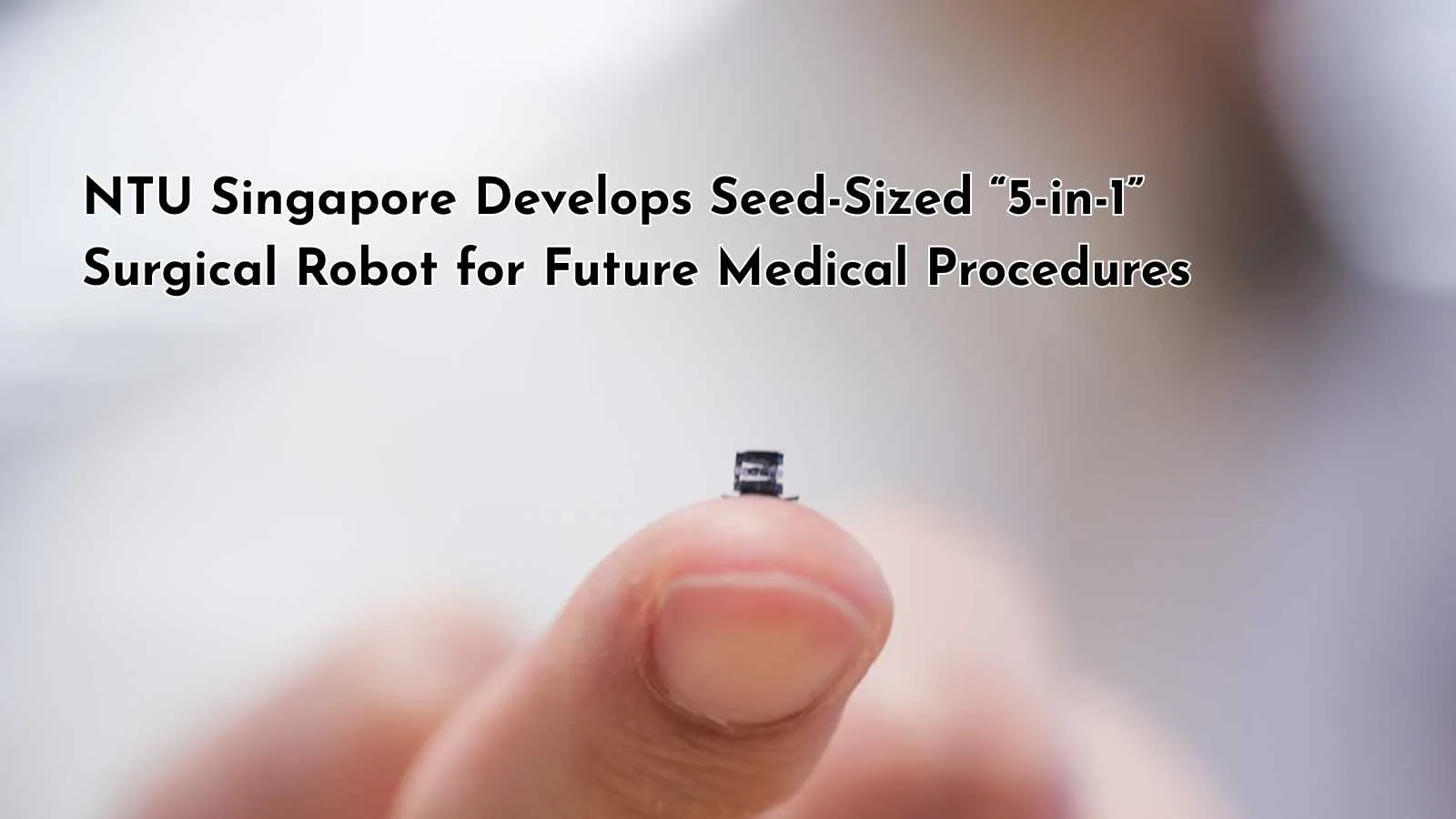
Scientists at Nanyang Technological University, Singapore have developed an ultra-small surgical robot capable of performing five different medical functions wirelessly inside the body, marking a major step toward more precise and minimally invasive treatments.
The robot, measuring just 4.4 millimetres in length, roughly the size of a seed, can move across soft tissues, cut biological material, deliver drugs, grip and collect tissue samples, and even generate heat remotely. Researchers say the device can switch between these functions in less than a second using weak magnetic fields.
The project was led by Associate Professor Lum Guo Zhan from NTU’s School of Mechanical and Aerospace Engineering. According to the research team, most existing miniature magnetic robots are limited to only one or two tasks, while this newly developed system combines multiple surgical capabilities in a single tiny platform.
To achieve this, researchers designed the robot using soft silicone-based materials embedded with microscopic magnetic particles. Different sections of the robot react differently to magnetic fields, allowing specific tools or movements to activate independently without affecting the entire device. This solves one of the biggest challenges in miniature robotics, where the whole robot usually behaves like a single magnet.
Another important advancement is the robot’s additional “rolling” movement, giving it six degrees of motion instead of the usual five found in many miniature robots. This allows the device to navigate narrow and irregular spaces inside the human body with greater precision.
The NTU team tested the robot on biological tissue models, including chicken liver and gelatin-based soft tissue simulations. During laboratory experiments, the robot successfully cut tissue, released simulated drug particles, collected tissue samples, and generated localised heat. Researchers noted that the heat-generation feature could support future cancer therapies based on magnetic hyperthermia.
The scientists also evaluated the safety of the robot’s materials by exposing them to human skin cells. More than 99 percent of the cells remained viable, suggesting the materials are largely non-toxic under laboratory conditions.
Experts believe such technology could eventually transform minimally invasive surgeries by reducing the need for large incisions and bulky instruments. Independent medical experts involved in reviewing the work suggested these robots may one day assist in targeted drug delivery, remote biopsies, and advanced therapeutic procedures.
The research, published in the journal Advanced Materials, took seven years to complete and was supported by Singapore’s research and innovation agencies.