
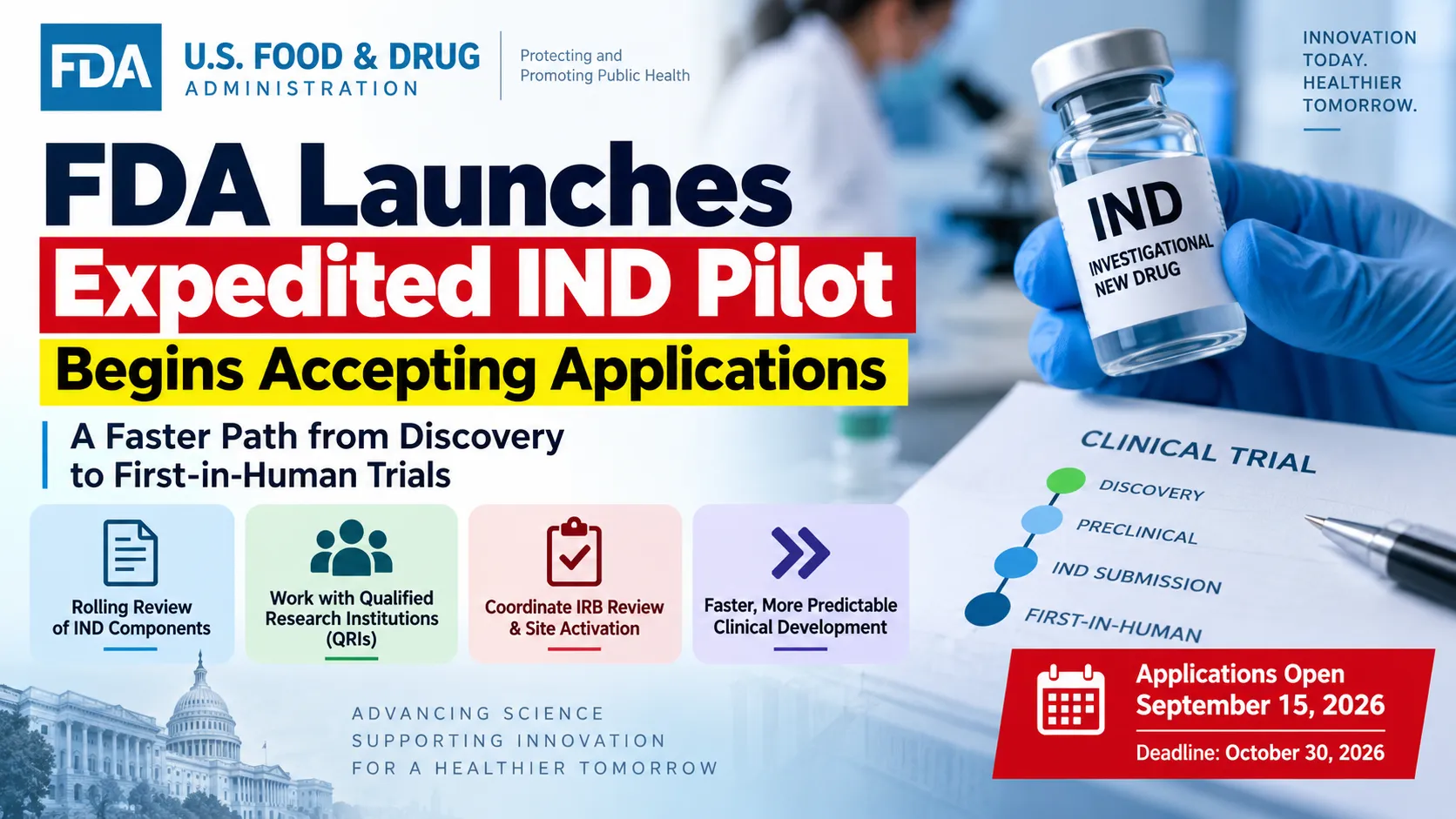
The U.S. Food and Drug Administration (FDA) has launched a new Expedited Investigational New Drug (IND) Pilot Program aimed at reducing the time required to move promising drug candidates from development into first-in-human (FIH) clinical trials in the United States.
Under the pilot, drug sponsors will partner with Qualified Research Institutions (QRIs), which can include academic medical centers, contract research organizations, health networks and other research organizations with relevant scientific and regulatory expertise.
Rolling Review of IND Components
A key feature of the pilot is a rolling review approach. Instead of waiting for a complete IND package, FDA will be able to accept and review individual components as they are completed during the pre-IND stage.
The participating QRIs will provide expertise across areas including:
Nonclinical pharmacology and toxicology
Clinical development
Chemistry, Manufacturing and Controls (CMC)
IND preparation and regulatory strategy
This approach is intended to allow scientific and regulatory issues to be identified and addressed earlier, potentially reducing delays and the risk of a clinical hold when the IND enters the 30-day review period.
Coordination of Clinical Trial Activities
The pilot also encourages sponsors to coordinate activities that can take place alongside IND development, including Institutional Review Board (IRB) review and clinical trial site activation, where appropriate.
FDA says the initiative is designed to make the path from drug discovery to first-in-human studies faster, more predictable and more collaborative, while maintaining existing standards for patient safety and scientific oversight.
Applications Open Until October 30, 2026.
The FDA began accepting applications on September 15, 2026. Sponsors must apply in partnership with a prospective QRI, with both parties' information submitted as a single application package.
The FDA expects to select approximately 8-10 Sponsor-QRI pairs for the initial pilot cohort. Applications are currently scheduled to remain open until October 30, 2026. FDA expects the pilot to generate evidence that could help shape future approaches to supporting early-stage drug development and potentially inform a future model for recognizing or accrediting institutions with strong scientific and regulatory expertise.
Why It Matters
The initiative represents a significant focus on accelerating early-stage clinical development, particularly the transition from IND-enabling studies to first-in-human Phase 1 trials. Importantly, participation in the pilot does not change FDA's regulatory authority or statutory requirements for determining whether a clinical trial can proceed.