
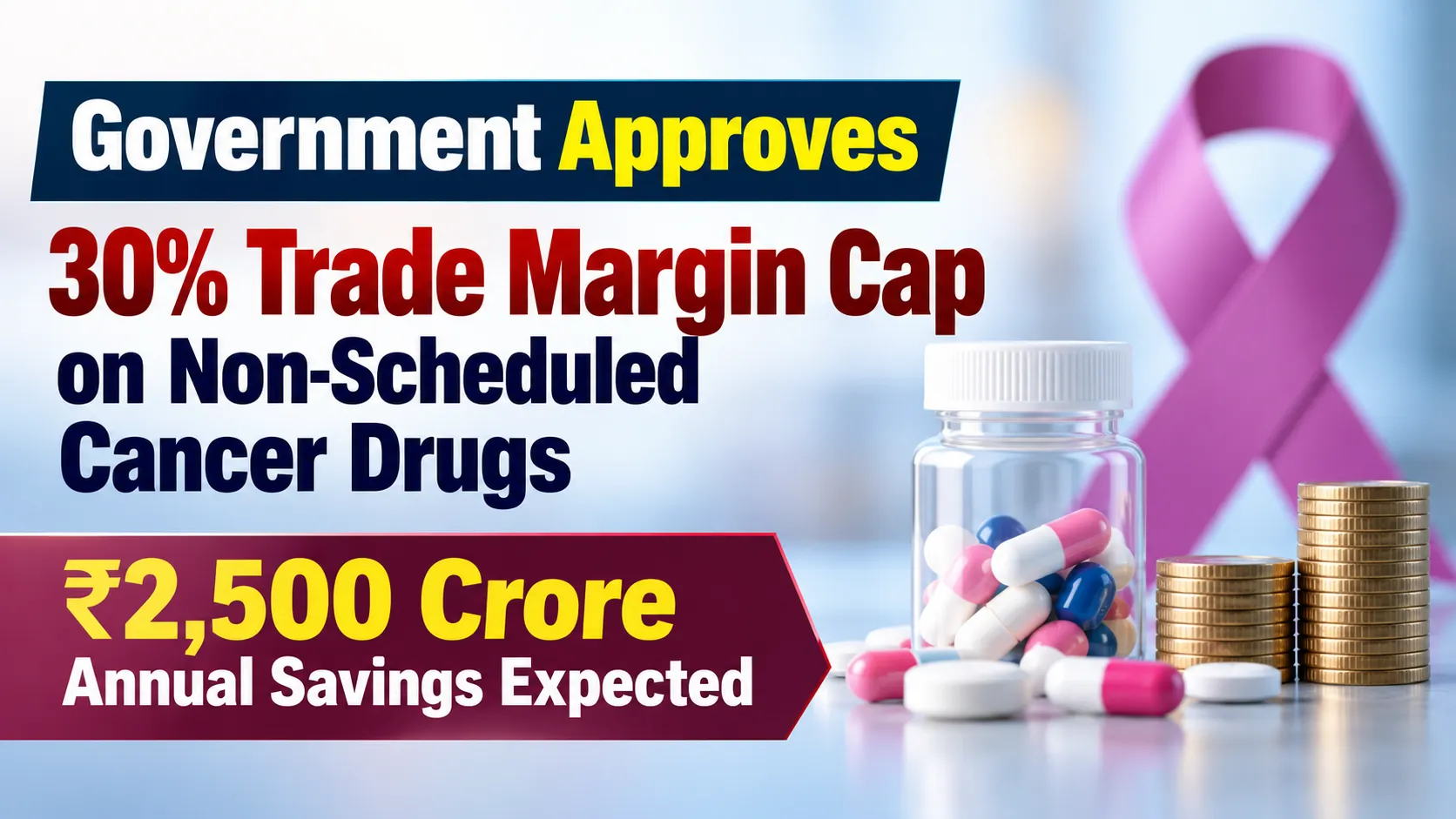
The government has approved a 30% cap on trade margins for non-scheduled anti-cancer medicines, aiming to reduce medicine prices by up to 70% and provide annual savings of ₹2,500 crore to cancer patients.
The Government of India has approved a new price-control measure to limit trade margins on non-scheduled anti-cancer drugs to 30% of their Maximum Retail Price (MRP). The decision aims to address high mark-ups across the pharmaceutical supply chain and reduce the financial burden of cancer treatment on patients and their families.
According to a Press Information Bureau (PIB) release dated 8 October 2026, the measure is expected to bring down medicine prices by up to 70%, with projected annual savings of ₹2,500 crore for cancer patients.
30% Trade Margin Cap to Cover Non-Scheduled Anti-Cancer Medicines
Under the approved measure, trade margins on non-scheduled anti-cancer medicines will be restricted to 30% of the MRP. These medicines are not covered by the existing scheduled list of drugs subject to government-notified ceiling prices.
While scheduled anti-cancer medicines already come under established price-control provisions, the new intervention extends price protection to additional cancer drugs that are currently outside that list.
The Directorate General of Health Services (DGHS) will constitute an expert committee to finalise the list of medicines to be covered. Following this process, the National Pharmaceutical Pricing Authority (NPPA) will take the necessary decision and issue the notification to implement the measure.
The government expects the intervention to reduce excessive mark-ups and improve affordability across the cancer medicine supply chain.
NPPA Analysis Highlights High Mark-Ups on Cancer Drugs
The decision follows concerns over the high prices of non-scheduled anti-cancer medicines and variations in the prices charged through different sales channels.
According to the government's analysis of market data, non-scheduled anti-cancer medicines carry an average price mark-up of approximately 170%. In some cases, the mark-up reaches 700% or more.
Such differences can significantly increase the amount patients pay for medicines, particularly when treatment involves expensive anti-cancer therapies over an extended period.
The government has also received concerns from state authorities, including Maharashtra, Rajasthan and Karnataka, as well as patients and civil society groups. The concerns relate to excessive medicine prices and the gap between procurement costs and the MRP charged to consumers.
The proposed margin cap is intended to address these pricing concerns and bring greater consistency to the pricing of non-scheduled anti-cancer medicines.
Earlier NPPA Intervention Reduced Prices by Up to 91%
The latest decision builds on the government's earlier experience with trade margin regulation in the anti-cancer drug market. In February 2019, following government directions, the NPPA imposed trade margin restrictions on 42 selected non-scheduled anti-cancer drugs under Paragraph 19 of the Drugs (Prices Control) Order, 2013.
The intervention reportedly reduced MRPs by up to 91% and generated annual savings of approximately ₹984 crore across 526 brands. The government has cited this experience as a basis for extending price protection to a wider range of non-scheduled anti-cancer medicines.
With the newly approved measure, the expected annual savings are projected to increase to ₹2,500 crore, although the actual impact will depend on the medicines covered and the implementation of the notification.
Manufacturers Required to Maintain Production Levels
Alongside the price-control measure, the government has specified that manufacturers of non-scheduled anti-cancer medicines will be required to maintain their current production levels.
The provision is intended to support continued availability of these medicines while their prices are brought under control.
The proposed coverage will extend across different categories of non-scheduled anti-cancer medicines, including:
• Branded and generic medicines
• Domestically manufactured and imported medicines
• Patented and non-patented medicines
This broad coverage is intended to ensure that the price-control measure benefits patients across different segments of the anti-cancer drug market.
What the Decision Means for Cancer Patients
Cancer treatment can involve substantial out-of-pocket expenditure, with medicine costs representing an important component of the financial burden faced by patients and their families.
The government's announcement cites an estimated cancer incidence of approximately 60 people per lakh population in India. Against this background, limiting trade margins on non-scheduled anti-cancer medicines is intended to improve affordability and reduce treatment-related expenses.
However, the 30% margin cap does not mean that every covered medicine will automatically become 70% cheaper. The extent of any price reduction will depend on the existing pricing structure, the medicine concerned and the applicable implementation provisions.
The expert committee's final list and the subsequent NPPA notification will be important in determining which medicines are covered and how the new restrictions will operate.
The government's stated objective is to extend price protection beyond scheduled medicines, curb excessive trade margins and provide further financial relief to cancer patients while maintaining medicine availability.