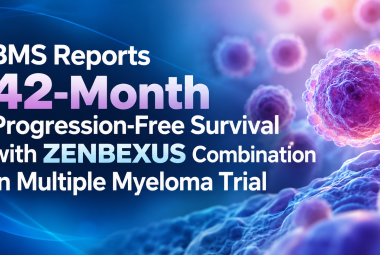

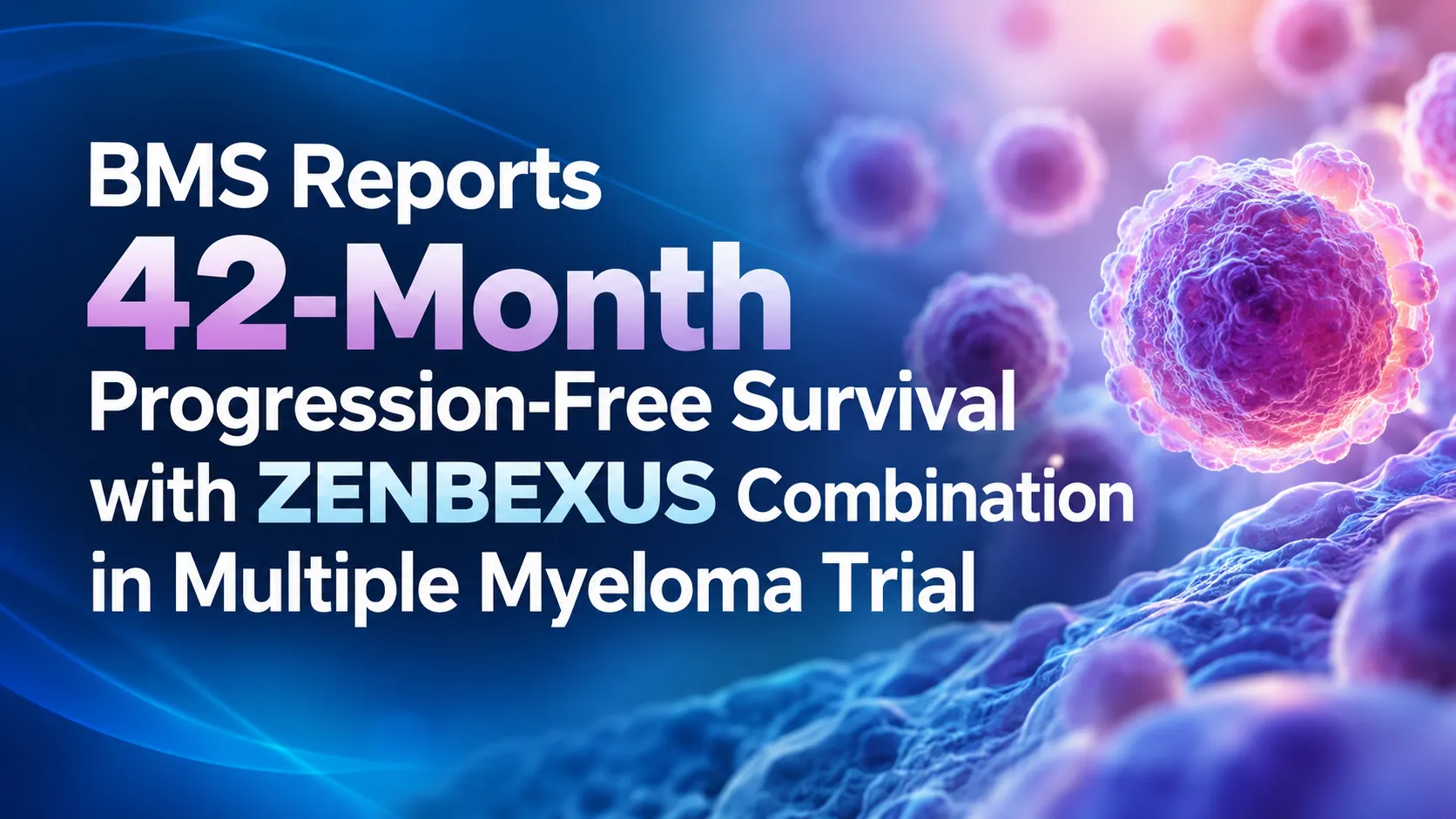
Bristol Myers Squibb (BMS) has announced positive results from its Phase III EXCALIBER-RRMM study, demonstrating superior progression-free survival with ZENBEXUS (iberdomide) in combination with daratumumab and dexamethasone in patients with relapsed or refractory multiple myeloma. The combination, referred to as ZDd, was compared with the standard-of-care regimen of daratumumab, bortezomib and dexamethasone (DVd).
According to the company, the ZDd combination achieved a median progression-free survival (PFS) of 42 months, compared with 20 months for DVd. The results represent a statistically significant improvement and correspond to a 51% reduction in the risk of disease progression or death.
The EXCALIBER-RRMM study (NCT04975997) evaluated the efficacy and safety of iberdomide in combination with daratumumab and dexamethasone against DVd in adults with relapsed or refractory multiple myeloma. The confirmatory progression-free survival analysis included 800 patients, with 400 participants assigned to each treatment group.
The study reported a hazard ratio of 0.49 for disease progression or death, with a p-value of less than 0.000001. The median follow-up period was 23 months. These findings indicate that patients receiving the ZDd combination experienced a longer period without disease progression or death than those receiving the comparator regimen.
The latest progression-free survival findings build on earlier results from the same study, which demonstrated improved minimal residual disease (MRD)-negative complete response rates with ZDd. In the earlier analysis, MRD-negative complete response was achieved in 41.1% of patients receiving ZDd, compared with 20.7% of patients receiving DVd.
MRD negativity means that cancer cells were not detected in the bone marrow using the specified sensitive testing method. It can indicate a deeper treatment response, although it does not necessarily mean that the disease has been permanently eliminated.
ZENBEXUS contains iberdomide, an oral cereblon E3 ligase modulator (CELMoD) designed to target multiple myeloma through cereblon-related mechanisms and influence immune responses. The treatment is being investigated in combination with established medicines to improve outcomes for patients whose disease has returned or stopped responding to previous treatment.
Daratumumab is a monoclonal antibody that targets CD38, a protein expressed on multiple myeloma cells. Dexamethasone is a corticosteroid commonly used in multiple myeloma treatment. The comparator regimen includes daratumumab, bortezomib and dexamethasone, an established combination for eligible patients with relapsed or refractory disease.
Bristol Myers Squibb reported that the safety profile of ZENBEXUS in combination with daratumumab and dexamethasone was consistent with previously reported safety findings from the study. The company plans to present detailed results from EXCALIBER-RRMM at the 68th Annual Meeting of the American Society of Hematology in New Orleans.
The findings could be relevant to treatment decisions for patients with relapsed or refractory multiple myeloma. However, the choice of therapy depends on factors such as previous treatments, disease characteristics, patient eligibility and individual safety considerations.
ZENBEXUS in combination with daratumumab and hyaluronidase-fihj and dexamethasone received accelerated approval from the US Food and Drug Administration (FDA) on August 13, 2026, for adults with multiple myeloma who have received at least one prior line of therapy, including a proteasome inhibitor and an immunomodulatory agent.
The accelerated approval was based on MRD-negative complete response findings. The latest progression-free survival results from EXCALIBER-RRMM provide additional clinical evidence supporting the evaluation of the treatment combination.