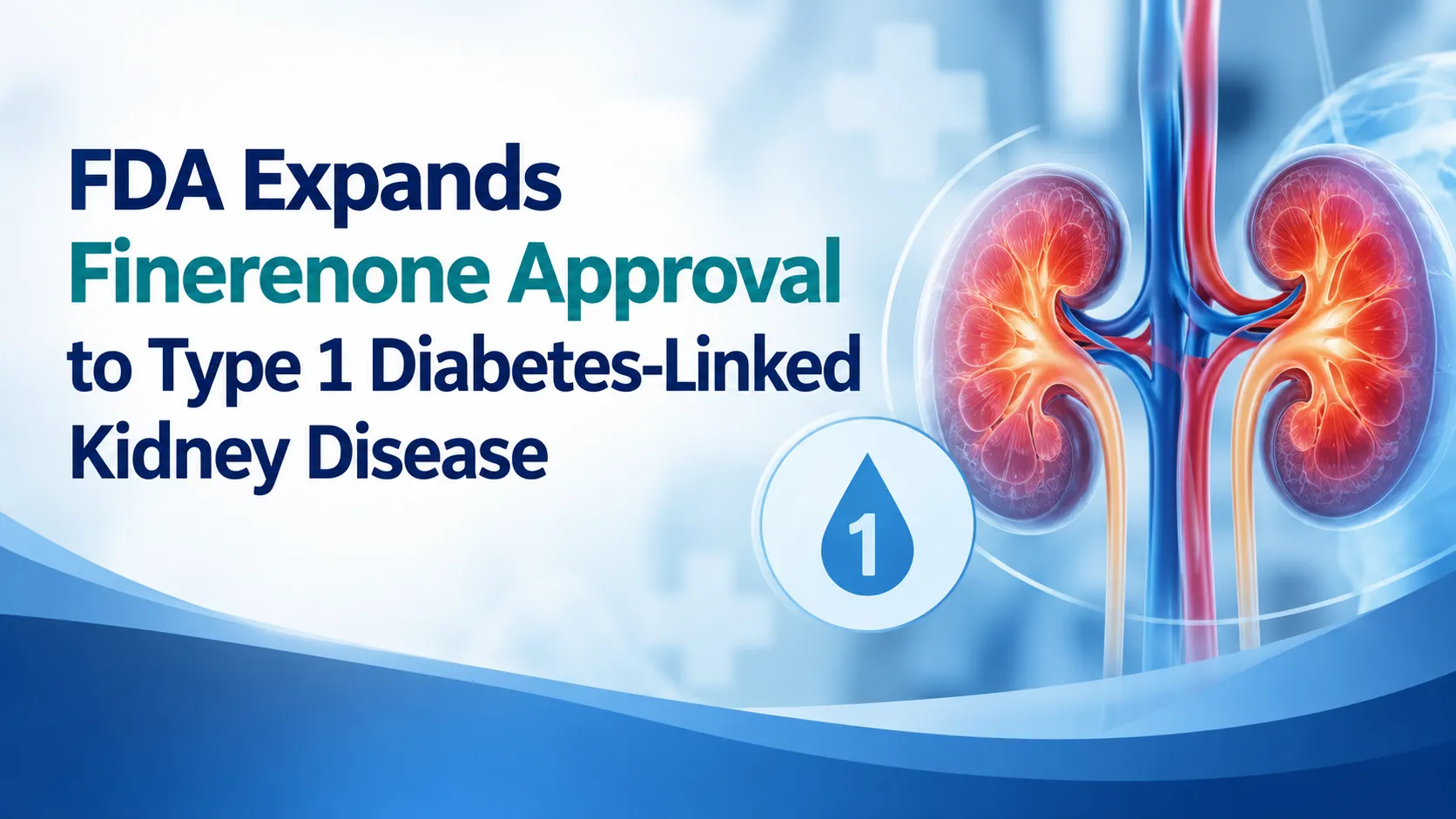
The U.S. Food and Drug Administration (FDA) has approved Kerendia (finerenone) for a new indication in adults with chronic kidney disease (CKD) associated with type 1 diabetes (T1D). Bayer announced it as the first FDA-approved treatment option in more than 30 years for adults with CKD associated with type 1 diabetes.
Under the expanded indication, finerenone is approved to reduce urinary albumin-to-creatinine ratio (UACR) in adults with CKD associated with type 1 diabetes. Reduction in UACR is expected to reduce the risk of sustained decline in estimated glomerular filtration rate (eGFR) and progression to end-stage kidney disease.
CKD is an important complication of type 1 diabetes. Bayer estimates that approximately 20–30% of people with type 1 diabetes in the U.S. also have CKD, placing them at increased risk of kidney disease progression, kidney failure and cardiovascular complications.
Finerenone is a selective, non-steroidal mineralocorticoid receptor antagonist (nsMRA). It works by blocking harmful effects associated with overactivation of the mineralocorticoid receptor, a pathway involved in kidney disease progression and cardiovascular damage.
The FDA's decision was supported primarily by results from the Phase III FINE-ONE trial, which evaluated finerenone in adults with CKD associated with type 1 diabetes. The randomized study included 242 participants from more than 80 sites across nine countries who received either finerenone or placebo once daily in addition to standard care.
After six months, finerenone produced a statistically significant 25% reduction in UACR from baseline compared with placebo. In the study, 68.1% of participants receiving finerenone achieved at least a 30% reduction in UACR at any time after baseline, compared with 46.6% of participants receiving placebo.
The approval was also supported by pooled evidence from the Phase III FIDELIO-DKD and FIGARO-DKD trials conducted in patients with CKD associated with type 2 diabetes. Bayer reported that more than 80% of the kidney benefit observed with finerenone in these studies was explained by reductions in UACR.
The safety profile observed in FINE-ONE was broadly consistent with previous clinical studies of finerenone in CKD associated with type 2 diabetes, and Bayer reported that no new safety signals were identified in the trial.
This approval expands the U.S. use of finerenone across multiple cardiovascular and kidney-related conditions. Kerendia was initially approved in the U.S. in 2021 for adults with CKD associated with type 2 diabetes and subsequently received an indication for certain patients with heart failure and a left ventricular ejection fraction of at least 40%. The new approval adds CKD associated with type 1 diabetes to its U.S. indications.
For the pharmaceutical industry, the decision represents an expansion of the clinical use of non-steroidal mineralocorticoid receptor antagonism into a population with type 1 diabetes-associated CKD. It also demonstrates how reductions in biomarkers such as UACR can support regulatory development programs for therapies intended to address progressive kidney disease.