
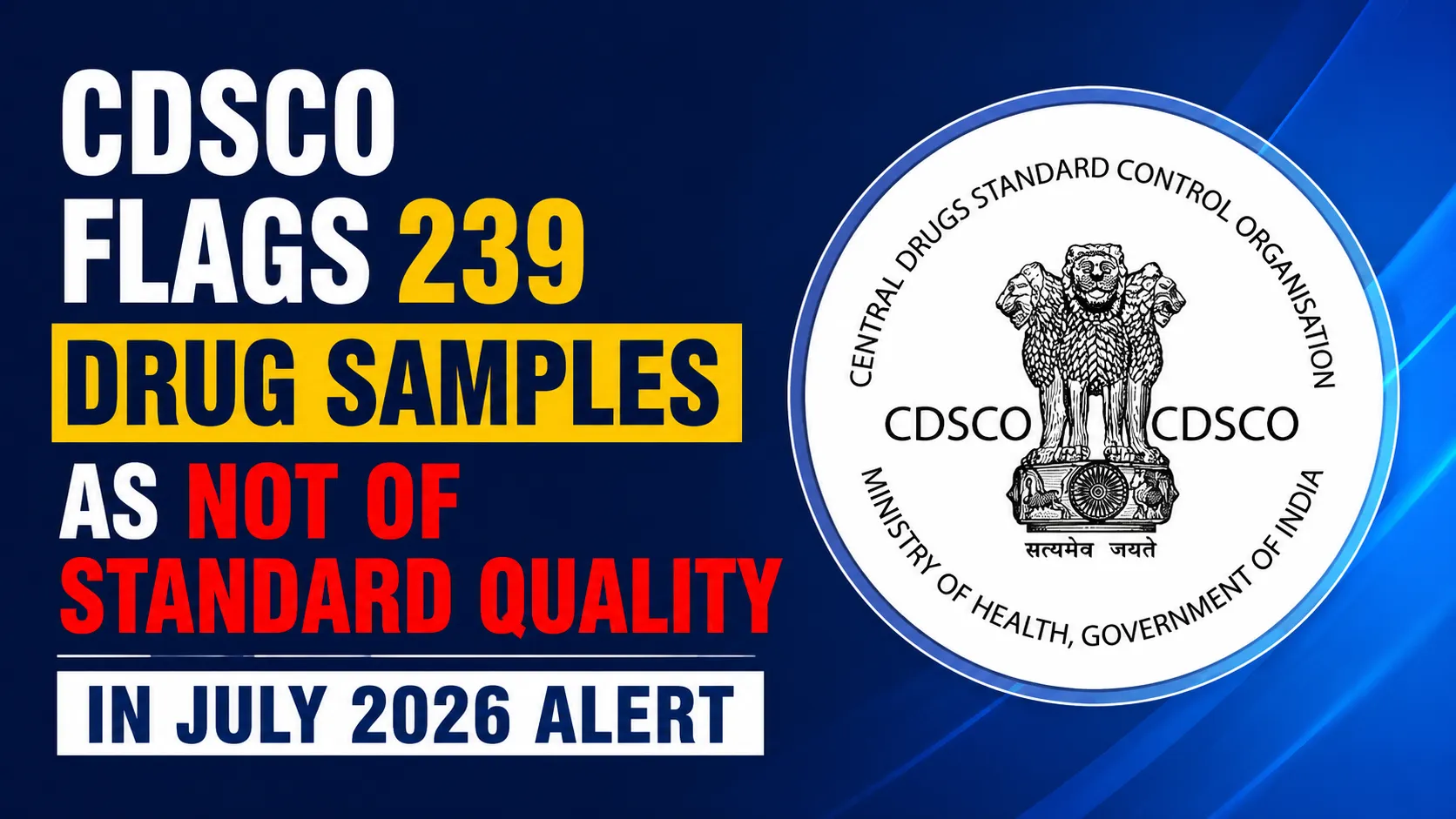
The Central Drugs Standard Control Organization (CDSCO) has released its July 2026 Not of Standard Quality (NSQ) drug alert, listing a large number of medicine samples that failed to meet specified quality standards during testing by state and CDSCO laboratories.
The July 2026 alert covers at least 239 entries, with quality concerns reported across a wide range of pharmaceutical products, including tablets, capsules, injections, syrups, creams, suspensions and other healthcare products. The reported failures involve parameters such as assay, dissolution, identification, sterility, particulate matter, pH, uniformity of weight and description.
Among the products listed are Methotrexate Tablets IP 7.5 mg, batch L09-2501, manufactured by Macmillon Pharmaceuticals Pvt. Ltd. The sample was reported for a failure under the description parameter. Another Methotrexate 7.5 mg batch, L09-2402, from the same manufacturer also appears in the alert for the same parameter.
The alert also identifies Calcium and Vitamin D3 Tablets IP, batch CH26T203, manufactured by Cureza Healthcare Pvt. Ltd. The sample failed the calcium dissolution requirement, with three of six tablets reported to be below the specified Q-25% limit, while some tablets did not completely dissolve within the prescribed time.
Pregabalin Capsules IP 300 mg, batch DMC-260508A, manufactured by Divine Medicare, were also listed. Testing found Pregabalin content of 211.16 mg per capsule against the labelled claim of 300 mg, according to the alert.
Another notable entry is Itraconazole 100 mg, batch MC004, manufactured by MK Healthcare. The reported test result found Itraconazole content of 63.54 mg per capsule, or 63.54% of the labelled 100 mg, while the composition stated on the label was also reported as not being in accordance with the IP monograph.
The list includes several commonly used medicines. Paracetamol 500 mg and 650 mg tablets appear in multiple entries, with some samples failing dissolution testing. One Paracetamol 500 mg batch from Cotec Healthcare failed the IP 2022 dissolution requirement, while Paracetamol 650 mg batches from Zenith Drugs and other manufacturers were also reported for dissolution failures.
The alert also contains products where the concern relates to sterility and particulate contamination. For example, a Metronidazole Infusion BP 0.5% w/v sample from Althea Pharma Pvt. Ltd. did not comply with the BP 2025 sterility requirement. A Sodium Chloride Injection IP 0.9% w/v sample from MKA Remedies was reported for particulate contamination.
Several other important medicines were flagged for assay and identification-related issues. Bupropion Hydrochloride Prolonged Release Tablets IP, Racecadotril Capsules IP 100 mg and Telmisartan Tablets IP 20 mg were among the samples reported as failing specified quality requirements.
The alert further includes injectable products such as Oxytocin Injection IP 5 IU/ml, where the sample was reported to have failed identification by HPLC and particulate matter requirements. Ferric Carboxymaltose Injection 50 mg/ml was reported for particulate matter and bacterial endotoxin testing, while a Rabeprazole Sodium Injection sample failed tests relating to description, pH, clarity, particulate matter and assay.
Some entries involve products with significantly reduced active ingredient content. For example, a sample of Pantoprazole Gastro-resistant Tablets IP was reported with Pantoprazole content of 84.7%, while a Betamethasone Valerate Ointment sample showed Betamethasone content of 73.7%.
The July alert also includes cases classified as misbranded or spurious. A product named Diabetis-All Powder was reported as spurious after testing identified the presence of Pioglitazone Hydrochloride and found a content of 0.32 mg/gm. Meanwhile, Nimesulide & Paracetamol Tablets and Amoxycillin & Potassium Clavulanate Tablets are listed as misbranded drugs in the later part of the alert.
The NSQ list also contains quality observations involving paediatric and consumer healthcare products. Azithromycin Oral Suspension IP 200 mg/5 ml, for example, was reported with azithromycin content at 65.76% of the labelled amount and fungal growth was also observed in the tested sample.
It is important to note that an NSQ alert relates to the specific sample and batch identified in the regulatory testing record. The listing should not automatically be interpreted as a declaration that every batch of a particular medicine or every product manufactured by a company is of poor quality.
Healthcare professionals, pharmacies, distributors and consumers should therefore check the exact product name and batch number against the CDSCO alert before drawing conclusions about a particular medicine. The July 2026 NSQ alert demonstrates the continuing role of post-market drug-quality surveillance in identifying products that fail prescribed specifications and bringing such findings to the attention of relevant stakeholders.