
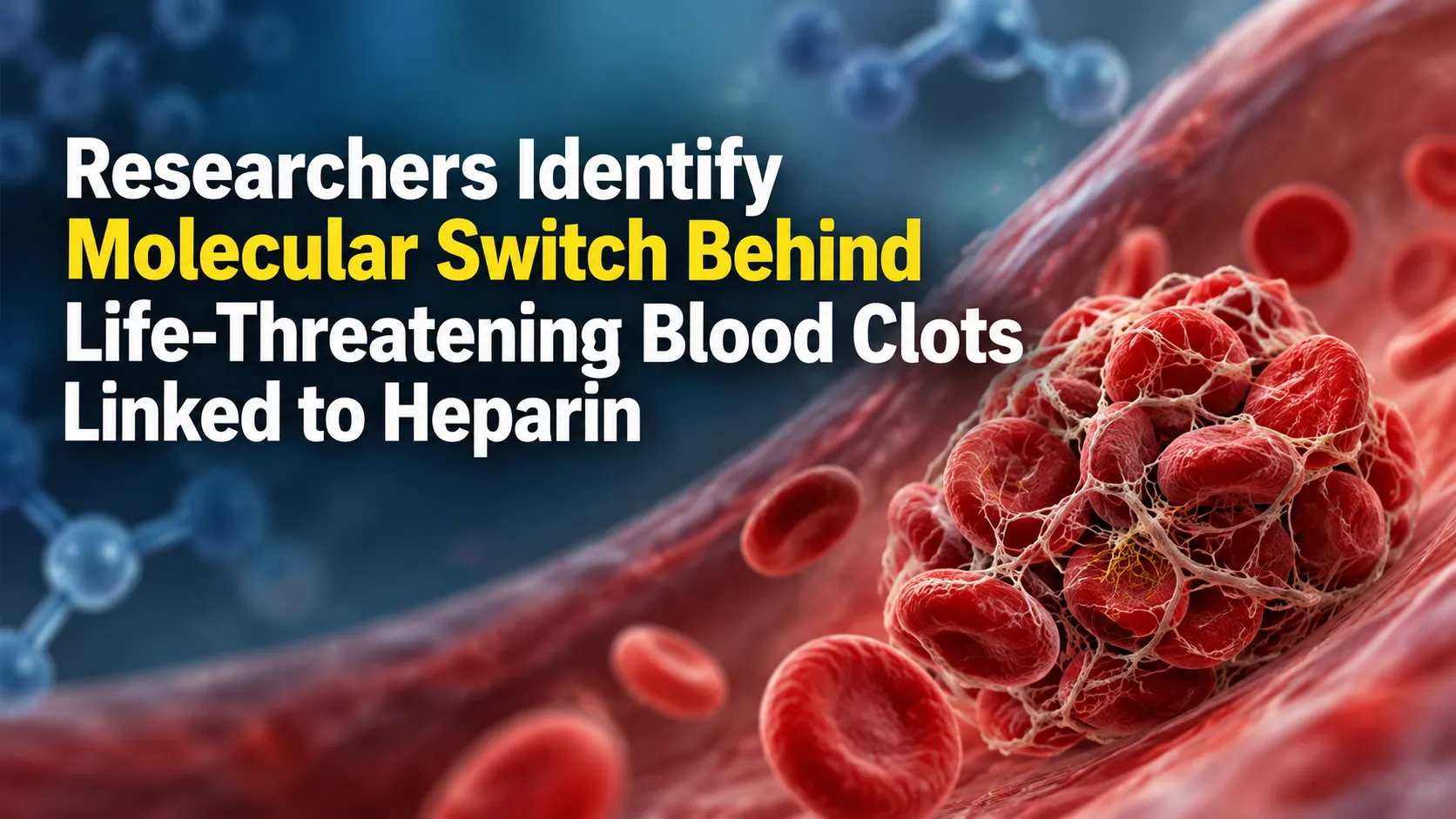
Researchers at McMaster University have uncovered a previously unknown molecular mechanism that may explain why some patients develop dangerous blood clots after receiving heparin, a widely used blood-thinning medicine. The discovery provides new insight into the biological process behind heparin-induced thrombocytopenia (HIT), a rare but potentially life-threatening immune reaction, and could eventually support the development of improved diagnostic tests and new treatment approaches.
The study, published on September 11, 2026, in Nature Communications, focused on platelet factor 4 (PF4), a protein naturally produced by the body that is involved in blood clotting. Under normal conditions, PF4 does not cause an immune reaction. However, in some patients exposed to heparin, the protein can undergo structural changes that allow the immune system to recognize it as a target.
This immune response can result in the formation of antibodies against PF4-heparin complexes. These antibodies can activate platelets and promote abnormal clot formation, leading to HIT. Despite the condition being relatively uncommon, its consequences can be severe, with complications including stroke, heart attack, loss of a limb and, in serious cases, death.
The McMaster research team used advanced nuclear magnetic resonance (NMR) spectroscopy to examine PF4 at the molecular level. Their analysis revealed a previously unidentified structural feature described as a “molecular switch.” This switch appears to control whether PF4 remains in a closed configuration that is relatively harmless or shifts into an open configuration that can be recognized by antibodies associated with HIT.
The researchers found that heparin can promote the structural state of PF4 that exposes the regions recognized by harmful antibodies. Importantly, experiments showed that modifying the molecular switch could stabilize PF4 in its closed form and substantially reduce its ability to trigger an immune response.
According to the researchers, identifying the structural switch provides a molecular explanation for how PF4 can become a disease-triggering antigen. The discovery could be particularly important for developing diagnostic approaches capable of distinguishing harmful immune responses more accurately.
More precise testing could potentially allow clinicians to identify HIT-associated antibodies earlier, giving them an opportunity to discontinue the triggering treatment and begin appropriate management before severe clotting complications develop. Earlier recognition may ultimately improve patient outcomes and reduce the healthcare burden associated with complications from HIT.
The researchers also believe that the work demonstrates how NMR spectroscopy can be used to investigate subtle changes in protein structure that have major consequences for human health. Similar molecular mechanisms may exist in other diseases in which changes in protein shape determine whether the immune system treats a normally harmless molecule as a dangerous target.
The study was supported by the Natural Sciences and Engineering Research Council of Canada (NSERC) and the China Scholarship Council (CSC). While further research will be required to translate the findings into clinical applications, the identification of the PF4 molecular switch offers a new direction for understanding, detecting and potentially preventing heparin-induced thrombocytopenia.