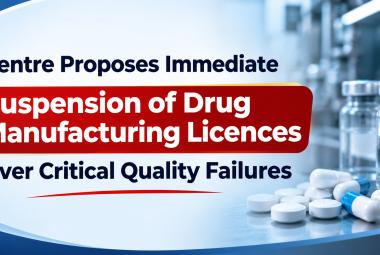

The Union Ministry of Health and Family Welfare has proposed immediate suspension of manufacturing licences for drugs found Not of Standard Quality (NSQ) on specified critical quality parameters. The proposed amendments to the Drugs Rules, 1945, aim to strengthen regulatory oversight, prevent the continued manufacture and distribution of substandard medicines, and ensure faster action to protect public health.
Under the proposed amendments, the Central Licensing Approving Authority or the concerned State Licensing Authority may immediately suspend the manufacturing licence of a drug upon receiving a Government Analyst's report declaring it NSQ due to deficiencies in Assay, Dissolution, Related Substances, Impurities or Sterility. These parameters are considered critical indicators of medicine quality and compliance with prescribed standards.
Under the existing provisions of the Drugs Rules, 1945, suspension or cancellation of a manufacturing licence generally follows a prescribed regulatory procedure, including the issuance of a show-cause notice. The Ministry noted that this process may create a time gap between the identification of a substandard medicine and regulatory action, during which the affected drug may continue to remain in circulation, potentially posing risks to patients.
To address this concern, the proposed changes seek to enable immediate regulatory intervention following the receipt of an adverse Government Analyst's report concerning the specified critical quality parameters. The move is intended to minimise patient exposure to substandard medicines and make regulatory action more effective and timely.
The draft amendments also establish mandatory conditions for revoking a suspension. Manufacturers will be required to conduct an effective Root Cause Analysis (RCA) to identify the reasons behind the quality failure and implement appropriate Corrective and Preventive Action (CAPA). The suspension will continue until the corrective measures have been implemented to the satisfaction of the concerned Licensing Authority.
The suspended licence will be restored only after the Licensing Authority verifies the implementation of the required corrective and preventive measures. This provision aims to ensure that manufacturers address the underlying causes of quality failures and introduce adequate safeguards to prevent similar incidents from recurring.
To improve regulatory coordination, the Ministry has also proposed consequential amendments to Form 13, which relates to the test report issued by the Government Analyst. Under the proposed mechanism, the report will be endorsed to the Drugs Controller General of India (DCGI), the concerned State or Union Territory Licensing Authority having jurisdiction over the manufacturing facility, and the manufacturer and marketer of the concerned drug.
The enhanced reporting mechanism is expected to facilitate timely communication of NSQ findings, enable coordinated action among regulatory authorities and strengthen accountability across the pharmaceutical manufacturing and marketing chain.
The proposed amendments follow deliberations at the 65th meeting of the Drugs Consultative Committee (DCC), held on December 20, 2024, and recommendations made during the 92nd meeting of the Drugs Technical Advisory Board (DTAB), held on April 24, 2025.
The initiative is expected to strengthen post-marketing regulatory surveillance, promote accountability among pharmaceutical manufacturers and marketers, and reinforce public confidence in the quality of medicines available in the country.
The Ministry has notified the draft amendments for public consultation and invited objections and suggestions from stakeholders and members of the public within 30 days from the date on which copies of the Gazette of India containing the draft rules are made available to the public.