
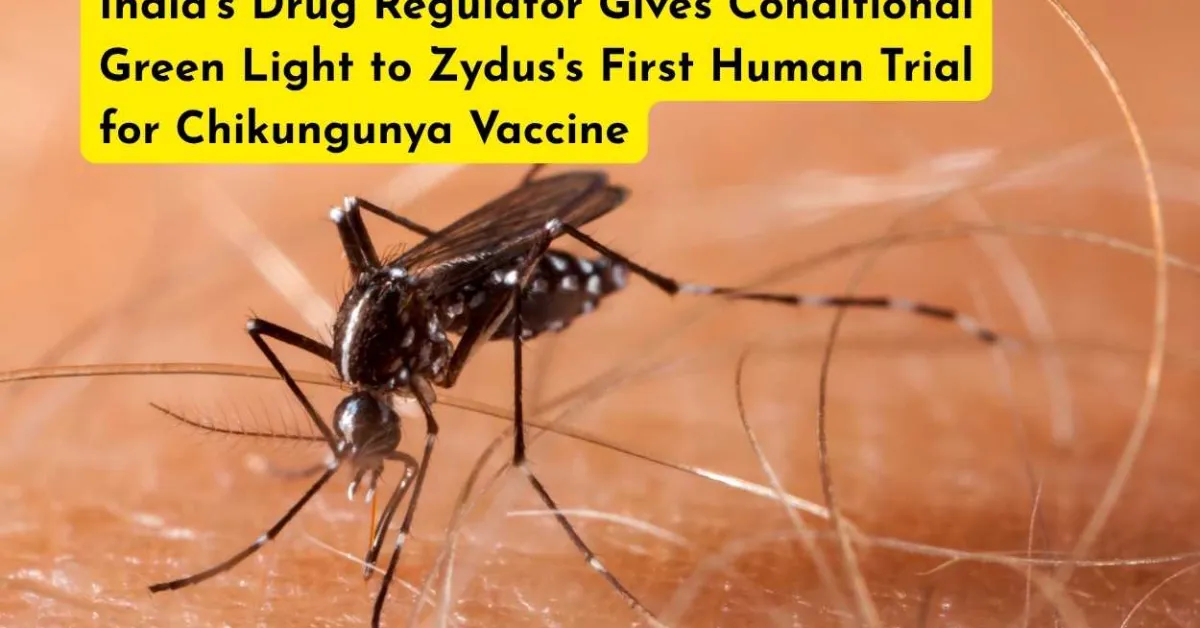
A key advisory body to India's top drug regulator has approved the first human trial of a homegrown chikungunya vaccine developed by Ahmedabad-based Zydus Lifesciences, but not without strings attached. The Subject Expert Committee (SEC) on Vaccines advised the Drugs Controller General of India (DCGI) to give the nod on Thursday after reviewing a revised protocol that the company had submitted following an earlier round of feedback in September last year.
The vaccine in question is an inactivated, Vero cell-based formulation derived from a parent virus seed (DEN-AFP-SV13-0030), designed to trigger immunity against the chikungunya virus which is a mosquito-borne pathogen that causes debilitating joint pain and fever, with no approved vaccine available in India.
The Phase I study will enroll healthy volunteers between 18 and 50 years of age. Participants will receive two doses, administered across three cohorts, a cautious step-up design common in early-stage vaccine research. Zydus had already completed a battery of pre-clinical work, including single-dose and repeated-dose toxicity studies in animals at doses six times higher than what is being proposed for humans.
Before the company can move ahead to Phase II where the vaccine would be tested in a much larger group, it must first report interim data to the CDSCO. That includes immunogenicity results up to 28 days after the second dose, safety data extending to 84 days post-vaccination, and a sign-off report from an independent Data Safety Monitoring Board (DSMB).
The SEC's approval is conditional, and the conditions are substantive. Before recruiting larger populations, Zydus must complete three additional studies: a lethal dose challenge test in an animal model or non-human primates to confirm what a protective human dose actually looks like; a developmental and reproductive toxicology (DART) study to assess any risks to fertility or developing fetuses; and additional immunogenicity data to nail down that protective dose.
The lethal challenge study is particularly notable. It is a demanding and expensive test and animals are deliberately exposed to a potentially fatal dose of the pathogen after vaccination, to see whether the vaccine actually prevents disease at the dose being studied in humans. That the panel is requiring it before Phase II suggests regulators want stronger biological proof-of-concept before the trial scales up.
Chikungunya remains a significant public health challenge in India, with outbreaks occurring cyclically and disproportionately affecting low-income communities where mosquito control is difficult. The absence of a licensed vaccine in the country has meant that treatment has always been limited to managing symptoms.
For Zydus, this is a meaningful regulatory milestone, the company's vaccine candidate has now formally entered human testing territory, even if the path to licensure involves clearing several more scientific hurdles first. The committee's thoroughness, while it adds to the timeline, also reflects a broader seriousness in India's regulatory framework about novel vaccine platforms. An inactivated whole-virus approach like this has not been commercially approved for chikungunya anywhere in the world.
The trial is registered as BIO/CT/25/000115 with the Central Drugs Standard Control Organisation (CDSCO). The hybrid-mode SEC meeting was held on March 19, 2026.