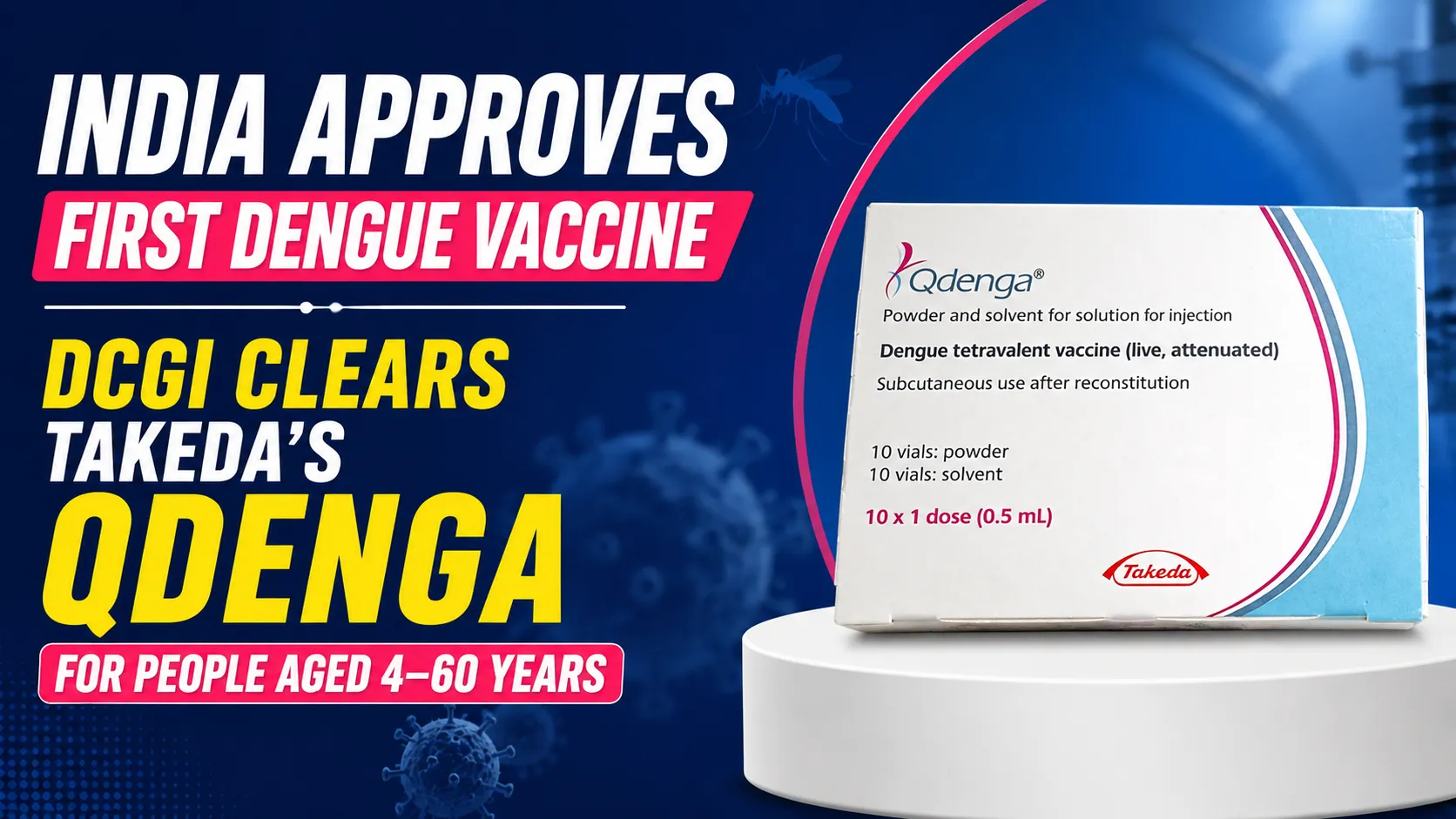
In a landmark development for dengue prevention, the Drug Controller General of India (DCGI) has granted market authorization to Takeda Biopharmaceuticals India's QDENGA (Dengue Tetravalent Vaccine [Live, Attenuated]), making it the first dengue vaccine approved in India. The vaccine is approved for the prevention of dengue in individuals 4 to 60 years of age and can be administered regardless of prior dengue infection, eliminating the need for pre-vaccination screening.
The approval comes at a time when dengue continues to pose a major public health challenge in India. According to Takeda, reported dengue cases in the country have increased significantly over the past two decades, while India accounts for nearly one-third of the global dengue burden. QDENGA is designed to provide protection against all four dengue virus serotypes and has been developed to reduce both dengue illness and dengue-related hospitalizations.
SEC Recommendation Based on Indian and Global Clinical Evidence
The approval follows a positive recommendation by the Subject Expert Committee (SEC) - Vaccines during its meeting held on 19 March 2026, where the committee reviewed Takeda's application seeking new drug permission for import along with the Phase III clinical study report conducted in India.
According to the SEC minutes, Takeda submitted results from an Indian Phase III randomized, double-blind, placebo-controlled study involving 480 healthy adults, adolescents, and children aged 4–60 years. The committee observed that the vaccine was well tolerated, safe, and immunogenic in the Indian population.
The committee also reviewed extensive international data, noting that:
• The vaccine had already been approved in 41 countries, including the European Union, the United Kingdom, Switzerland, Indonesia, Malaysia, and Thailand.
• WHO had prequalified the vaccine for use in eligible populations.
• Takeda presented efficacy results from the global pivotal DEN-301 Phase III trial, involving 20,099 participants across eight countries.
• More than 28,000 participants had been enrolled across multiple Phase I, II, and III clinical studies worldwide.
• Around 24.4 million doses had been distributed globally at the time of the SEC review, with post-marketing safety remaining consistent with clinical trial findings.
After reviewing the evidence, the SEC recommended granting permission for import of the vaccine for individuals aged 4-60 years, subject to the condition that Takeda conducts a post-marketing safety and effectiveness study in the Indian population within six months of the vaccine's commercial introduction.
Long-Term Protection Demonstrated
Takeda stated that QDENGA has demonstrated sustained protection against dengue in long-term follow-up studies. Clinical data showed 80.2% efficacy against virologically confirmed dengue one year after the second dose, while efficacy against dengue-related hospitalization reached 90.4% after 18 months. Unlike some earlier dengue vaccines, QDENGA does not require confirmation of previous dengue infection before vaccination.
Global Rollout Continues
Since its first launch in 2022, QDENGA has now been approved in 43 countries, with more than 32 million doses distributed worldwide, according to Takeda. The company has also partnered with Biological E to expand manufacturing capacity, supporting broader global access to the vaccine.
The approval represents a significant milestone in India's efforts to strengthen dengue prevention, although public health experts emphasize that vaccination should complement, rather than replace, mosquito control measures and other disease prevention strategies.