
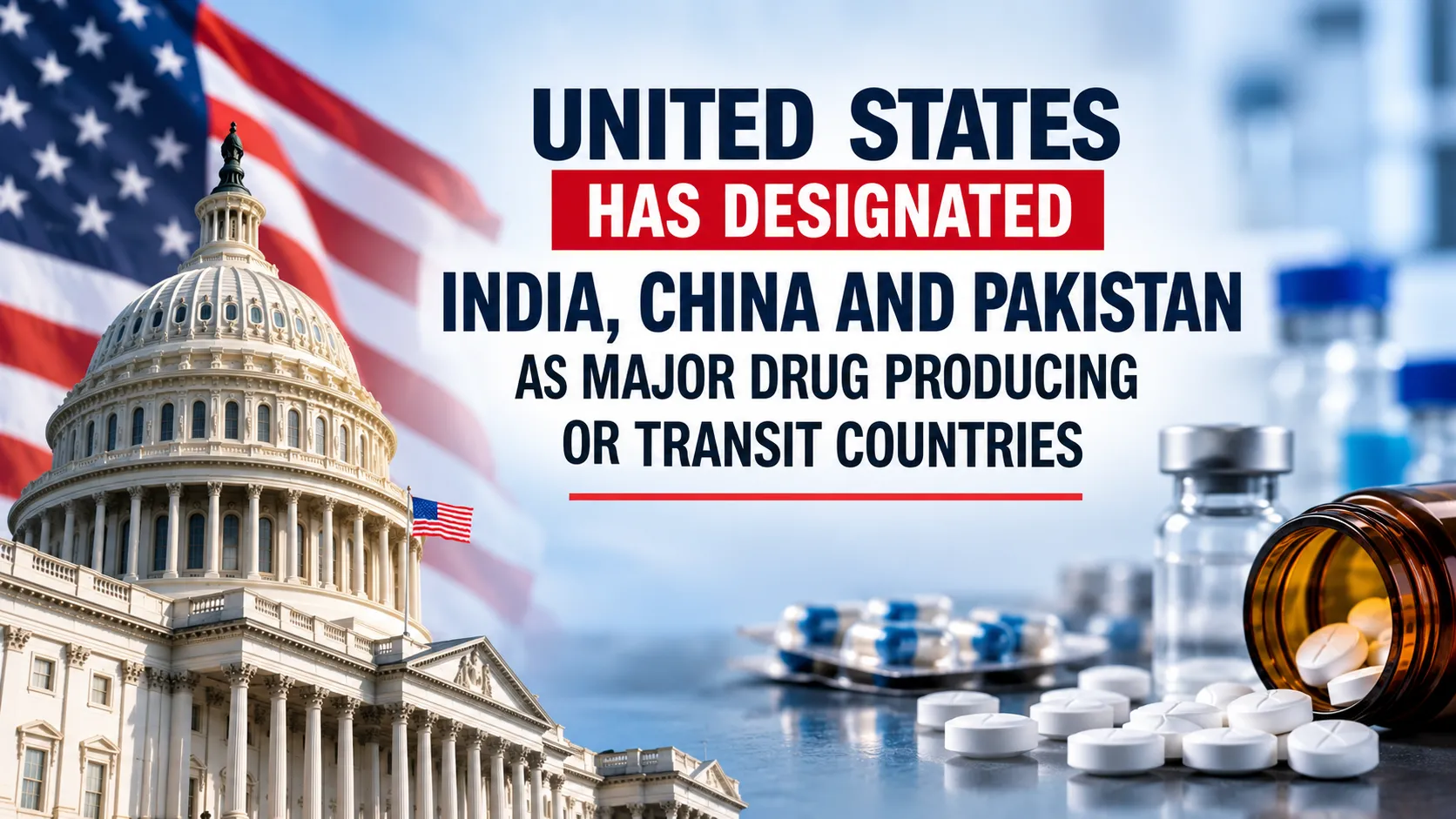
The United States has included India, China and Pakistan among 23 countries designated as major drug transit or major illicit drug-producing countries for fiscal year 2027. The designation was submitted to the U.S. Congress on September 15, 2026, as part of the annual U.S. “Major’s List,” which identifies countries considered significant sources or transit points for illicit drugs entering the United States.
According to the White House, the 2027 list includes Afghanistan, The Bahamas, Belize, Bolivia, Burma, China, Colombia, Costa Rica, the Dominican Republic, Ecuador, El Salvador, Guatemala, Haiti, Honduras, India, Jamaica, Laos, Mexico, Nicaragua, Pakistan, Panama, Peru and Venezuela. The U.S. government said the designation relates to countries associated with the production or transportation of illicit drugs and precursor chemicals.
The inclusion of India on the list does not mean that the United States has classified India's legitimate pharmaceutical industry as an illicit drug producer. The designation is part of the U.S. government's counternarcotics framework and concerns illicit drug production, trafficking and the movement or diversion of precursor chemicals. The White House has separately described India as a source and transit country in the context of its strategy to prevent illicit drugs and precursor chemicals from entering the United States.
Importantly, the U.S. designation also distinguishes between being included on the Major's List and failing to take adequate counternarcotics action. For 2027, the White House identified Afghanistan, Bolivia, Burma and Colombia as countries that had “failed demonstrably” during the previous 12 months to make substantial efforts to meet their international counternarcotics obligations. India, China and Pakistan were included on the broader Major's List but were not among those four countries identified under that separate finding.
The development is relevant to India's pharmaceutical and chemical sectors because the United States is placing increasing emphasis on controlling the diversion of legitimate chemicals, pharmaceutical ingredients and manufacturing capabilities into illicit drug supply chains. The U.S. National Drug Control Strategy has specifically called for stronger cooperation with source and transit countries, including India and China, involving shipping, chemical, pharmaceutical and logistics companies.
For Indian pharmaceutical companies, the designation therefore needs to be viewed primarily in the context of U.S. counternarcotics policy rather than as a finding against India's legitimate pharmaceutical manufacturing sector. India has a major role in the global supply of medicines and pharmaceutical ingredients, and increased U.S. scrutiny of precursor chemicals and supply chains could place greater emphasis on traceability, compliance, documentation and controls designed to prevent diversion.
The U.S. announcement comes at a time when Washington is also increasing its focus on international cooperation against synthetic drugs and precursor chemicals. The White House has highlighted fentanyl analogues and precursor-related trafficking as significant drug-control concerns, while its 2026 national strategy calls for stronger measures involving international supply chains and companies handling chemicals and pharmaceutical materials.
The 2027 designation is consequently expected to remain relevant for India-U.S. cooperation on illicit drug trafficking, precursor-chemical controls and pharmaceutical supply-chain security. For the legitimate Indian pharmaceutical industry, the key issue will be maintaining strong regulatory and supply-chain controls while continuing pharmaceutical trade and cooperation with the U.S. market.