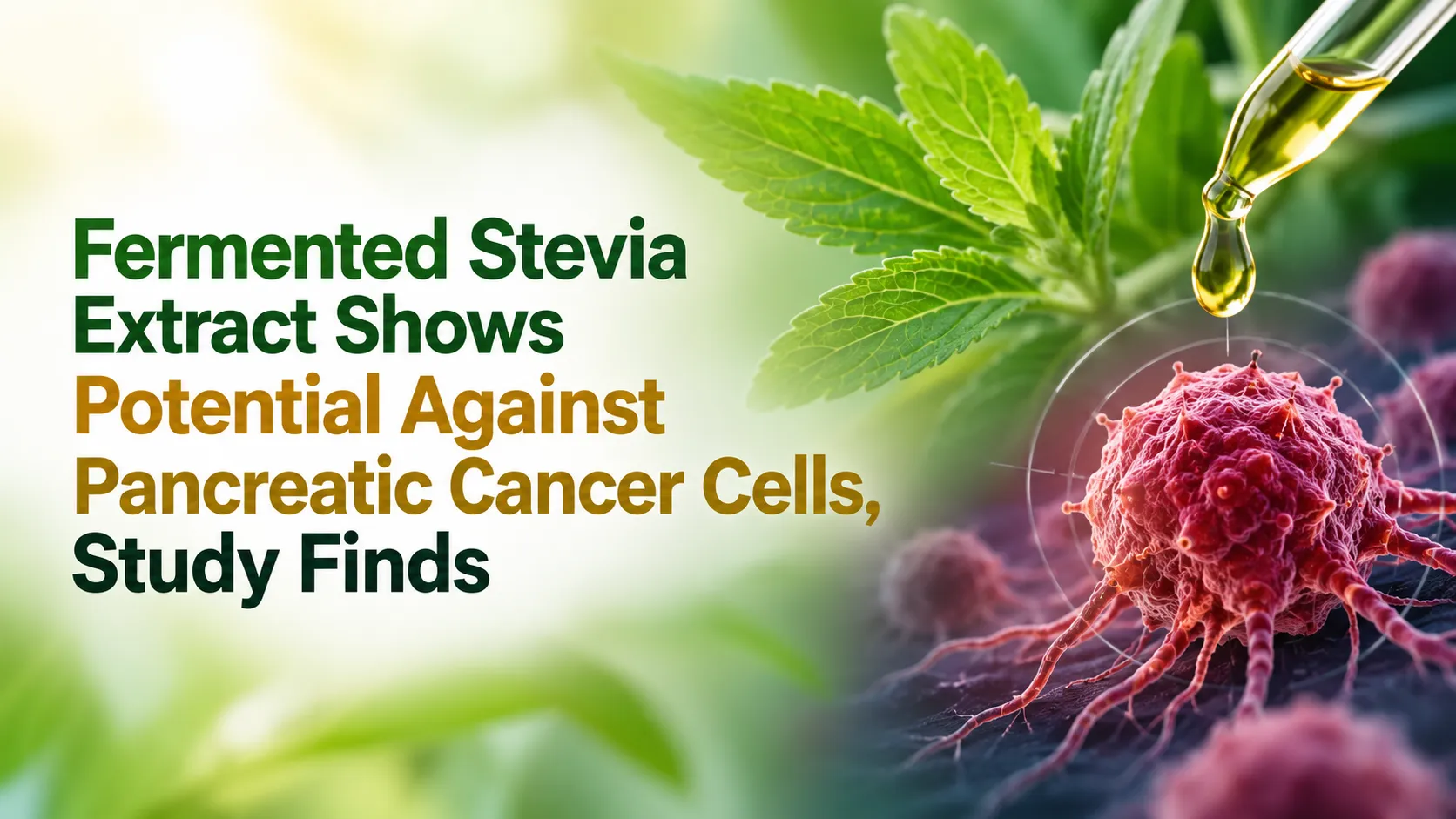
A research team from Hiroshima University has reported that stevia leaf extract fermented with the plant-derived bacterium Lactobacillus plantarum SN13T demonstrated enhanced anticancer activity against pancreatic cancer cells in laboratory experiments.
The study, published in the International Journal of Molecular Sciences, investigated whether fermentation could improve the biological activity of stevia leaf extract and identified chlorogenic acid methyl ester (CAME) as an important compound associated with the observed effects.
What Did the Researchers Investigate?
Pancreatic cancer is considered a particularly aggressive cancer, with limited treatment options and a tendency to be diagnosed at an advanced stage. The researchers therefore explored whether a plant-derived preparation could demonstrate activity against pancreatic cancer cells.
The study focused on stevia (Stevia rebaudiana Bertoni) leaf extract. Researchers fermented the extract using L. plantarum SN13T, a bacterial strain isolated from banana leaves.
The researchers then compared the biological activity of the fermented stevia leaf extract (FSLE) with that of the non-fermented stevia leaf extract (SLE).
Fermentation Increased Activity Against PANC-1 Cells
The experiments used PANC-1, a human pancreatic cancer cell line, along with HEK-293 cells as a non-cancerous comparison model.
According to the study, both stevia extracts reduced PANC-1 cell viability, but the fermented preparation demonstrated greater cytotoxic activity.
The reported 48-hour IC50 value was approximately 331.3 μg/mL for the unfermented stevia extract, compared with 271.2 μg/mL for the fermented extract.
The researchers also observed changes in cell morphology following treatment, including reduced cell numbers, weakened cell adhesion and increased cell rounding and shrinkage.
Importantly, the researchers reported that the fermented extract showed relatively limited toxicity toward HEK-293 cells compared with its effects on PANC-1 cells.
Fermentation Conditions Were Optimized
The research team evaluated different fermentation conditions, including temperature, fermentation duration and oxygen availability.
The study ultimately identified anaerobic fermentation at 37 °C for 72 hours as the optimal condition among the conditions tested for producing an extract with activity against PANC-1 cells.
This suggests that microbial fermentation may alter the chemical composition of a plant extract and potentially generate or increase compounds with biological activity.
Chlorogenic Acid Methyl Ester Identified as an Active Compound
One of the notable findings was the identification of chlorogenic acid methyl ester (CAME) in the fermented stevia extract.
The researchers reported a CAME concentration of approximately 374.4 μg/mL in the fermented extract. CAME was detected in the fermented preparation but not in the unfermented stevia extract, suggesting that fermentation may have contributed to its formation or enrichment.
The researchers used analytical techniques including HPLC separation and structural characterization using ¹H-NMR, ¹³C-NMR and ESI-MS to identify the compound.
CAME Affected Pancreatic Cancer Cell Growth and Migration
Further experiments examined the effect of CAME on PANC-1 cells. The researchers reported that CAME:
• inhibited PANC-1 cell proliferation;
• reduced colony-forming ability;
• inhibited cell migration;
• affected wound-healing behavior in cell-based assays;
• caused cell-cycle arrest;
• promoted apoptosis.
Flow cytometry experiments indicated that CAME increased the proportion of PANC-1 cells in the G0/G1 phase of the cell cycle and promoted apoptotic cell death.
Changes in Apoptosis-Related Genes
The study also investigated molecular changes associated with apoptosis.
Treatment with CAME was reported to increase expression of several genes associated with pro-apoptotic signaling, including:
Bax
Bad
Caspase-3
Caspase-9
Cytochrome c
E-cadherin
At the same time, the expression of the anti-apoptotic gene Bcl-2 was reduced. These findings suggest that CAME may influence mitochondrial-associated apoptotic pathways in PANC-1 cells.
Fermentation Also Improved Antioxidant Activity
The researchers did not examine only anticancer activity. They also assessed the antioxidant properties of fermented and unfermented stevia extracts.
The fermented extract showed enhanced activity in DPPH and ABTS radical-scavenging assays compared with the non-fermented extract.
An additional experiment using hydrogen peroxide-induced oxidative stress in HEK-293 cells also supported improved antioxidant activity following fermentation.
Why Is This Research Important?
The study highlights an interesting approach to natural-product research: using microbial fermentation to modify or enhance the biological properties of plant extracts.
Instead of studying the raw plant extract alone, the researchers used L. plantarum SN13T as a biological transformation system. The process appeared to change the chemical profile of the extract and was associated with increased activity against pancreatic cancer cells.
The researchers suggest that this approach could potentially help identify new bioactive compounds for future cancer research.
Does This Mean Stevia Can Treat Pancreatic Cancer?
No.
The findings should not be interpreted as evidence that eating stevia or consuming stevia products can treat pancreatic cancer. The primary study was conducted using cultured PANC-1 cancer cells, and laboratory activity does not establish that the same effect will occur in humans.
The concentration and preparation of CAME used in the experiments also cannot simply be equated with the amount of stevia consumed as a food or sweetener.
Further research, including appropriate animal studies, pharmacokinetic and safety investigations, and eventually well-designed human clinical trials, would be required before any therapeutic conclusions could be drawn.
Interestingly, subsequent research published in 2026 has investigated fermented stevia extract in a PANC-1 pancreatic tumor xenograft mouse model, extending the earlier cell-based work into an animal model.
Research Area and Finding
Plant investigated : Stevia rebaudiana
Microorganism used : Lactobacillus plantarum SN13T
Cancer model : PANC-1 pancreatic cancer cells
Comparison model : HEK-293 cells
Optimized fermentation : 37 °C, anaerobic, 72 hours
Important compound identified : Chlorogenic acid methyl ester (CAME)
Reported CAME concentration : 374.4 µg/mL
Cellular effects : Reduced proliferation and migration
Cell-cycle effect : G0/G1 arrest
Cell-death mechanism : Increased apoptosis
Molecular changes : Increased Bax, Bad, Caspase-3/9 and Cytochrome c; decreased Bcl-2
Conclusion
The Hiroshima University study provides laboratory evidence that fermentation of stevia leaf extract with Lactobacillus plantarum SN13T can enhance its biological activity against PANC-1 pancreatic cancer cells.
The identification of chlorogenic acid methyl ester as an active compound and its reported effects on cell proliferation, migration, cell-cycle progression and apoptosis provide potential directions for further investigation.
However, the findings remain preclinical. They demonstrate activity in experimental models and should not currently be interpreted as proof of an effective pancreatic cancer treatment in humans.
Research Source
Zhang R, Danshiitsoodol N, Noda M, Yonezawa S, Kanno K, Sugiyama M. Stevia Leaf Extract Fermented with Plant-Derived Lactobacillus plantarum SN13T Displays Anticancer Activity to Pancreatic Cancer PANC-1 Cell Line. International Journal of Molecular Sciences. 2025;26(9):4186. DOI: 10.3390/ijms26094186.