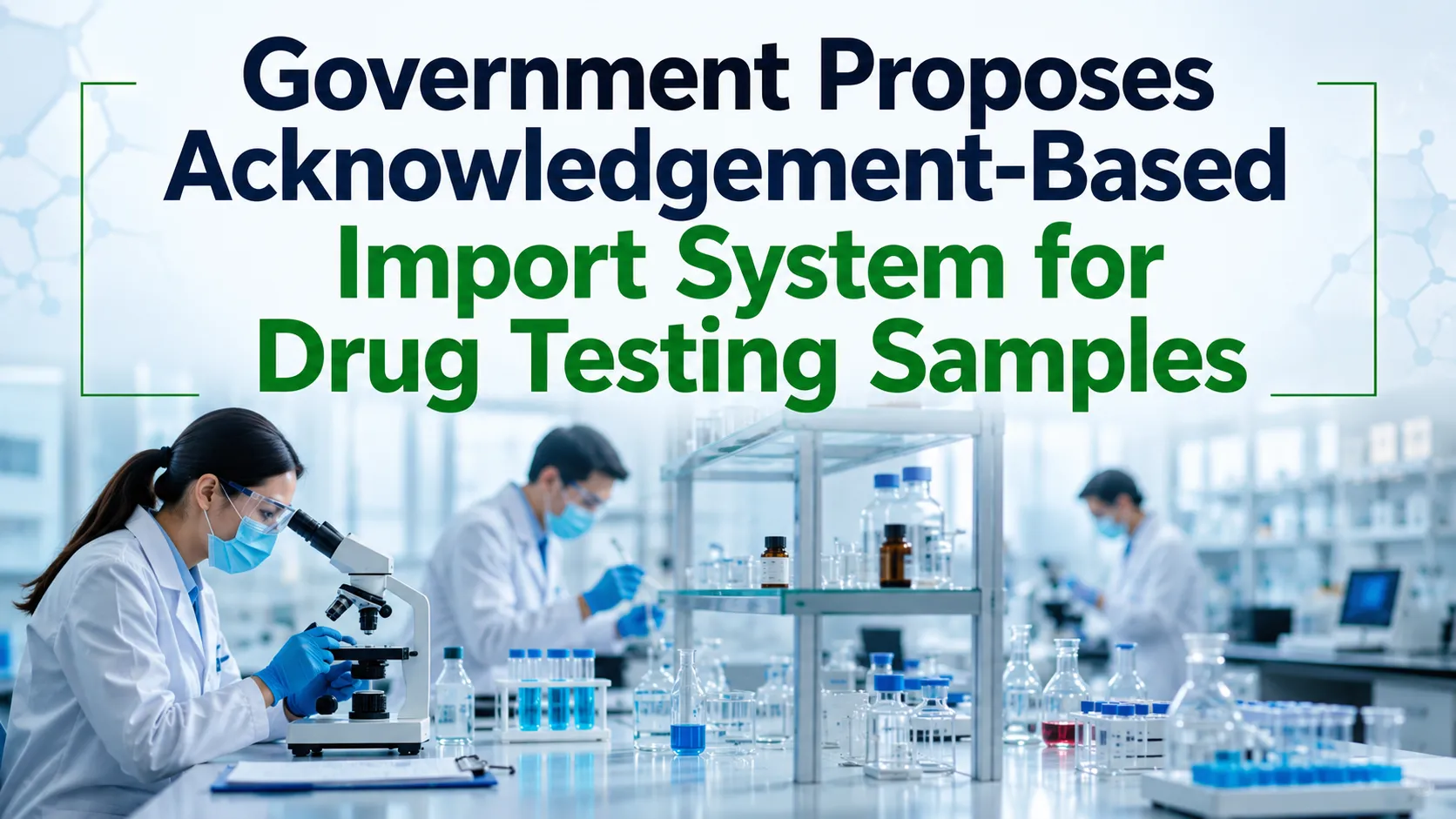
In a significant regulatory reform aimed at strengthening pharmaceutical research and improving ease of doing business, the Ministry of Health and Family Welfare has proposed amendments to the Drugs Rules, 1945 to simplify the import procedure for drugs intended for examination, testing and analysis.
The proposed amendment replaces the existing licensing requirement for importing small quantities of drugs for analytical and non-clinical testing with an acknowledgement-based online intimation system. The proposal has been released as a draft notification for public consultation.
At present, organizations importing small quantities of drugs for examination, laboratory testing or analysis are required to obtain prior permission under the existing Form 11 provisions of the Drugs Rules, 1945. Under the proposed amendment, applicants will only need to submit a prior online intimation. Once the acknowledgement is generated, the import of eligible drug samples can proceed without waiting for a separate licence or approval. This marks a shift from a permission-based regulatory framework to a notification-based system for eligible imports.
Which Imports Will Benefit?
The simplified procedure will apply to imports of small quantities of drugs intended exclusively for:
* Analytical testing
* Quality evaluation
* Laboratory examination
* Non-clinical research
* Research and development (R&D) activities
The amendment is expected to substantially reduce regulatory timelines for research organizations, pharmaceutical companies, academic institutions, contract research organizations (CROs), testing laboratories and biotechnology start-ups that regularly import reference materials or drug samples for analysis.
Categories Still Requiring Prior Licence
The acknowledgement-based mechanism will not apply to certain high-risk categories of drugs. These products will continue to require prior licensing before import:
* Reproductive hormones
* Cytotoxic drugs
* Beta-lactam drugs
* Biologics containing live microorganisms
* Narcotic drugs
* Psychotropic substances
These exclusions ensure that sensitive and high-risk products continue to remain under enhanced regulatory oversight.
Extension of Earlier Regulatory Reform
The proposal follows the amendments introduced to the New Drugs and Clinical Trials Rules, 2019 in January 2026, when the Government adopted a similar notification-based system for domestic test licences. With the present draft amendment, the same simplified regulatory approach is now proposed for imports of testing samples, creating greater consistency between domestic and imported materials used in research and development.
Expected Benefits
According to the Ministry, the proposed reform is expected to:
* Eliminate licensing requirements for eligible imports used in testing and R&D.
* Reduce compliance burden for applicants.
* Enable faster commencement of analytical and non-clinical studies.
* Accelerate pharmaceutical research and innovation.
* Support biotechnology start-ups and pharmaceutical industries.
* Improve regulatory efficiency through an online acknowledgement system.
* Promote ease of doing business in India's pharmaceutical sector.
The Ministry believes the simplified framework will create a seamless and instant digital gateway for stakeholders while encouraging innovation across the life sciences ecosystem.
The draft notification has been placed in the public domain for stakeholder consultation. Comments, objections and suggestions may be submitted to the Ministry of Health and Family Welfare before the notification is finalized.
The proposed amendment represents another step in the Government's ongoing efforts to modernize India's pharmaceutical regulatory framework by reducing unnecessary procedural barriers while maintaining regulatory safeguards for higher-risk drug categories.