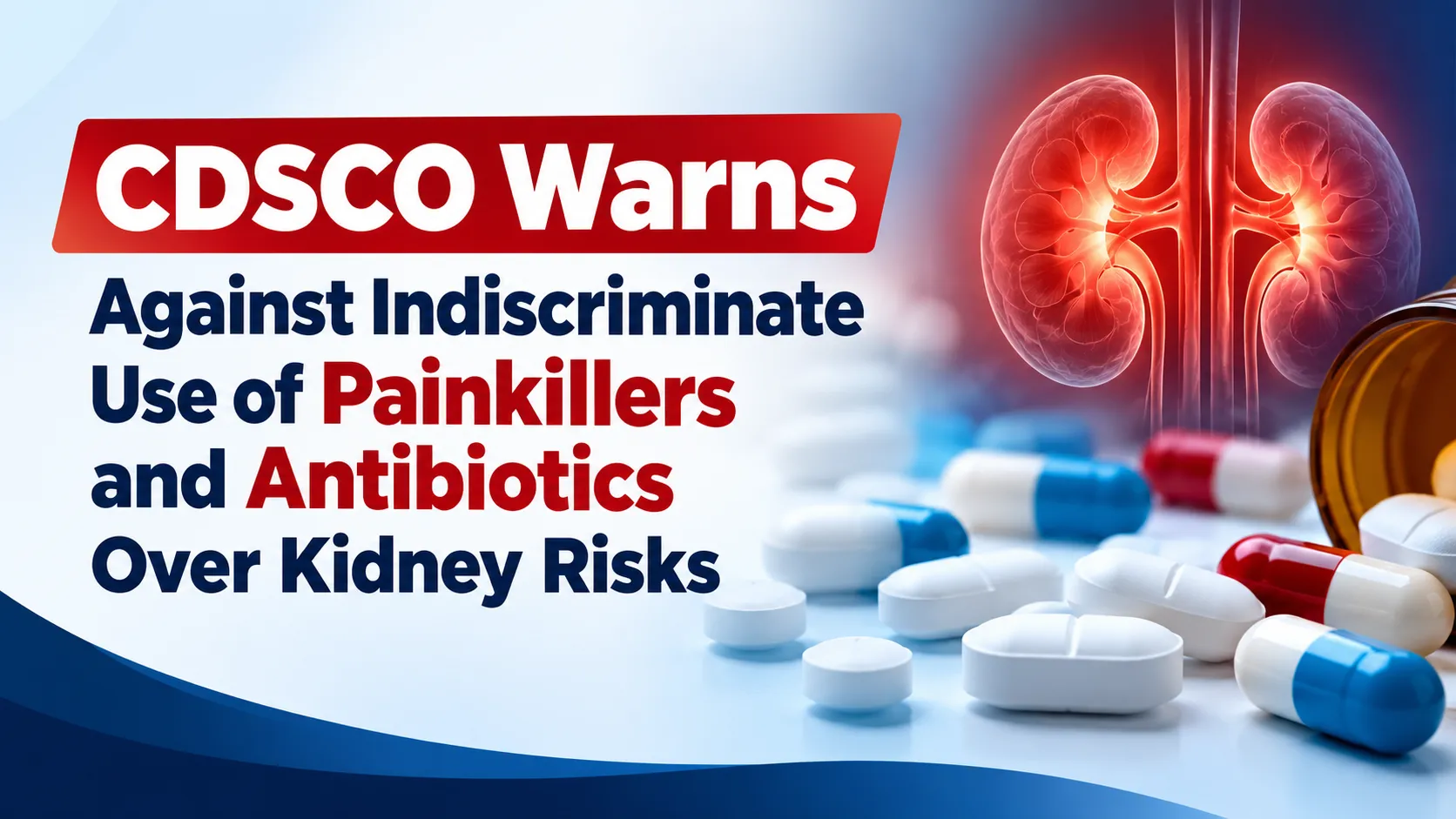
The Central Drugs Standard Control Organisation (CDSCO), under the Directorate General of Health Services, Government of India, has issued a circular advising against the indiscriminate use of non-steroidal anti-inflammatory drugs (NSAIDs), commonly used as painkillers, and antibiotics. The circular, dated September 21, 2026, highlights the associated risks, including renal complications and antimicrobial resistance.
The circular was issued by the New Drugs Division of CDSCO and is addressed to various stakeholders, including the general public, healthcare professionals, pharmacists, retailers, wholesalers, hospitals and healthcare institutions.
NSAIDs and Antibiotics Already Subject to Prescription Requirements
According to the circular, the import, manufacture, sale and distribution of drugs are regulated under the Drugs and Cosmetics Act, 1940 and the Drugs Rules, 1945.
CDSCO states that drugs including NSAIDs and antibiotics are required to be sold and distributed in accordance with applicable prescription requirements. Various drugs are placed under Schedules G, H, H1 and X based on their potential risks and require appropriate medical supervision. The circular specifically notes that most NSAIDs are included under Schedule H and should not be sold by retail without the prescription of a Registered Medical Practitioner.
Similarly, most antibiotic drugs are included under Schedule H1. Such medicines carry warnings stating that they are dangerous to take except in accordance with medical advice and should not be sold by retail without a prescription.
CDSCO Advises Against Self-Medication
CDSCO has advised that NSAIDs and antibiotics should be used only when clinically indicated, at the appropriate dose and for the appropriate duration, under the supervision of a Registered Medical Practitioner.
For the general public, the circular advises :
• NSAIDs/painkillers and antibiotics should not be taken indiscriminately, repeatedly or for prolonged periods without medical advice.
• Antibiotics should not be used for self-medication or for conditions where antibiotic treatment is not clinically indicated, including most uncomplicated viral infections.
• Antibiotics prescribed by healthcare professionals should be taken strictly as advised and should not be shared with others or used from leftover medicines.
• People with pre-existing kidney disease or other risk factors for renal impairment should inform their healthcare professional before using NSAIDs.
• Individuals are advised to seek medical advice when pain, fever or other symptoms persist or recur rather than repeatedly using painkillers or antibiotics on their own.
• Advice for Doctors and Other Healthcare Professionals
CDSCO has advised healthcare professionals to prescribe NSAIDs and antibiotics only when clinically indicated, after considering factors such as the patient's clinical condition, age, co-morbidities, concomitant medicines and relevant risk factors.
The circular also recommends considering the lowest effective dose for the shortest appropriate duration, particularly for NSAIDs in patients at increased risk of renal impairment.
Healthcare professionals have also been advised to take appropriate precautions in patients with renal impairment, dehydration, cardiovascular disease or other conditions that may increase the risks associated with NSAID use.
For antibiotics, the circular calls for judicious prescribing in accordance with antimicrobial stewardship principles, taking into account the likely causative organism, site and severity of infection and, where appropriate, microbiological investigations and local susceptibility patterns.
Unnecessary combination therapy, inappropriate antibiotic selection, incorrect dosing and unnecessarily prolonged antibiotic treatment should be avoided.
Instructions for Pharmacists, Retailers and Distributors
The CDSCO circular also specifically addresses pharmacists, retailers and distributors. It advises strict compliance with statutory requirements concerning the sale and distribution of Schedule H, H1 and other prescription drugs.
According to the circular :
• Schedule H/H1 drugs should not be sold at retail except in accordance with applicable provisions of the Drugs Rules, 1945.
• Pharmacists and retailers should not encourage or facilitate self-medication with antibiotics or prescription-only NSAIDs.
• Prescribed warnings and conditions of sale appearing on medicine labels should be duly observed.
• Hospitals Asked to Strengthen Rational Drug Use
Hospitals and healthcare institutions have been advised to strengthen systems for rational prescribing and monitoring of NSAIDs and antibiotics.
The circular also calls for promotion of antimicrobial stewardship, prescription review and appropriate patient counselling.
State and Union Territory Drug Control Authorities have been requested to create awareness among healthcare professionals, pharmacists, retailers and the general public regarding the risks associated with indiscriminate use of NSAIDs and antibiotics and to ensure compliance with applicable provisions of the Drugs and Cosmetics Act, 1940 and Drugs Rules, 1945.
Focus on Safe and Responsible Medicine Use
The circular concludes by advising all concerned stakeholders to take necessary steps to promote the rational, safe and responsible use of NSAIDs and antibiotics and to prevent avoidable adverse drug reactions, renal complications and antimicrobial resistance.
The document has been signed by Dr. Rajeev Singh Raghuvanshi, Drugs Controller General (India), and was issued by the CDSCO's New Drugs Division.