
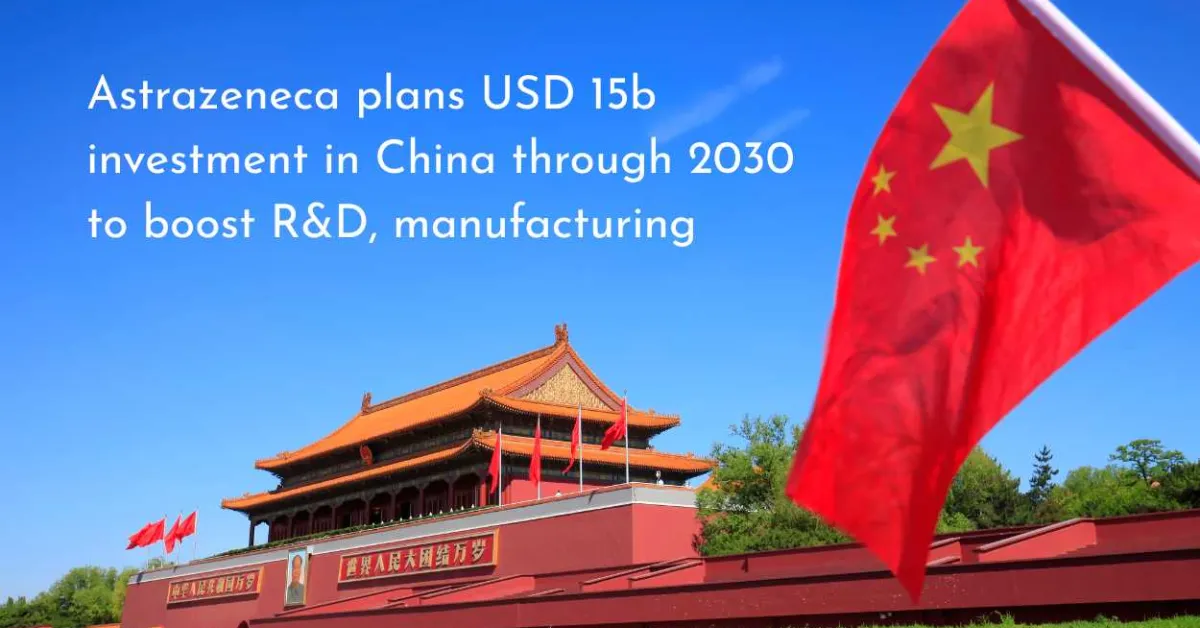
British pharmaceutical firm AstraZeneca PLC announced on Thursday it will commit usd 15 billion (about ₹1.2 lakh crore) to expand research, development and manufacturing operations in China through 2030, underscoring the country’s growing importance in global drug innovation and production.
The investment, detailed in a company press release, aims to bolster AstraZeneca’s capabilities across the entire drug value chain from discovery and clinical development to large-scale manufacturing, particularly in cell therapies and radioconjugates, two areas of rapid scientific advance.
“AstraZeneca’s landmark 15 billion USD investment begins an exciting next chapter in China,” said Chief Executive Pascal Soriot. “By expanding our capabilities in breakthrough treatments, we will strengthen our contribution to China’s high-quality development and bring next-generation modalities to patients.”
The initiative will build on AstraZeneca’s existing footprint in China — where the company operates multiple R&D centers in Beijing and Shanghai and manufacturing sites in Wuxi, Taizhou, Qingdao and Beijing that supply medicines domestically and to about 70 global markets.
As part of the plan, AstraZeneca expects to expand its workforce in China to over 20,000 employees, creating thousands of jobs in the wider healthcare ecosystem. The company said it will deepen collaborations with local biotechnology firms, including partnerships with AbelZeta, CSPC, Harbour BioMed, Jacobio and Syneron Bio, building on its 2024 acquisition of Chinese cell-therapy specialist Gracell Biotechnologies.
The announcement coincided with a state visit to Beijing by UK Prime Minister Keir Starmer, who described the deal as a driver of economic growth and a model for UK-China cooperation. AstraZeneca’s expansion in China comes amid broader geopolitical maneuvering, as Western companies balance investment in China against supply chain risks and shifting diplomatic ties.
China has become AstraZeneca’s second-largest market since the company entered the country in 1993, with more than 40 innovative medicines approved locally and collaborations with hundreds of clinical hospitals. The company said its efforts align with China’s Healthy China 2030 strategy to improve healthcare access and early detection of disease.
Analysts say AstraZeneca’s move reflects a broader trend of global pharmaceutical companies deepening their presence in China’s rapidly evolving biotech sector, even as some peers reduce exposure amid geopolitical uncertainty and competitive pressures.
The scale of the investment also highlights China’s rising role as not just a market for established therapies but as a scientific and manufacturing hub for next-generation treatments — a shift that could have long-term implications for global drug development and commercial strategies.