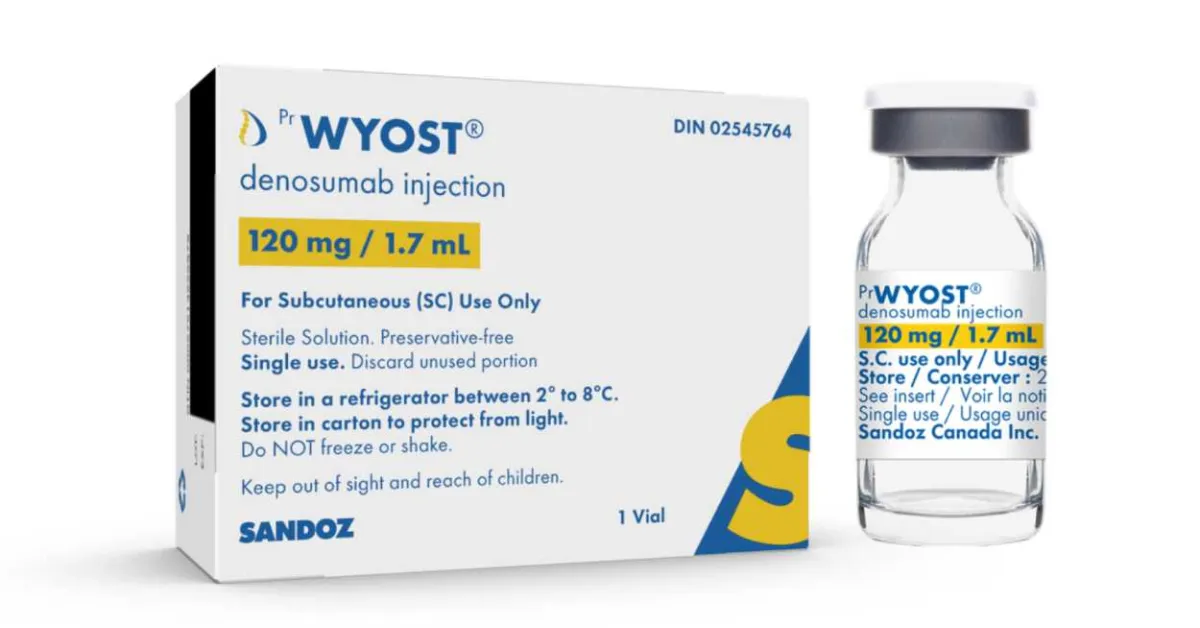
Sandoz the global leader in affordable medicines, today announced the European launch of Wyost® (denosumab 120 mg) and Jubbonti® (denosumab 60 mg). The medicines are among the first denosumab biosimilars to launch in Europe and are approved by the European Commission to treat all indications of the reference medicines, Xgeva®* (denosumab 120 mg) and Prolia®* (denosumab 60 mg). Wyost® is approved for the treatment of cancer-related bone disease and Jubbonti® is approved to treat osteoporosis.
Wyost® and Jubbonti® represent key value drivers for Sandoz and the European launch marks the next major step in advancing the company’s growth strategy. It builds on other key biosimilar launches this year including Wyost® and Jubbonti® in the US and the recent launches of Tyruko® (natalizumab) in the US and Afqlir® (aflibercept) in Europe.
Christophe Delenta, President Europe, Sandoz, said: “We know that primary and secondary bone loss, and cancer-related bone events, place a significant burden on millions of patients and their families, as well as on European healthcare systems. That’s why the launch of these denosumab biosimilars is such an important milestone, expanding access to these potentially life-changing medicines and reinforcing our commitment to delivering sustainable treatment options for patients.”
Close to one quarter (4.14 million)3 of all newly reported cancer cases globally occur in Europe and cancer remains a leading cause of premature death for people aged 30-69 years in most European countries4. Nearly all types of cancer can spread to the bone and cause pain and fractures, but cancers that often metastasize there include breast, lung and prostate.
According to the latest figures, 32 million people in Europe over 50 years old are estimated to live with osteoporosis, with the number of fractures per year set to increase by almost 25% by 20346. Only a minority of patients at high risk currently receive treatment, even after their first fracture.
Wyost® and Jubbonti® will be launched across Europe today, with additional rollouts to follow throughout 2026. This launch builds on the continuing Sandoz leadership and pioneering legacy in biosimilars, dating back to the introduction of the first biosimilar in 2006. It further expands the company’s presence in a global reference-medicine market worth a combined ~USD 6.6 billion8 and reinforces its established position in oncology and immunology.
Sandoz is committed to helping millions of patients access critical and potentially life-changing biologic medicines sustainably and affordably, with a leading global portfolio comprising 13 biosimilars and a further 27 assets in various stages of development.
*Xgeva® and Prolia® are registered trademarks of Amgen Inc.
ABOUT WYOST® (DENONSUMAB) AND JUBBONTI® (DENOSUMAB)
Wyost® (denosumab 120 mg) and Jubbonti® (denosumab 60 mg) have been developed as biosimilars to the reference medicines Xgeva and Prolia, respectively. Both medicines contain the same active ingredient (denosumab), a human monoclonal antibody (IgG2) that targets and binds with high affinity and specificity to RANKL, preventing activation of its receptor, RANK, on the surface of osteoclast precursors and osteoclasts. Prevention of the RANKL/RANK interaction inhibits osteoclast formation, function and survival, thereby decreasing bone resorption in cortical and trabecular bone.
Wyost® is indicated in Europe to prevent skeletal related events (SREs; pathological fracture, radiation to bone, spinal cord compression or surgery to bone) in adults with advanced malignancies involving bone, and to treat adults and skeletally mature adolescents with a giant cell tumor of bone that is unresectable or where surgical resection is likely to result in severe morbidity.
Jubbonti® is indicated in Europe to treat osteoporosis in postmenopausal women and in men at increased risk of fractures, bone loss associated with hormone ablation in men with prostate cancer at increased risk of fractures and bone loss associated with long-term systemic glucocorticoid therapy in adult patients at increased risk of fracture.