
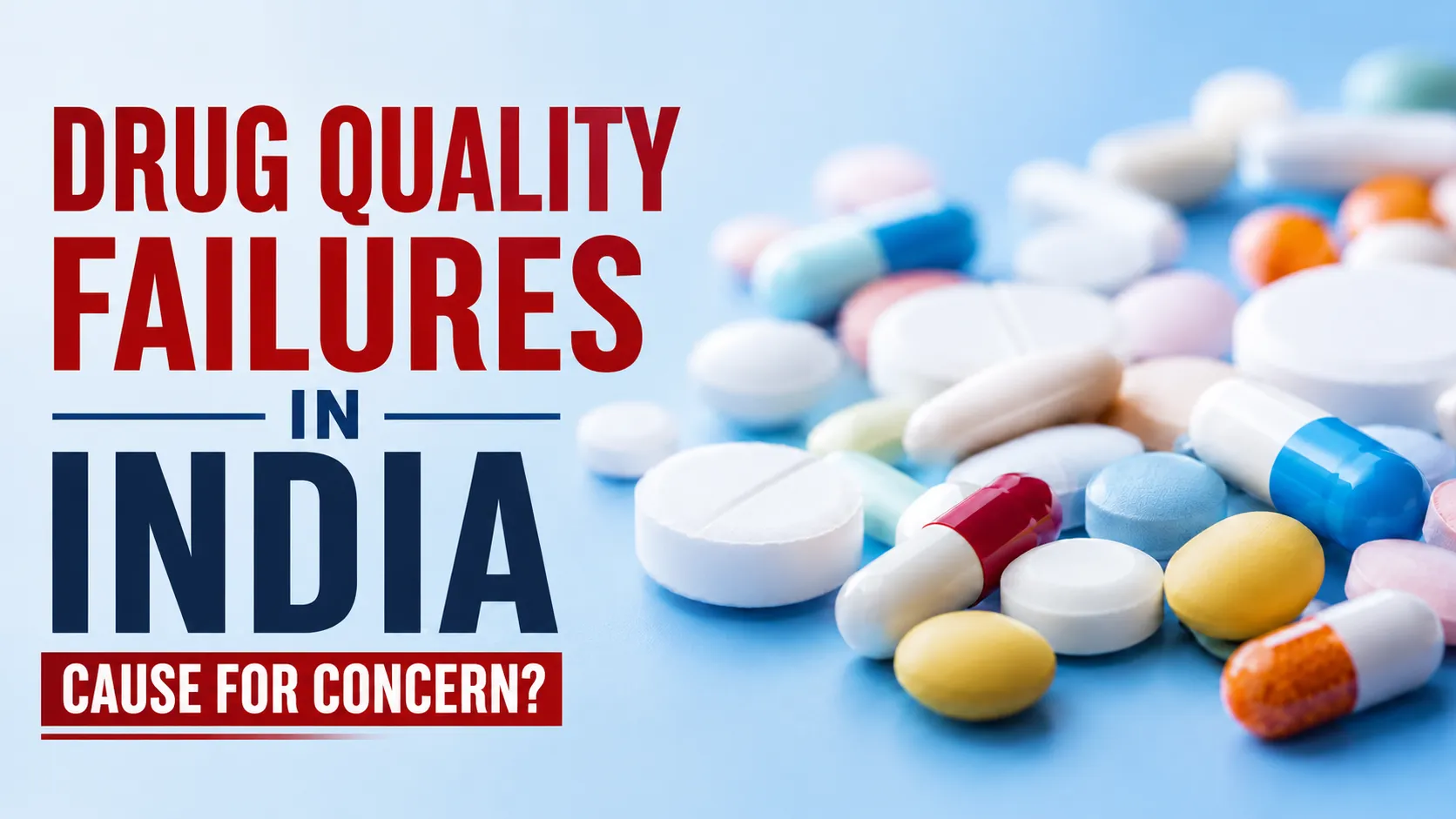
The question that hit our mind is, why are so many drug samples failing quality tests in india? Is it normal or does the pharmaceutical industry need to improve?
The recent release of the Central Drugs Standard Control Organisation (CDSCO) drug quality alert for May 2026 has once again sparked debate within the pharmaceutical sector. The report identified 157 drug samples as Not of Standard Quality (NSQ) and 2 samples as Spurious, involving products ranging from antibiotics and anti-diabetic medicines to cardiovascular drugs, cough syrups, injections, medical devices, and cosmetics.
Names of several pharmaceutical manufacturers, including both well-known and lesser-known companies, appeared in the report. The failed products were found to have issues related to dissolution, assay, sterility, microbial contamination, particulate matter, related substances, disintegration, description, and labeling requirements.
As these reports become a regular feature of India's pharmaceutical landscape, an important question emerges:
Are these failures a sign of a deeper quality crisis, or are they simply the result of an effective regulatory surveillance system doing its job?
The answer lies somewhere in between.
Understanding the Scale of India's Pharmaceutical Industry
India is often called the "Pharmacy of the World" for good reason. The country supplies approximately 20% of the world's generic medicines and exports pharmaceutical products to more than 200 countries.
Every year, Indian pharmaceutical companies manufacture billions of tablets, capsules, injections, syrups, ointments, and medical devices. Thousands of manufacturing facilities operate across the country, producing products for domestic and international markets.
When viewed against this enormous scale, the identification of 157 failed samples does not necessarily indicate a nationwide quality collapse. In fact, every major pharmaceutical market including the United States, Europe, Japan, and Australia routinely reports quality defects, recalls, warning letters, and manufacturing deviations.
The real question is not whether failures occur. The real question is:
Why are they occurring repeatedly, and what can be done to reduce them?
What Exactly Does "Not of Standard Quality" Mean?
Many people assume that a failed sample means a drug is fake or dangerous. That is not always the case. A product is classified as Not of Standard Quality (NSQ) when it fails one or more prescribed quality parameters established by pharmacopeial standards or manufacturer specifications.
These failures may involve :
• Dissolution
• Assay
• Sterility
• Related substances
• Identification
• Microbial contamination
• Disintegration
• Description
• Uniformity of content
• Appearance and clarity
Some failures may have minimal clinical impact, while others can directly affect patient safety and treatment outcomes. For example, a medicine that fails dissolution testing may contain the correct amount of drug but release it too slowly or too quickly in the body, resulting in reduced therapeutic effectiveness.
Why Are Dissolution Failures So Common?
One of the most striking observations in recent CDSCO reports is the frequency of dissolution-related failures. In the May 2026 report alone, dissolution failures were observed in several products including:
• Amoxycillin and Potassium Clavulanate Tablets
• Cefixime Tablets
• Itraconazole Capsules
• Omeprazole Capsules
• Telmisartan Tablets
• Thyroxine Tablets
• Lamotrigine Tablets
• Various anti-diabetic medicines
Dissolution testing evaluates how effectively a drug is released from its dosage form after administration. In simple terms, the test answers an important question:
Will the patient actually receive the medicine at the intended rate after taking it?
Several factors can influence dissolution performance :
- Raw Material Variability
Different API suppliers may provide materials with varying particle sizes, crystal structures, moisture content, and physical properties. Even small variations can significantly impact dissolution behavior.
- Formulation Challenges
Modern medicines often contain multiple active ingredients and complex release mechanisms. Developing robust formulations requires extensive research, optimization, and stability testing.
- Manufacturing Variations
Changes in compression force, granulation parameters, drying temperatures, blending times, or coating thickness can affect how a tablet dissolves.
- Storage Conditions
India's climatic conditions present unique challenges. High temperatures and humidity can gradually alter product characteristics during transportation and storage.
- Cost Pressures
In highly competitive generic markets, manufacturers often face intense pricing pressure. While cost efficiency is important, excessive cost-cutting can affect process controls, formulation development, and quality monitoring programs. The recurring appearance of dissolution failures suggests that manufacturers need to focus on lifecycle product quality rather than simply meeting release specifications at the time of manufacture.
Pressure on Small and Mid-Sized Manufacturers
India's pharmaceutical ecosystem includes thousands of manufacturing facilities. Many are world-class operations that successfully meet stringent international regulatory requirements. However, small and medium-sized manufacturers often face challenges that larger companies are better equipped to manage.
- Infrastructure Investments
Modern pharmaceutical manufacturing requires:
* Advanced production equipment
* Sophisticated analytical instruments
* Environmental monitoring systems
* Electronic quality management systems
* Validation programs
Maintaining and upgrading these systems requires substantial financial investment.
- Talent Shortages
Quality Assurance, Quality Control, Production, Validation, and Regulatory Affairs professionals remain in high demand across the industry. Frequent employee turnover can affect operational consistency and knowledge retention.
- Contract Manufacturing Complexity
Many pharmaceutical brands outsource manufacturing to third-party facilities. While contract manufacturing is common globally, inadequate oversight can increase the risk of quality deviations.
- Increasing Regulatory Expectations
Manufacturers today must simultaneously satisfy :
* CDSCO requirements
* WHO-GMP standards
* Export market regulations
* International inspection expectations
Keeping pace with evolving regulatory expectations requires continuous investment. Importantly, quality failures are not limited to small manufacturers. Recent CDSCO reports have included products manufactured by established companies as well, demonstrating that quality challenges can affect organizations of any size.
Is India's Regulatory System Working?
Whenever NSQ reports are published, public concern is understandable. However, the existence of these reports may actually indicate that India's regulatory surveillance system is functioning.
- Active Sample Collection
Thousands of products are tested every year across Central and State laboratories. Drug inspectors routinely collect samples from:
* Retail pharmacies
* Hospitals
* Distributors
* Manufacturing sites
- Increased Transparency
India publicly discloses NSQ and spurious drug findings on a monthly basis. This level of transparency allows healthcare professionals, hospitals, pharmacists, and distributors to take appropriate action.
- Expanded Testing Infrastructure
The network of Central and State Drug Testing Laboratories has expanded significantly over the years, improving surveillance capabilities.
- Increased Regulatory Scrutiny
Following international concerns regarding pharmaceutical quality, Indian regulators have intensified inspections and compliance monitoring activities.
However, challenges remain :
* Variability in state-level enforcement
* Limited regulatory manpower
* Delays in legal proceedings
* Need for greater digital integration of surveillance data
The key challenge is ensuring that surveillance findings lead to meaningful corrective and preventive actions rather than simply becoming monthly statistics.
The Bigger Concern : Repeat Categories of Failure
Perhaps the most important finding is not the number of failed samples but the repeated appearance of specific therapeutic categories.
Antibiotics
Several batches of Amoxycillin-Clavulanate, Cefixime, Ceftriaxone, and other antibiotics continue to appear in NSQ reports.
Poor-quality antibiotics can contribute to :
* Treatment failure
* Prolonged illness
* Increased healthcare costs
* Antimicrobial resistance
Anti-Diabetic Medicines
Products containing Metformin, Glimepiride, Voglibose, and Teneligliptin frequently appear in quality alerts. Considering India's status as the diabetes capital of the world, maintaining consistent quality in these medicines is essential.
Cardiovascular Medicines
Products containing Telmisartan, Rosuvastatin, Amlodipine, and other cardiovascular agents continue to appear in surveillance reports. These medicines are often taken daily for years, making consistency particularly important.
Thyroid Medicines
Thyroxine products require extremely precise dosing. Even minor quality variations can significantly affect patient outcomes.
Respiratory Medicines
Multiple cough syrups and respiratory formulations have failed assay tests for active ingredients such as Ambroxol, Menthol, Dextromethorphan, and Phenylephrine.
The repeated occurrence of failures within the same therapeutic categories suggests that regulators and industry stakeholders should investigate whether common formulation or manufacturing challenges are contributing to these trends.
The Spurious Drug Problem
While NSQ products receive significant attention, the identification of spurious drugs may represent an even greater concern. A spurious drug is fundamentally different from an NSQ product. NSQ products generally originate from legitimate manufacturing processes but fail quality standards. Spurious drugs involve intentional misrepresentation, counterfeit activity, or unauthorized use of product identities.
The presence of spurious medicines threatens :
* Patient safety
* Public trust
* Brand reputation
* Supply chain integrity
Strong enforcement actions and rapid investigations remain critical to addressing this issue.
What Should the Industry Do?
Reducing NSQ findings requires a shift from reactive quality control to proactive quality management.
Build Quality into Product Development
Quality by Design (QbD) approaches can help manufacturers understand critical formulation and process variables before products reach commercial production.
Strengthen Process Validation
Manufacturing processes should be continuously monitored to ensure consistent product performance throughout the product lifecycle.
Improve Supplier Qualification
Raw material variability remains a major source of quality issues.
Robust supplier audits and material characterization programs can help reduce risk.
Expand Stability Monitoring
Products should be evaluated under real-world storage conditions that reflect India's climate and distribution network.
Invest in Digital Quality Systems
Advanced analytics, electronic batch records, and predictive quality tools can help identify problems before they reach the market.
Foster a Culture of Quality
True quality excellence cannot be achieved through compliance alone.
It requires organizational commitment from senior leadership to shop-floor operators.
What Do These Findings Tell Us?
The latest CDSCO report identifying 157 Not of Standard Quality (NSQ) drug samples and 2 spurious drugs should be viewed as more than a routine regulatory update. These findings offer important insights into the current state of pharmaceutical quality management in India and highlight areas where continuous improvement is still needed. While the number of failed samples may appear concerning, it is important to recognize that India manufactures billions of dosage units annually and remains one of the world's largest suppliers of generic medicines. Therefore, the existence of NSQ products does not necessarily indicate a widespread quality crisis. Rather, it reflects the challenges of maintaining consistent quality across a vast and highly complex pharmaceutical ecosystem.
One of the most significant observations from recent NSQ reports is the recurring occurrence of dissolution and assay failures. Scientific literature suggests that these are among the most critical and technically challenging quality attributes to control. According to Yu et al. (August 2014), implementation of Quality by Design (QbD) principles helps manufacturers better understand the relationship between formulation variables, manufacturing processes, and product performance, thereby reducing variability and improving product consistency. The continued appearance of dissolution failures in antibiotics, anti-diabetic medicines, cardiovascular drugs, and gastrointestinal products suggests that formulation robustness and process control remain areas requiring ongoing attention across parts of the industry.
The findings also raise important questions regarding the quality of medicines used in the treatment of chronic diseases. Products containing Metformin, Glimepiride, Telmisartan, Rosuvastatin, Amlodipine, and Thyroxine have repeatedly appeared in surveillance reports over recent years. Unlike short-term therapies, these medicines are often taken daily for months or years. Even minor deviations in dissolution, potency, or content uniformity may affect therapeutic outcomes, particularly in patients who depend on long-term treatment for diabetes, hypertension, cardiovascular disorders, or thyroid diseases.
Another notable observation is the repeated presence of antibiotic products among failed samples. Antibiotics such as Amoxycillin-Clavulanate, Cefixime, and Ceftriaxone continue to appear in quality alerts. This trend deserves careful attention because poor-quality antimicrobial medicines have implications beyond individual treatment outcomes. Nayyar et al. (March 2012) highlighted that substandard anti-infective medicines can contribute to treatment failure and may potentially support the emergence of antimicrobial resistance when therapeutic drug concentrations are not consistently achieved. While an individual NSQ finding does not automatically result in resistance, maintaining high-quality standards for antibiotics remains a critical public health priority.
The findings further illustrate the growing complexity of pharmaceutical manufacturing and supply chains. Modern pharmaceutical products rely on numerous raw materials, excipients, packaging components, and outsourced manufacturing activities. Variability at any stage from raw material procurement to storage and distribution, can influence final product quality. India's climatic conditions, characterized by high temperatures and humidity in many regions, add further challenges to maintaining stability throughout a product's shelf life. Consequently, manufacturers must increasingly focus on supplier qualification, change control, stability monitoring, and risk-based quality management practices.
At the same time, the publication of these findings should not be interpreted solely as evidence of industry shortcomings. The ability of CDSCO and State Drug Regulatory Authorities to identify and publicly report quality defects demonstrates that surveillance systems are functioning. The World Health Organization (November 2017) estimated that approximately 10% of medical products in low- and middle-income countries may be substandard or falsified. Against this global backdrop, India's monthly NSQ reporting reflects a commitment to transparency and post-marketing surveillance. In many respects, identifying quality defects is a sign that regulatory monitoring systems are actively working rather than failing.
However, surveillance alone cannot improve pharmaceutical quality. The true value of NSQ reporting lies in how effectively manufacturers and regulators respond to the findings. Each failed sample represents an opportunity to conduct root-cause investigations, strengthen corrective and preventive actions (CAPA), improve manufacturing controls, and enhance quality systems. If similar deficiencies continue to appear repeatedly, it suggests that the industry must move beyond compliance-based approaches and embrace a culture of continuous quality improvement.
The broader message emerging from these findings is not that India's pharmaceutical industry is facing a quality crisis, but that quality excellence remains an ongoing journey. As Ozawa et al. (March 2018) noted, substandard medicines continue to impose a significant public health and economic burden in many countries. For India, maintaining its position as a global pharmaceutical leader will depend not only on production capacity and affordability but also on the ability to consistently deliver medicines that meet the highest standards of quality, safety, and efficacy. The latest CDSCO report therefore serves as both a reminder of existing challenges and an opportunity for the industry to strengthen quality systems, improve patient confidence, and further enhance its global reputation.
References
• Ozawa S, Evans DR, Bessias S, Haynie DG, Yemeke TT, Laing SK, et al. Prevalence and estimated economic burden of substandard and falsified medicines in low- and middle-income countries: A systematic review and meta-analysis. JAMA Network Open. 2018 Mar 2;1(4):e181662. doi:10.1001/jamanetworkopen.2018.1662.
• World Health Organization. A study on the public health and socioeconomic impact of substandard and falsified medical products. Geneva: World Health Organization; 2017 Nov. Available from: https://www.who.int/publications/i/item/9789241513432
• Nayyar GML, Breman JG, Newton PN, Herrington J. Poor-quality antimalarial drugs in Southeast Asia and sub-Saharan Africa. Lancet Infectious Diseases. 2012 Jun;12(6):488-496. doi:10.1016/S1473-3099(12)70064-6.
• Yu LX, Amidon G, Khan MA, Hoag SW, Polli J, Raju GK, et al. Understanding pharmaceutical quality by design. The AAPS Journal. 2014 Jul;16(4):771-783. doi:10.1208/s12248-014-9598-3.
• International Council for Harmonisation (ICH). ICH Q9(R1): Quality Risk Management. Geneva: ICH; 2023. Available from: https://www.ich.org/page/quality-guidelines
• International Council for Harmonisation (ICH). ICH Q10: Pharmaceutical Quality System. Geneva: ICH; 2008. Available from: https://www.ich.org/page/quality-guidelines
• World Health Organization. WHO Technical Report Series No. 986, Annex 2: WHO Good Manufacturing Practices for Pharmaceutical Products. Geneva: World Health Organization; 2014.
• Quality by Design for ANDAs: An Example for Immediate-Release Dosage Forms. Silver Spring, MD: FDA; 2012. Available from: https://www.pharmaexcipients.com/wp-content/uploads/2023/03/Quality-by-Design-for-ANDAs.pdf