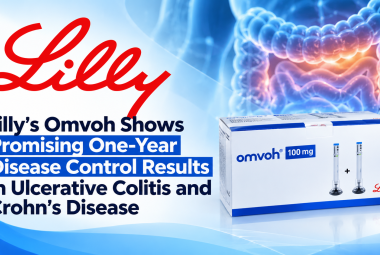

Eli Lilly and Company has announced new analyses of clinical trial data showing that its drug Omvoh (mirikizumab-mrkz) helped some patients with moderately to severely active ulcerative colitis and Crohn’s disease achieve multiple treatment goals simultaneously at one year.
The findings come from post-hoc analyses of the Phase 3 LUCENT and VIVID clinical trial programmes. The analyses evaluated comprehensive disease control in ulcerative colitis and corticosteroid-free deep remission in Crohn’s disease, going beyond individual measures of disease activity to assess several indicators of treatment success together.
According to Lilly, patients who achieved these outcomes were also more likely to report improved health-related quality of life. Benefits were observed in analyses that included patients who had previously experienced biologic treatment failure.
Omvoh Results in Ulcerative Colitis
In the LUCENT-2 maintenance study, 27.7% of patients treated with Omvoh achieved comprehensive disease control at one year, compared with 14% of patients receiving placebo during the maintenance period.
Comprehensive disease control is a composite outcome combining multiple indicators:
- Clinical remission, reflecting improvement in symptoms and disease activity.
- Histologic remission, indicating reduced inflammatory activity in intestinal tissue.
- No corticosteroid use for at least 12 weeks before Week 52.
Faecal calprotectin levels of 250 μg/g or lower, providing a biomarker measure of intestinal inflammation.
Among patients with a history of biologic treatment failure, 23.4% of those treated with Omvoh achieved comprehensive disease control, compared with 9.4% in the placebo group.
The analysis also found that 91.1% of Omvoh-treated patients who achieved comprehensive disease control attained remission on the Inflammatory Bowel Disease Questionnaire (IBDQ), a validated measure of health-related quality of life. The corresponding proportion among patients who did not achieve comprehensive disease control was 65.2%.
Patients who achieved comprehensive disease control were also more likely to report no or minimal bowel urgency and improvements in work productivity.
Crohn’s Disease Analysis Shows Corticosteroid-Free Deep Remission
In the Phase 3 VIVID-1 study, 20.4% of patients receiving Omvoh achieved corticosteroid-free deep remission at one year, compared with 2% of patients receiving placebo.
This composite outcome required patients to achieve clinical remission, endoscopic remission and remain free from corticosteroid use for at least 12 weeks before Week 52.
The results were also observed among patients who had previously experienced biologic treatment failure. In this subgroup, 15.7% of patients treated with Omvoh achieved corticosteroid-free deep remission, compared with none of the patients receiving placebo in the analysis.
Among Omvoh-treated patients who achieved corticosteroid-free deep remission, 88.1% also achieved IBDQ remission. The corresponding proportion among those who did not achieve the deep-remission endpoint was 51%.
Nearly half of the patients included in the Crohn’s disease analysis had previously experienced biologic treatment failure, highlighting the relevance of the findings to a population that may face greater treatment challenges.
Why These Findings Matter
Inflammatory bowel disease (IBD) includes chronic conditions such as ulcerative colitis and Crohn’s disease. Treatment success is often assessed through individual endpoints, including symptom improvement, endoscopic findings and inflammatory biomarkers.
Composite outcomes assess several of these dimensions together. The approach may help clinicians evaluate whether treatment is addressing symptoms, intestinal inflammation and patients’ day-to-day wellbeing at the same time.
However, these results should be interpreted in the context of the study designs. The reported findings are from post-hoc analyses of existing clinical trial data and do not establish that every patient will achieve remission or that the treatment is superior to all available alternatives.
What Is Omvoh (Mirikizumab)?
Omvoh is a monoclonal antibody that targets the p19 subunit of interleukin-23 (IL-23), a pathway involved in inflammatory processes associated with IBD.
By inhibiting the IL-23 pathway, mirikizumab is intended to reduce inflammation associated with ulcerative colitis and Crohn’s disease. The medicine has received regulatory approvals for adults with moderately to severely active forms of both conditions in multiple countries.
Lilly has previously reported safety findings from the LUCENT and VIVID clinical trial programmes. Reported adverse reactions included upper respiratory tract infections, injection-site reactions, headache, joint pain and other events; elevated liver tests were also reported in the Crohn’s disease programme. Treatment decisions require assessment of the individual patient’s condition and the medicine’s prescribing information.
Presentation of the Findings
The analyses are associated with presentations at major gastroenterology scientific meetings. The ulcerative colitis analysis was presented at the American College of Gastroenterology Annual Scientific Meeting on October 11, 2026. The Crohn’s disease analysis is scheduled for presentation at United European Gastroenterology Week 2026 in Barcelona on October 18, 2026, according to Lilly’s announcement.
The findings add to ongoing research into treatment strategies that aim to achieve more comprehensive disease control in people living with inflammatory bowel disease.