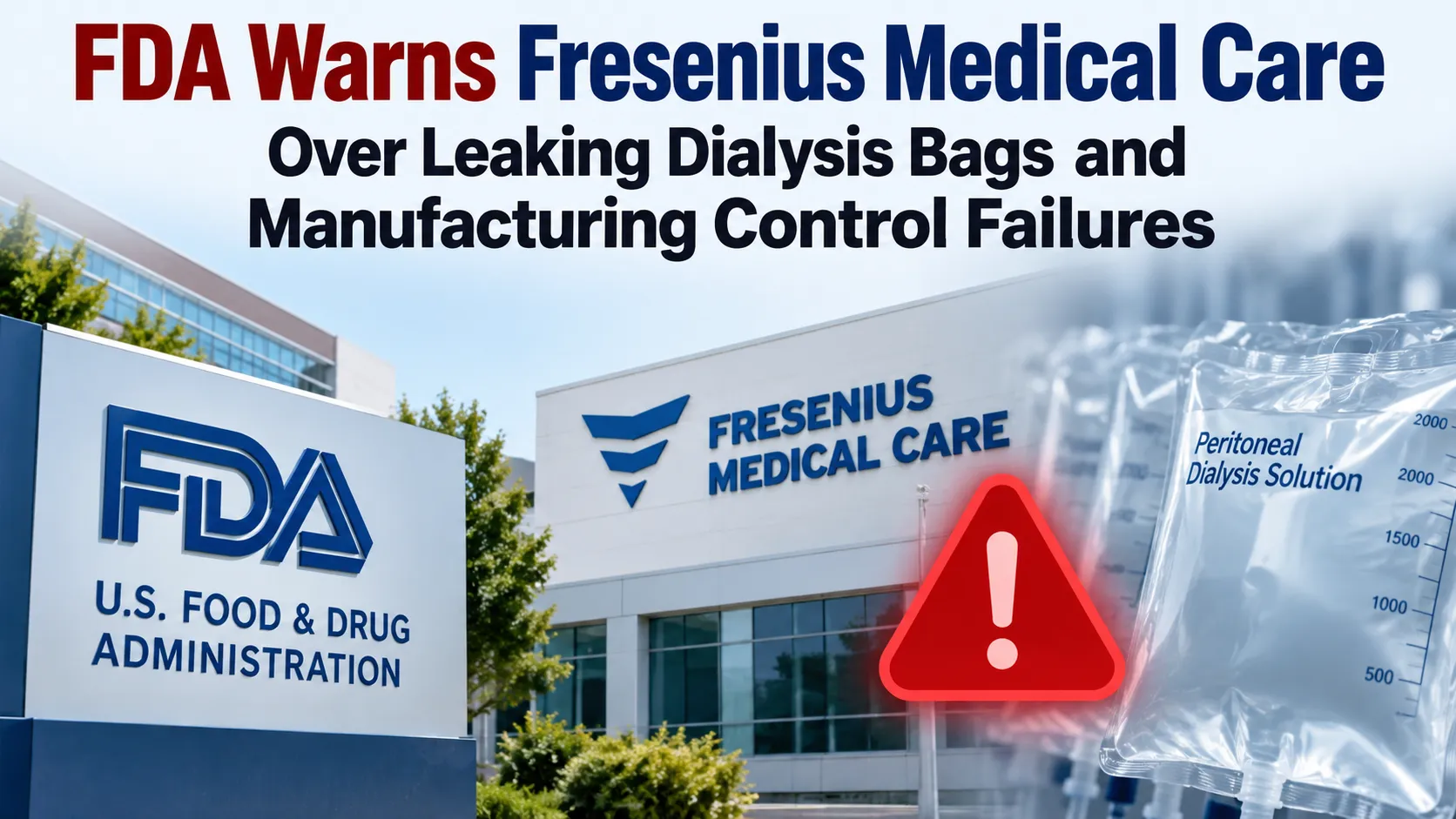
The U.S. Food and Drug Administration (FDA) has issued a warning letter to Fresenius Medical Care AG & Co. KGaA, citing significant Current Good Manufacturing Practice (CGMP) violations at its Ogden, Utah manufacturing facility.
The warning letter, dated August 25, 2026, follows an FDA inspection conducted from March 2 to March 6, 2026, at Fresenius USA Manufacturing, Inc., doing business as Fresenius Medical Care North America Ogden Plant. The agency said the facility's manufacturing methods, facilities and controls did not conform to CGMP requirements, rendering the affected drug products adulterated under the Federal Food, Drug, and Cosmetic Act.
FDA raises concerns over leaking dialysis solution bags
One of the major deficiencies involved the company's handling of customer complaints concerning leaking large-volume parenteral (LVP) bags, including Delflex Peritoneal Dialysis Solution.
According to FDA, Fresenius initiated an investigation in August 2025 after identifying a trend involving leaking bags. The investigation ultimately recorded 35 complaints involving approximately 156 bags from multiple batches and attributed the leaks to holes caused by the printing process.
However, FDA found that the company's risk assessment did not adequately reflect the potential patient safety consequences. Although the company's risk management matrix identified peritonitis as a potential harm and recommended the highest severity level, the company assigned the lowest severity level and characterized the potential harm as property damage.
FDA said Fresenius did not initiate a recall at that stage. A voluntary recall was subsequently conducted in April 2026 for affected DELFLEX Dextrose Peritoneal Dialysis Solution products due to a lack of assurance of sterility.
The agency warned that leaking bags could expose peritoneal dialysis patients to potentially non-sterile drug products. Non-sterile peritoneal dialysis solution can increase the risk of peritonitis, which can result in serious and potentially life-threatening complications.
FDA also noted that two previous Field Alert Reports submitted by the company involved leaking LVP bags with microbial contamination.
FDA demands independent investigation and CAPA
FDA said Fresenius' response did not provide an adequate corrective and preventive action (CAPA) plan.
The company has been asked to conduct an independent assessment of the root causes of leaking bags, including potential problems associated with its printing technology, equipment handling and personnel practices. FDA also requested an evaluation of alternative printing technologies that could minimize or eliminate the printing process as a source of bag damage.
The agency additionally requested comprehensive reviews of the company's quality unit, investigation systems, defect rates, manufacturing process capability, statistical process controls, equipment qualification, validation and maintenance programs.
Deficiencies found in visual inspection program
A second major area of concern involved the facility's visual inspection program for sterile injectable products.
FDA found that personnel performing visual inspections had not been adequately qualified. The agency said the qualification kit did not contain sufficiently representative visible particulates, particularly with respect to particle size, and that qualification records lacked adequate detail.
FDA stated that qualification kits should challenge inspectors with particles across the relevant range and noted that particles in the 100–150 micron range should typically be included to adequately assess detection capabilities. The agency also requested that the company's procedures incorporate the requirements of USP <790> Visible Particulates in Injections.
Consultant and corrective action required
Because of the nature of the deficiencies, FDA recommended that Fresenius engage a qualified CGMP consultant to evaluate its operations. The consultant is also expected to conduct a comprehensive six-system CGMP audit and assess the completion and effectiveness of corrective and preventive actions.
FDA has instructed the company to respond within 15 working days of receiving the warning letter, explaining the corrective actions already taken and measures planned to prevent recurrence.
The agency warned that failure to promptly and adequately address the violations could lead to further regulatory or legal action, including seizure or injunction. FDA may also withhold approval of certain new applications or supplements listing the facility as a manufacturer until the violations are resolved.