
The Drugs Technical Advisory Board (DTAB) has recommended changes to the regulatory requirements for manufacturing drugs intended for clinical trials, bioavailability and bioequivalence studies, analytical testing and non-clinical studies.
The matter was considered during the 94th meeting of DTAB held on August 27, 2026, in connection with a proposal to review the existing Good Manufacturing Practices (GMP) requirements for drugs manufactured for testing and research purposes. The Board was informed that the present system of manufacturing trial batches does not clearly differentiate between the GMP requirements applicable to batches manufactured for clinical purposes and those manufactured for non-clinical purposes.
After detailed deliberation, DTAB recommended that Rule 55 and Rule 63 of the New Drugs and Clinical Trials Rules, 2019 (NDCT Rules, 2019) may be amended to provide greater clarity regarding the manufacturing requirements for different purposes.
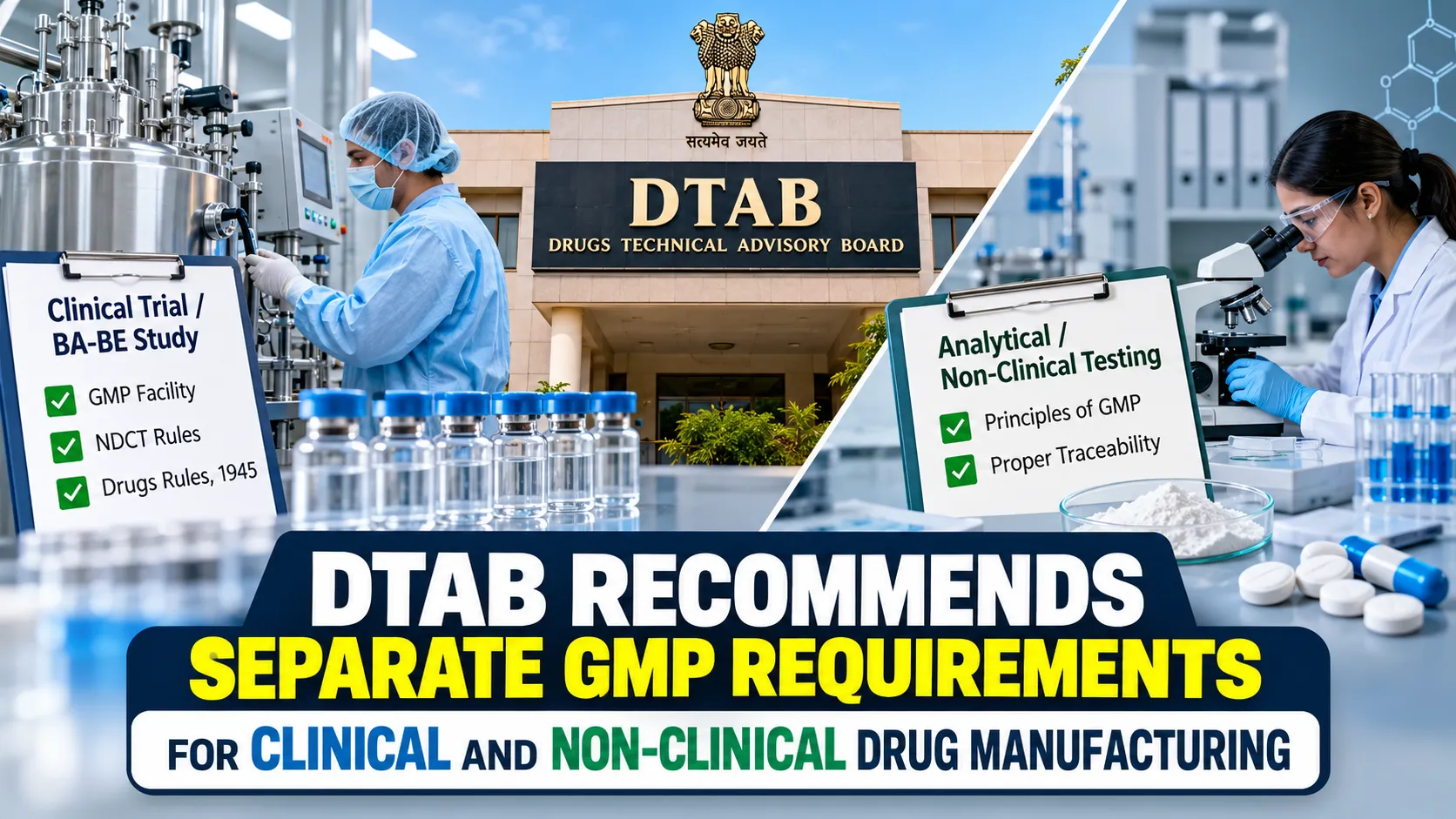
Under the proposed amendment to Rule 55, a permission holder would be required to manufacture new drugs intended for clinical trials or bioavailability and bioequivalence studies in small quantities, in accordance with the provisions of the NDCT Rules and at the places specified in the permission. Such manufacturing would have to be carried out in a facility complying with the Good Manufacturing Practices prescribed under the Drugs Rules, 1945.
The proposed amendment would also introduce a specific provision for new drugs manufactured for analytical and non-clinical testing purposes. Such drugs may be manufactured in accordance with the principles of Good Manufacturing Practices, with proper traceability.
A similar clarification has been recommended under Rule 63, which deals with the manufacture of active pharmaceutical ingredients (APIs) or pharmaceutical formulations under the relevant permissions. Where such manufacture is intended for clinical trials or bioavailability and bioequivalence studies, the proposed provision continues to require manufacturing in a facility complying with the applicable GMP requirements under the Drugs Rules, 1945.
However, where the API or pharmaceutical formulation is manufactured specifically for analytical and non-clinical testing purposes, the proposed provision would allow manufacturing in accordance with the principles of GMP, with proper traceability.
The proposed changes therefore establish a clearer regulatory distinction between material manufactured for human clinical or BA/BE studies and material manufactured solely for analytical or non-clinical research and testing.
The recommendation could have implications for pharmaceutical companies, research organisations, analytical laboratories and other entities involved in drug development, particularly where small quantities of drug substances or formulations are required for non-clinical or analytical work.
It is important to note that the recommendation recorded in the DTAB meeting minutes is not, by itself, a final amendment to the NDCT Rules, 2019. The proposed changes would need to go through the applicable rule-making process before they become legally enforceable.
The DTAB recommendation was recorded in the minutes of its 94th meeting held on August 27, 2026.