
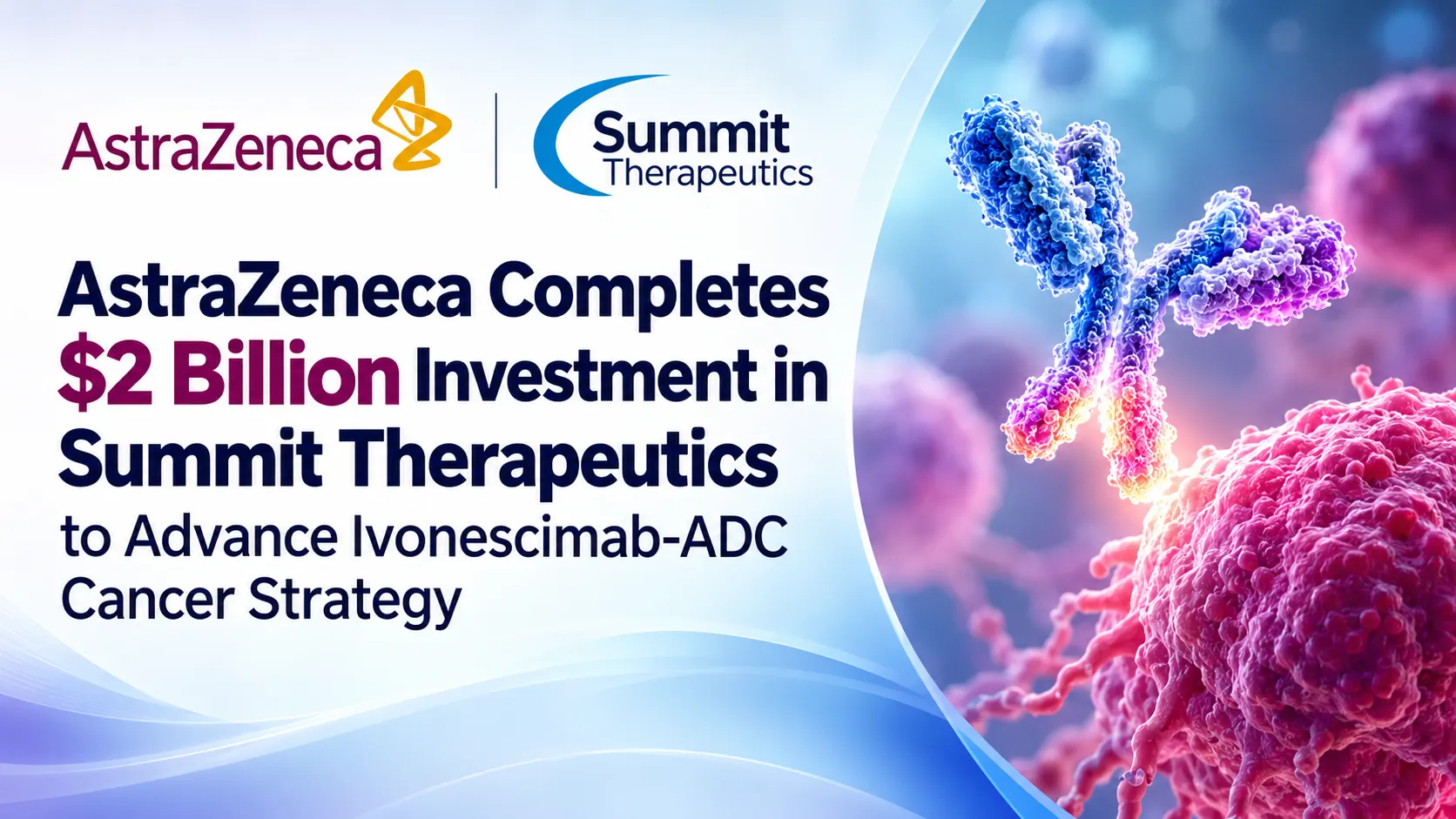
AstraZeneca has completed its 2 billion USD equity investment in Summit Therapeutics, strengthening a strategic partnership focused on advancing ivonescimab, a potential first-in-class bispecific antibody targeting PD-1 and VEGF, in combination with antibody-drug conjugates (ADCs) across multiple cancer types.
Ivonescimab is a bispecific antibody designed to combine PD-1 immune checkpoint inhibition with the anti-angiogenic effects associated with VEGF blockade in a single molecule. Under the collaboration, AstraZeneca and Summit will evaluate sonesitatug vedotin (Sone-Ve) in combination with ivonescimab. Sone-Ve is a Claudin-18.2-targeting ADC, and the companies plan to initiate clinical trials in gastrointestinal cancers.
The companies also intend to establish a broader global development programme combining ivonescimab with additional AstraZeneca cancer medicines, including other ADCs.
The strategic expansion around ivonescimab also includes a separate collaboration involving AstraZeneca, Daiichi Sankyo and Summit Therapeutics.
Under that agreement, the companies will evaluate Datroway® (datopotamab deruxtecan) in combination with ivonescimab across multiple tumour types, including lung and breast cancers.
As part of the investment announced in September, AstraZeneca agreed to purchase approximately 109,000 shares of Summit preferred stock, convertible into common shares at a 1:1,000 ratio. Following completion of the investment, AstraZeneca holds rights equivalent to approximately 12% of Summit Therapeutics' outstanding common stock, or approximately 10.6% on a fully diluted basis.
Ivonescimab was developed by Akeso Inc., while Summit holds exclusive rights to develop and commercialise the medicine in major territories outside China.
The drug is already approved for certain patients with non-small cell lung cancer (NSCLC) in China, while a Biologics License Application for EGFR-mutated NSCLC is under review by the U.S. Food and Drug Administration.
Beyond NSCLC, ivonescimab is being investigated in Phase III trials across several cancer types, including small cell lung cancer, biliary tract cancer, bladder cancer, triple-negative breast cancer, head and neck squamous cell carcinoma, colorectal cancer and pancreatic cancer.
AstraZeneca said the completed investment is intended to accelerate the development of combination approaches that bring together next-generation immunotherapy and ADC-based cancer treatment strategies.