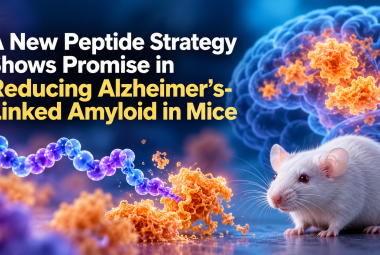

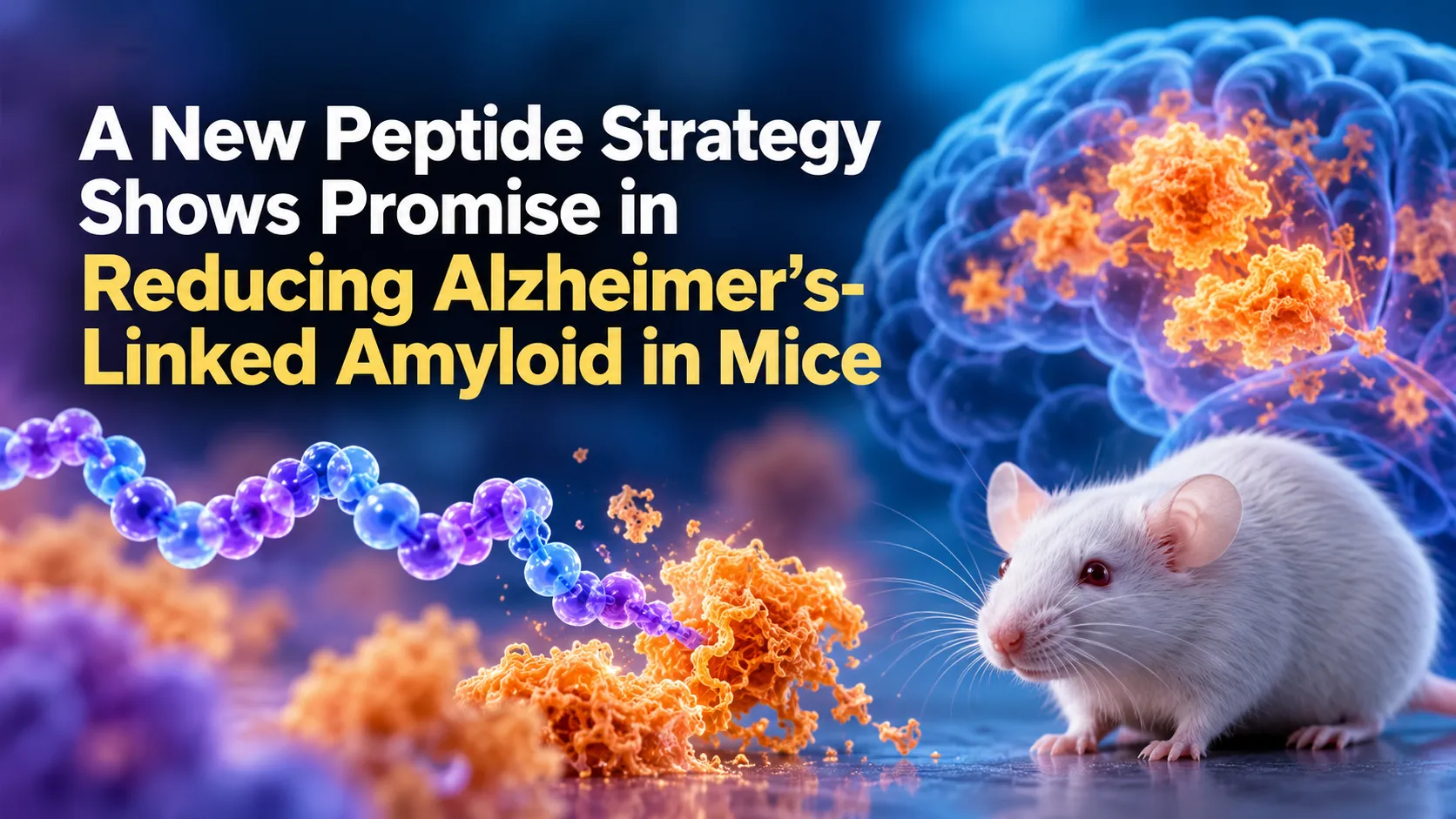
Researchers have identified a synthetic peptide that may offer a new approach to studying and modulating the biological processes associated with Alzheimer’s disease. The compound, known as P33, reduced amyloid-beta (Aβ) levels and amyloid plaque burden in mice engineered to develop Alzheimer’s-like pathology, according to a study published in Bioorganic Chemistry.
The study, titled “cis-γ-Amino-L-proline peptides as chemical probes of amyloidogenic processing in neurons and APP/PS1 mice,” investigates a family of chemically engineered peptides designed to enter cells, resist enzymatic degradation and influence the production of amyloid-beta, a protein fragment associated with Alzheimer’s disease.
A different approach to amyloid-beta
Alzheimer’s disease involves several interconnected biological processes, including amyloid-beta accumulation, tau pathology, inflammation and synaptic dysfunction. Although existing treatments targeting amyloid have demonstrated clinical benefits in some patients, researchers continue to investigate additional approaches to modifying disease-related pathways.
The research team examined cis-γ-amino-L-proline peptides, a class of non-natural peptides whose chemical structures can be modified to adjust their charge, stability and biological activity.
Using a screening library of 50 peptides, the researchers initially evaluated their effects in neuronal cell cultures. They assessed amyloid-beta production alongside indicators of cellular toxicity to distinguish potentially useful compounds from peptides that lowered amyloid levels because of cell damage.
Among the candidates examined, P33 emerged as a promising lead because it reduced amyloid-beta release while showing no significant increase in the cell-death marker cleaved caspase-3 under the tested conditions.
P33 and the BACE1 pathway
Further experiments investigated the relationship between P33 and beta-secretase 1 (BACE1), an enzyme involved in the processing of amyloid precursor protein into amyloid-beta.
In primary neuronal cultures, P33 reduced BACE1-associated activity by more than 50% at the two tested time points. The peptide did not significantly alter activity associated with the related enzyme BACE2 under the same experimental conditions.
The findings suggest that P33 may influence amyloid-producing pathways without completely suppressing BACE1-associated activity. However, the researchers emphasized that their experiments did not establish direct inhibition of purified BACE1 or definitively prove the peptide’s precise mechanism of action.
The peptide also demonstrated measurable permeability in an in-vitro model of the blood-brain barrier, with an apparent permeability value of (5.48 \times 10^{-6}) cm/s. This result supports further investigation of its potential for central nervous system research, although it does not establish that effective concentrations reach the brain in living animals.
Amyloid levels and plaque burden decline in mice
The researchers next tested P33 in APP/PS1 transgenic mice, an established model of Alzheimer’s-like amyloid pathology.
In an acute experiment involving six-month-old mice, animals received daily intraperitoneal injections of P33 for three consecutive days. Six days after the first injection, brain amyloid-beta 1–42 levels were approximately 45.5% lower in the P33-treated group than in vehicle-treated controls.
A separate chronic experiment examined 12-month-old mice. Nineteen animals received either a vehicle control or P33 at 200 micrograms per kilogram per injection, three times weekly for eight weeks.
Following chronic treatment, soluble brain amyloid-beta 1–42 levels were approximately 35.6% lower in the P33 group than in controls.
The researchers also reported reductions in amyloid plaque measurements in two brain regions:
- Neocortex: Average plaque size decreased by approximately 18.8%, plaque-covered area by 27.3%, and plaque density by 25.3%.
- Hippocampus: Average plaque size decreased by approximately 24.0%, plaque-covered area by 41.3%, and plaque density by 28.0%.
These results provide preliminary evidence that P33 can influence amyloid pathology in this mouse model.
Did the treatment improve memory?
The team also evaluated recognition memory using the novel object recognition test, a behavioral assessment in which animals explore familiar and unfamiliar objects.
P33-treated mice showed a higher discrimination index for the novel object than vehicle-treated controls. However, the difference did not reach statistical significance ((p = 0.1111)).
Consequently, the findings suggest a possible improvement in recognition memory, but they do not establish a statistically significant cognitive benefit. The behavioral experiment was also small, involving ten mice from the second treatment cohort.
Preliminary safety findings
Safety-related assessments did not identify significant increases in selected inflammatory markers following acute treatment. During chronic treatment, the researchers observed no detectable histopathological abnormalities in examined peripheral organs, including the liver, lungs, kidneys and spleen.
The study also found no significant differences in the measured brain markers ICAM-1 and SDF-1 between treated and control animals.
These observations are encouraging for further preclinical investigation, but they do not establish comprehensive or long-term safety in humans. The study was exploratory, involved relatively small animal groups and did not establish the peptide’s full pharmacokinetic profile.
Importantly, limitations in analytical sensitivity prevented the researchers from directly demonstrating P33 exposure in the brain or fully characterizing the relationship between its concentration and biological effects.
What the findings mean
The study presents cis-γ-amino-L-proline peptides as a potential chemical platform for investigating amyloid-producing processes within cells. P33 combines measurable cellular activity, favorable results in an experimental blood-brain barrier model and reductions in amyloid-related measures in APP/PS1 mice.
Nevertheless, the findings remain preclinical. The study does not demonstrate that P33 prevents Alzheimer’s disease, reverses dementia or improves cognition in humans. Additional research is needed to establish its mechanism of action, pharmacokinetics, brain exposure, dose-response relationship and safety before its therapeutic potential can be assessed.
The researchers conclude that this peptide family provides a modular foundation for developing new chemical probes of amyloidogenic processing and for further investigation of Alzheimer’s-related biology.