
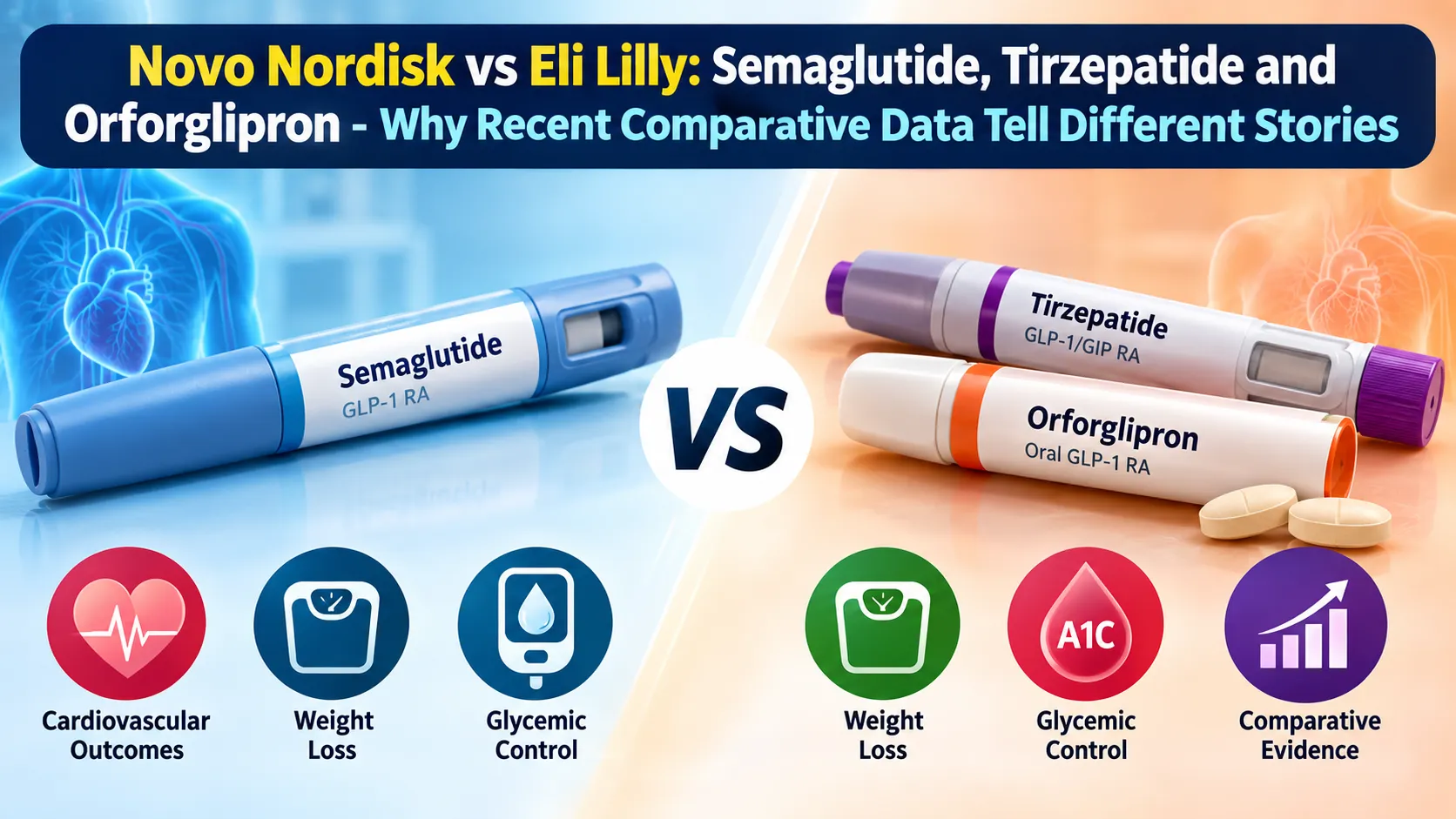
The competition between Novo Nordisk and Eli Lilly in the diabetes and obesity medicine market is producing a new wave of comparative clinical data. In September 2026, both companies released analyses comparing their medicines with competing therapies, but the results are not all pointing in the same direction.
Novo Nordisk presented real-world data suggesting that increasing semaglutide (Ozempic) from 1 mg to 2 mg was associated with a lower risk of major adverse cardiovascular events compared with switching to tirzepatide (Mounjaro) in adults with type 2 diabetes.
Eli Lilly, meanwhile, released data suggesting that tirzepatide (Zepbound) 10 mg and 15 mg was associated with greater weight loss than semaglutide 7.2 mg (Wegovy HD) in adults with obesity. Lilly also released another indirect comparison suggesting that orforglipron (Foundayo) 17.2 mg produced greater weight loss and A1C reduction than oral semaglutide 25 mg in adults with type 2 diabetes.
At first glance, these announcements may appear to be competing claims about which medicine performs better. However, the studies are examining different drugs, doses, patient populations, endpoints and study designs. Understanding those differences is essential before drawing conclusions from the headlines.
Novo Nordisk's Latest Data: Semaglutide and Cardiovascular Events
Novo Nordisk's COMPETE SWITCH CV analysis examined real-world claims data from 636,525 adults with type 2 diabetes who were receiving semaglutide 1 mg. Researchers compared patients whose semaglutide dose was increased to 2 mg with patients who switched to tirzepatide, with tirzepatide doses allowed to reach up to 15 mg.
According to Novo Nordisk, escalation to semaglutide 2 mg was associated with a 6% lower risk of major adverse cardiovascular events (MACE) compared with switching to tirzepatide. The MACE outcome included all-cause death, myocardial infarction and stroke. The company reported an adjusted hazard ratio of 1.06, with a 95% confidence interval of 1.04–1.08.
The size of the dataset makes the analysis notable, but the study design is equally important. This was a retrospective real-world claims analysis, not a randomized head-to-head cardiovascular outcomes trial. Patients were not randomly assigned to remain on semaglutide or switch to tirzepatide. Consequently, differences between the groups may reflect treatment selection and other factors in addition to the medicines themselves.
Therefore, the finding should be described as an association observed in real-world data, rather than definitive proof that semaglutide 2 mg provides superior cardiovascular protection to tirzepatide.
Lilly's Latest Zepbound vs Wegovy HD Analysis
Eli Lilly's September 2026 announcement looked at a different clinical question: weight loss in adults with obesity.
Lilly conducted an indirect treatment comparison using data from the SURMOUNT-1 and STEP UP clinical trials. The analysis compared Zepbound (tirzepatide) 10 mg and 15 mg with Wegovy HD (semaglutide) 7.2 mg.
According to Lilly, tirzepatide 15 mg was associated with 4.5 percentage points greater weight loss than semaglutide 7.2 mg. Tirzepatide 10 mg was associated with 3.2 percentage points greater weight loss under the treatment-regimen estimand. Lilly also reported that participants receiving tirzepatide 15 mg had more than three times the odds of achieving at least 20% body-weight reduction compared with Wegovy HD.
However, this was not a direct randomized trial of tirzepatide 15 mg versus semaglutide 7.2 mg. The analysis combined information from different clinical trials. That makes the comparison useful, but it should be interpreted differently from a single randomized head-to-head study.
A Second Lilly Comparison: Foundayo vs Oral Semaglutide
Lilly's September 2026 announcements also included another comparison, this time involving Foundayo (orforglipron), Lilly's once-daily oral GLP-1 receptor agonist.
Lilly reported an indirect treatment comparison between Foundayo 17.2 mg and oral semaglutide 25 mg in adults with type 2 diabetes. At 52 weeks, Foundayo was associated with 1.5 percentage points greater weight loss and 0.3 percentage points greater A1C reduction than oral semaglutide 25 mg, based on the efficacy estimand.
This comparison is particularly interesting because it involves two oral medicines rather than the injectable semaglutide-versus-tirzepatide comparisons that have dominated the discussion in recent years.
But again, the comparison was indirect. The data were derived from the ACHIEVE-3 and PIONEER PLUS trials rather than from a single trial in which patients were randomized directly to Foundayo or oral semaglutide 25 mg.
Foundayo Had Already Been Compared Directly With Oral Semaglutide
The new indirect comparison does not represent the first comparison between orforglipron and oral semaglutide. In the ACHIEVE-3 Phase 3 trial, 1,698 adults with type 2 diabetes inadequately controlled on metformin were randomized to orforglipron 9 mg or 17.2 mg, or oral semaglutide 7 mg or 14 mg.
At 52 weeks, Lilly reported that A1C decreased by an average of 1.9% with orforglipron 9 mg and 2.2% with orforglipron 17.2 mg, compared with 1.1% with oral semaglutide 7 mg and 1.4% with oral semaglutide 14 mg. Weight loss was also greater with orforglipron. Participants lost an average of 6.7% with orforglipron 9 mg and 9.2% with 17.2 mg, compared with 3.7% with oral semaglutide 7 mg and 5.3% with 14 mg.
The important difference is that ACHIEVE-3 was a randomized direct comparison, whereas the September 2026 comparison involving oral semaglutide 25 mg is an indirect treatment comparison.
Why the 25 mg Oral Semaglutide Comparison Matters
The latest Foundayo analysis also involves a higher oral semaglutide dose than the doses used in the direct ACHIEVE-3 comparison. ACHIEVE-3 directly compared Foundayo with oral semaglutide 7 mg and 14 mg. The new analysis instead compares Foundayo 17.2 mg with oral semaglutide 25 mg, using data from PIONEER PLUS.
Lilly notes that the 25 mg oral semaglutide dose was not approved in the United States at the time of the announcement, with Novo Nordisk having submitted an application seeking approval of that dose. This makes the latest analysis a different comparison from the earlier direct trial and is another reason why the results should not simply be combined into one overall ranking.
Looking Back: Tirzepatide vs Semaglutide Was Already a Major Clinical Comparison
The semaglutide-versus-tirzepatide comparison is not new. One of the most important direct comparisons came several years earlier in the SURPASS-2 trial.
2021: SURPASS-2 Compared Tirzepatide With Semaglutide 1 mg
Published in the New England Journal of Medicine in 2021, SURPASS-2 randomized adults with type 2 diabetes to tirzepatide 5 mg, 10 mg or 15 mg, or semaglutide 1 mg.
The trial found that tirzepatide produced greater reductions in HbA1c than semaglutide 1 mg. Body-weight reductions were also greater with tirzepatide. At 40 weeks, mean weight reductions were 7.6 kg with tirzepatide 5 mg, 9.3 kg with 10 mg and 11.2 kg with 15 mg, compared with 5.7 kg with semaglutide 1 mg. The estimated treatment differences in body weight were 1.9 kg, 3.6 kg and 5.5 kg, respectively, favoring tirzepatide, and all three comparisons were statistically significant. This was a direct randomized comparison, but it was primarily a study of glycemic control and weight, not a cardiovascular outcomes trial.
2025: SURMOUNT-5 Provided Another Direct Weight-Loss Comparison
A later trial provided another direct comparison, this time in adults with obesity without type 2 diabetes. The SURMOUNT-5 trial, published in the New England Journal of Medicine in 2025, randomized 751 participants to maximum tolerated doses of tirzepatide or semaglutide. Tirzepatide doses were 10 mg or 15 mg, while semaglutide doses were 1.7 mg or 2.4 mg. At week 72, the least-squares mean reduction in body weight was 20.2% with tirzepatide compared with 13.7% with semaglutide, a difference of 6.5 percentage points. Tirzepatide also produced a greater reduction in waist circumference. Unlike the September 2026 Lilly comparison involving Wegovy HD 7.2 mg, SURMOUNT-5 was a randomized direct head-to-head trial. That distinction matters when comparing the strength of the evidence.
Novo Had Also Published Earlier Real-World Comparative Data in 2026
The September cardiovascular announcement was also not Novo Nordisk's first 2026 comparison of semaglutide 2 mg with tirzepatide. In June 2026, Novo announced another COMPETE SWITCH real-world analysis involving more than 64,000 adults with type 2 diabetes. The analysis compared people whose semaglutide 1 mg dose was increased to 2 mg with people who switched to tirzepatide.
For HbA1c, Novo reported that patients escalating to semaglutide 2 mg were similarly likely to reach an HbA1c below 7% at one year compared with those switching to tirzepatide. Novo also reported that the semaglutide 2 mg group was more likely to achieve at least 5% weight loss. This is important because the June and September analyses came from the same broader real-world comparison program but focused on different outcomes. The June analysis focused on HbA1c and weight, while the September analysis focused on cardiovascular events.
Cardiovascular Evidence Adds Another Layer
Cardiovascular outcomes make the comparison more complicated because tirzepatide already has randomized cardiovascular-outcomes evidence — but not against semaglutide.
The SURPASS-CVOT trial, published in the New England Journal of Medicine in December 2025, compared tirzepatide with dulaglutide in 13,299 patients with type 2 diabetes and established atherosclerotic cardiovascular disease.
Tirzepatide was noninferior to dulaglutide for the composite endpoint of cardiovascular death, myocardial infarction or stroke. The hazard ratio was 0.92, with a 95.3% confidence interval of 0.83–1.01. The trial did not demonstrate statistically significant superiority over dulaglutide for the primary cardiovascular endpoint.
This is not a semaglutide-versus-tirzepatide trial. However, it demonstrates why cardiovascular comparisons require looking at the actual randomized evidence rather than assuming that results from one cardiovascular trial can be transferred directly to another drug.
Three Different Comparisons Are Now Happening
The current evidence can therefore be divided into three major comparative stories.
First: tirzepatide versus semaglutide for weight and glucose outcomes. Earlier direct trials such as SURPASS-2 and SURMOUNT-5 found greater weight reduction with tirzepatide than with the semaglutide regimens tested in those studies.
Second: semaglutide versus tirzepatide for cardiovascular outcomes. Novo's latest COMPETE SWITCH CV analysis reported a 6% lower MACE risk associated with escalation to semaglutide 2 mg compared with switching to tirzepatide in the studied real-world type 2 diabetes population.
Third: orforglipron versus oral semaglutide. Lilly's latest indirect analysis reported greater weight loss and A1C reduction with Foundayo 17.2 mg than oral semaglutide 25 mg in adults with type 2 diabetes.
These are therefore different scientific questions, even though they involve medicines from the same broad therapeutic area.
Why the Headlines Can Look Contradictory
The apparent contradiction comes largely from the fact that pharmaceutical comparisons can change depending on what is being measured.
A medicine may show greater weight reduction in one population while another analysis examines cardiovascular events. One study may compare a 1 mg dose with a 15 mg dose, while another examines 7.2 mg versus 15 mg. One analysis may be randomized and direct, while another may use real-world claims data or an indirect treatment comparison. Those differences can substantially affect the results.
For example, SURPASS-2 directly compared tirzepatide with semaglutide 1 mg, while the new Lilly analysis compares tirzepatide with semaglutide 7.2 mg using an indirect approach. Likewise, Novo's cardiovascular analysis compares semaglutide 2 mg escalation with switching to tirzepatide using retrospective real-world data.
These studies should therefore not be treated as if they were one large head-to-head trial.
Direct Trials, Real-World Studies and Indirect Comparisons Are Different
One of the most important lessons from these announcements is the difference between three types of evidence. A randomized head-to-head trial directly assigns participants to the medicines being compared. SURPASS-2 and SURMOUNT-5 are examples of this type of comparison.
A real-world observational study examines what happened among patients receiving different treatments in routine clinical practice. Novo's COMPETE SWITCH analyses fall into this category.
An indirect treatment comparison uses results from separate trials to estimate how two treatments may compare when they have not been tested directly against each other in the same trial. Lilly's September 2026 Zepbound-versus-Wegovy HD and Foundayo-versus-oral semaglutide 25 mg analyses are examples. Each approach can provide useful information, but the interpretation is different.
The Bigger Pharmaceutical Competition
The developments also illustrate the intensity of the pharmaceutical competition between Novo Nordisk and Eli Lilly.
Novo Nordisk has built a major franchise around semaglutide, including Ozempic and Wegovy, while Lilly has developed tirzepatide through Mounjaro and Zepbound and is now bringing newer approaches such as orforglipron into the market.
The companies therefore have strong commercial reasons to generate comparative evidence around their products. That makes it particularly important for healthcare professionals, researchers and readers to look beyond the headline and examine what was actually compared, in whom, at what dose, for which endpoint and using what methodology.
Conclusion
The latest Novo Nordisk and Eli Lilly announcements provide another chapter in the rapidly developing evidence base around semaglutide, tirzepatide and newer GLP-1-based therapies.
Novo's latest real-world analysis focuses on cardiovascular events, reporting a lower MACE risk associated with semaglutide 2 mg compared with switching to tirzepatide in adults with type 2 diabetes. Lilly's latest analyses focus primarily on weight and glycemic outcomes, reporting greater weight loss with tirzepatide compared with semaglutide 7.2 mg and greater weight loss and A1C reduction with orforglipron compared with oral semaglutide 25 mg in indirect comparisons.
Earlier randomized trials add another important layer. SURPASS-2 found greater HbA1c and weight reductions with tirzepatide than semaglutide 1 mg in type 2 diabetes, while SURMOUNT-5 found greater weight loss with tirzepatide than semaglutide in adults with obesity without diabetes.
Taken together, the evidence shows why drug-to-drug comparisons cannot be reduced to a single headline. The answer can change depending on the clinical endpoint, patient population, dose, comparator and study methodology.