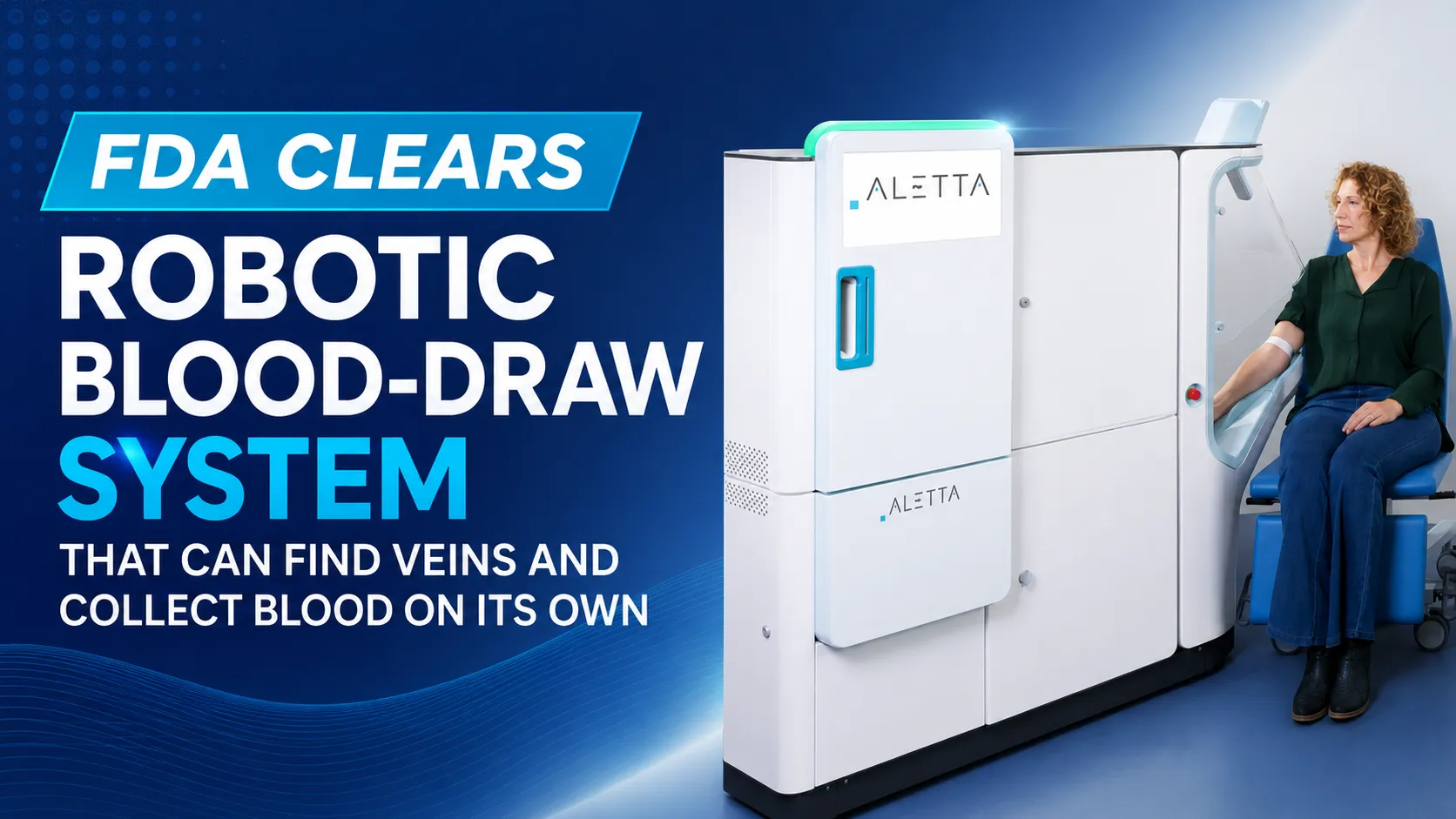
The U.S. Food and Drug Administration (FDA) has authorized Aletta, a first-of-its-kind standalone robotic device designed to draw blood from a patient’s arm without hands-on intervention by a phlebotomist.
The authorization, announced on August 19, 2026, allows Aletta to be used in adults in outpatient settings under the supervision of a trained phlebotomist. According to the FDA, one trained phlebotomist can oversee up to three Aletta devices at the same time, potentially helping healthcare facilities manage shortages of trained blood-collection professionals.
How does the robotic blood-draw device work?
Aletta is designed to perform multiple steps of a conventional blood draw autonomously. The patient first positions their arm according to the device's instructions, after which the procedure is initiated.
The system uses near-infrared light and Doppler ultrasound to identify a suitable vein and distinguish it from arteries. If the system cannot identify an appropriate vein, it will not proceed with the needle insertion.
Once a suitable vein is identified, Aletta can independently :
Apply a tourniquet
Prepare the skin
Insert and dispose of the needle
Change blood collection tubes
Collect the required samples
Place a bandage after the procedure
A supervising phlebotomist remains responsible for oversight, including confirming that the collection tubes are filled in the correct order and adequately filled.
Multiple safety features built into the system
The FDA said Aletta incorporates several safety mechanisms. The device continuously applies disinfectant to the skin during ultrasound scanning and is cleaned by trained personnel between patients.
If a patient moves excessively during the procedure, the needle automatically detaches and the blood draw stops. Additional sensors can also pause the procedure and alert the supervisor if potentially unsafe conditions are detected.
Clinical performance
The FDA's authorization was supported by clinical data showing that Aletta achieved successful blood-draw rates comparable to or better than trained human phlebotomists when the device proceeded with a needle stick.
The evaluation included people with different health statuses, individuals who reported difficult vein access and patients with varying skin tones. The FDA said device-related adverse events were uncommon and mild.
FDA authorization through the De Novo pathway
The FDA granted marketing authorization to Vitestro, the developer of Aletta, through the De Novo pathway, which is used for certain novel medical devices that are considered low to moderate risk and do not have an existing legally marketed predicate device.
The authorization also establishes special controls covering areas such as labeling, performance testing and clinical testing.
What could this mean for healthcare?
Blood collection is one of the most frequently performed procedures in healthcare, but shortages of trained phlebotomists can contribute to delays in accessing blood-draw services.
The FDA's authorization represents a significant step toward greater automation of routine clinical procedures. While Aletta is not designed to eliminate the need for trained phlebotomists, its ability to operate under the supervision of one trained professional could allow healthcare facilities to increase blood-collection capacity.
The technology also highlights how robotics, imaging and automated sensing are increasingly being combined to perform procedures that traditionally require direct hands-on intervention.
The FDA authorization applies to Aletta for adults in outpatient settings and requires oversight by a trained phlebotomy supervisor.