
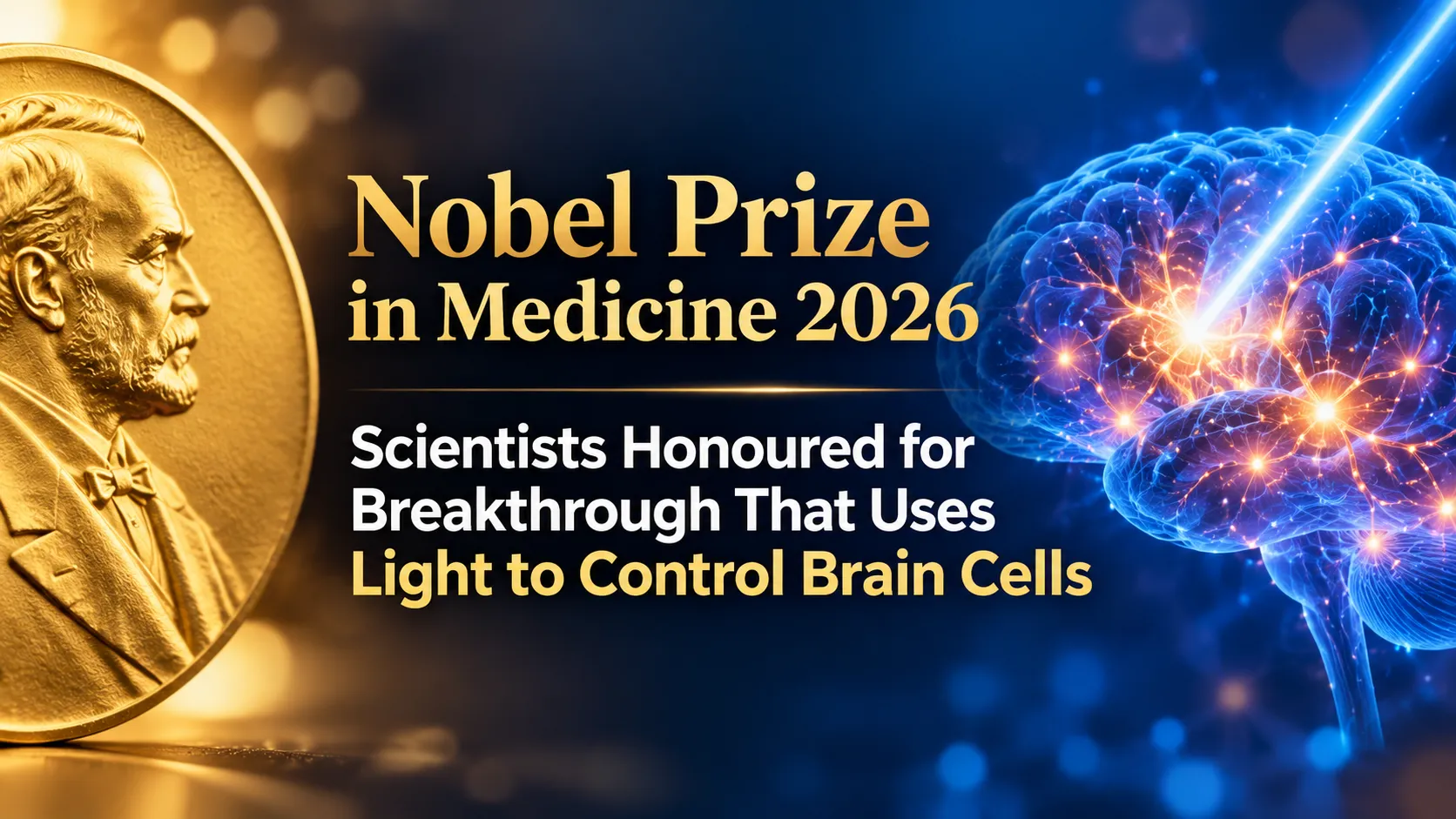
The 2026 Nobel Prize in Physiology or Medicine has been awarded jointly to Karl Deisseroth, Peter Hegemann and Georg Nagel for their discoveries concerning light-gated ion channels and optogenetics, a breakthrough that has transformed the study of nerve cells and brain function.
The Nobel Assembly at Karolinska Institutet announced the award on October 5, recognising the three scientists for research that made it possible to control the activity of individual nerve cells using light. Their work has opened new ways to investigate how the brain's complex networks influence functions such as movement, memory, emotions and behaviour.
From Algae to a Major Neuroscience Breakthrough
The scientific journey behind the Nobel-winning work began with studies of light-sensitive proteins in algae. Peter Hegemann and Georg Nagel investigated how certain algal cells respond to light and helped identify light-gated ion channels, including channelrhodopsins. These proteins can respond to light by allowing ions to pass through cell membranes, thereby changing the electrical activity of cells.
Karl Deisseroth subsequently helped turn this biological discovery into a powerful research technology. By introducing light-sensitive proteins into specific nerve cells, researchers could use pulses of light to activate or inhibit selected neurons. This approach became known as optogenetics.
What is Optogenetics?
Optogenetics combines genetic engineering with light-based control of cells. Scientists can introduce genes encoding light-sensitive proteins into selected neurons. When light is delivered to these cells, the proteins act like molecular switches and alter the electrical activity of the neurons.
This provides researchers with an unusually precise way of studying the nervous system. Instead of affecting large groups of neurons with conventional electrical or chemical methods, optogenetics can allow investigators to target specific populations of nerve cells and examine how their activity affects behaviour and brain function.
Why the Discovery Matters for Medicine
The Nobel-winning technology has become an important tool in neuroscience laboratories around the world. It has helped researchers investigate the neural circuits responsible for different behaviours and understand how particular groups of nerve cells contribute to brain function.
Beyond basic research, optogenetics and related technologies are also being investigated for potential medical applications. Research has explored approaches for restoring vision in people with retinal disorders, including retinitis pigmentosa, and for developing more precise approaches to hearing restoration and other neurological applications.
Three Scientists Share the Nobel Prize
Karl Deisseroth, an American neuroscientist associated with Stanford University, shares the 2026 Nobel Prize with German scientists Peter Hegemann and Georg Nagel. Hegemann is associated with Humboldt University of Berlin, while Nagel is associated with the University of Würzburg.
The laureates will share the 2026 Nobel Prize amount of 12 million Swedish kronor. The award marks the recognition of decades of research that began with fundamental questions about how organisms sense light and ultimately produced a powerful technology for investigating the human brain.
A New Way to Study the Brain
The 2026 Nobel Prize in Physiology or Medicine highlights how fundamental biological research can eventually lead to technologies with major implications for medicine. What began with the study of light-sensitive proteins in algae has evolved into a method that allows scientists to manipulate and study specific nerve cells with unprecedented precision.
The work of Deisseroth, Hegemann and Nagel therefore represents an important bridge between basic biology, neuroscience and potential future therapies, offering scientists new tools to investigate the mechanisms underlying neurological function and disease.