B.Sc. / B.Pharma / D.Pharma. experience as a Medical Representative in a Pharma Company. Divisional Business Manager, Area Business Manager, Field Sales Officer in Oral Care, Pain Management, Orthopedics & General Healthcare, Oral Care / ENT / Oncology, Respiratory and Anti-Infectives, Gynecology
Advertisement for Walk-in Interview for the post of a Junior Research Fellow (JRF) under IPR Chair [Supported by Department of Industry & Internal Trade under SPRIHA, Ministry of Industry & Commerce, GoI] at Panjab University, Chandigarh at a fixed stipend.
Established in 1984, the Institute of Microbial Technology is one among the chain of 37 national laboratories, 6 units and 39 outreach centres of the Council of Scientific and Industrial Research. Set-up to be a fore-runner in the niche domain of microbial biotechnology, the Institute in its initial years functioned from a start-up laboratory that provided a truly world-class R&D ambience in an area of over 10,000 sq. ft. to its researchers.
MSc in Immunology, Life Sciences, Biotechnology, Molecular Biology, Bioinformatics, Biochemistry, or Genomics. Postgraduate Institute of Medical Education and Research
Masters in Natural or Pharmaceutical Sciences. Genetic investigation into the role of a novel sugar utilization cassette in virulence and host adaption of a phytopathogen. Institute of Microbial Technology
Phenome India-CSIR health cohort knowledge base. Institute of Microbial Technology invites Masters / Integrated Masters in Natural or Pharmaceutical Sciences/ MVSc/ Animal Sciences. Or Doctoral Degree
Masters degree or equivalent in a relevant discipline, including Life Sciences, Biotechnology, Microbiology, Bioinformatics, Computational Biology, Biochemistry, Pharmacology, Biomedical Sciences, or another related field.
Masters / Integrated Masters in Natural or Pharmaceutical Sciences / MVSc / Animal Sciences. Innovating with Microbes to address unmet healthcare and industrial needs. Institute of Microbial Technology
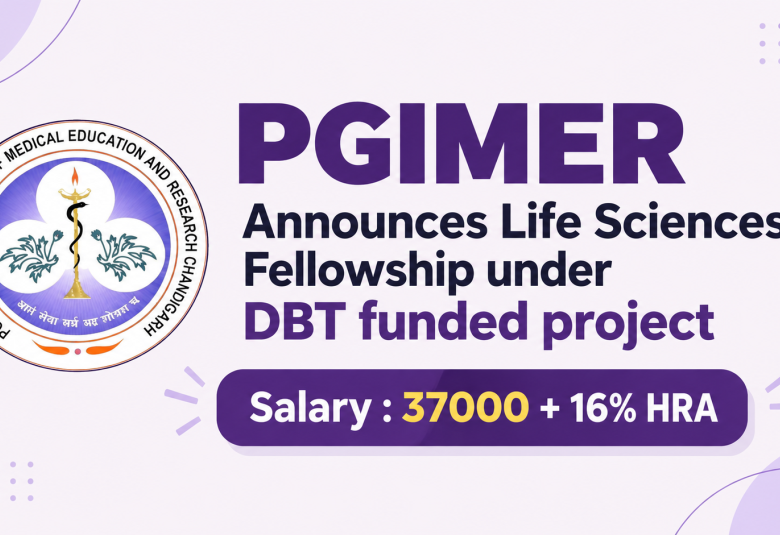
The PGIMER owes its inception to the vision of late Sardar Partap Singh Kairon, the then Chief Minister of Punjab and the distinguished medical educationists of the then combined state of Punjab, supported by the first Prime Minister of India Pt. Jawahar Lal Nehru who considered the institutions of scientific knowledge as temples of learning and the places of pilgrimage. The institute started in 1962 and Pt Jawahar Lal Nehru inaugurated the hospital now named “Nehru Hospital” on 7th July 1963.
First Class Postgraduate degree in Biotechnology, Microbiology, Immunology, Biochemistry, including the integrated PG degrees, with 5 years post-qualification experience or PhD + 2 years post-qualification experience.