The human microbiome, comprising trillions of microorganisms inhabiting the gut, skin, oral cavity, and other body sites, plays a vital role in digestion, metabolism, immunity, neurological function and overall health. Disruptions in microbial balance (dysbiosis) have been linked to a wide range of conditions, including obesity, diabetes, cardiovascular disease, Non-Alcoholic Fatty Liver Disease (NAFLD), urinary tract infections, and neurological disorders.
Globally, microbiome research has moved beyond descriptive, association based studies towards functional and translational applications, including probiotics, prebiotics, postbiotics, and other next-generation biotherapeutics. A number of microbiome-derived candidates, strains, and consortia have now reached a stage of characterization where their translational into therapeutic product is feasible. These interventions hold considerable promise for disease prevention and management and have the potential to deliver meaningful public health benefits. India harbours one of the world's richest and most diverse human microbiomes, shaped by its unique dietary habits, ethnic diversity, geographical variation, environmental exposures, and cultural practices. This diversity presents an unparalleled opportunity to advance microbiome research and develop indigenous microbiome-based solutions for improving human health. However, despite this immense potential, India currently lacks a coordinated national programme to systematically advance characterized microbial discoveries from preclinical validation through product development, manufacturing and clinical translation.
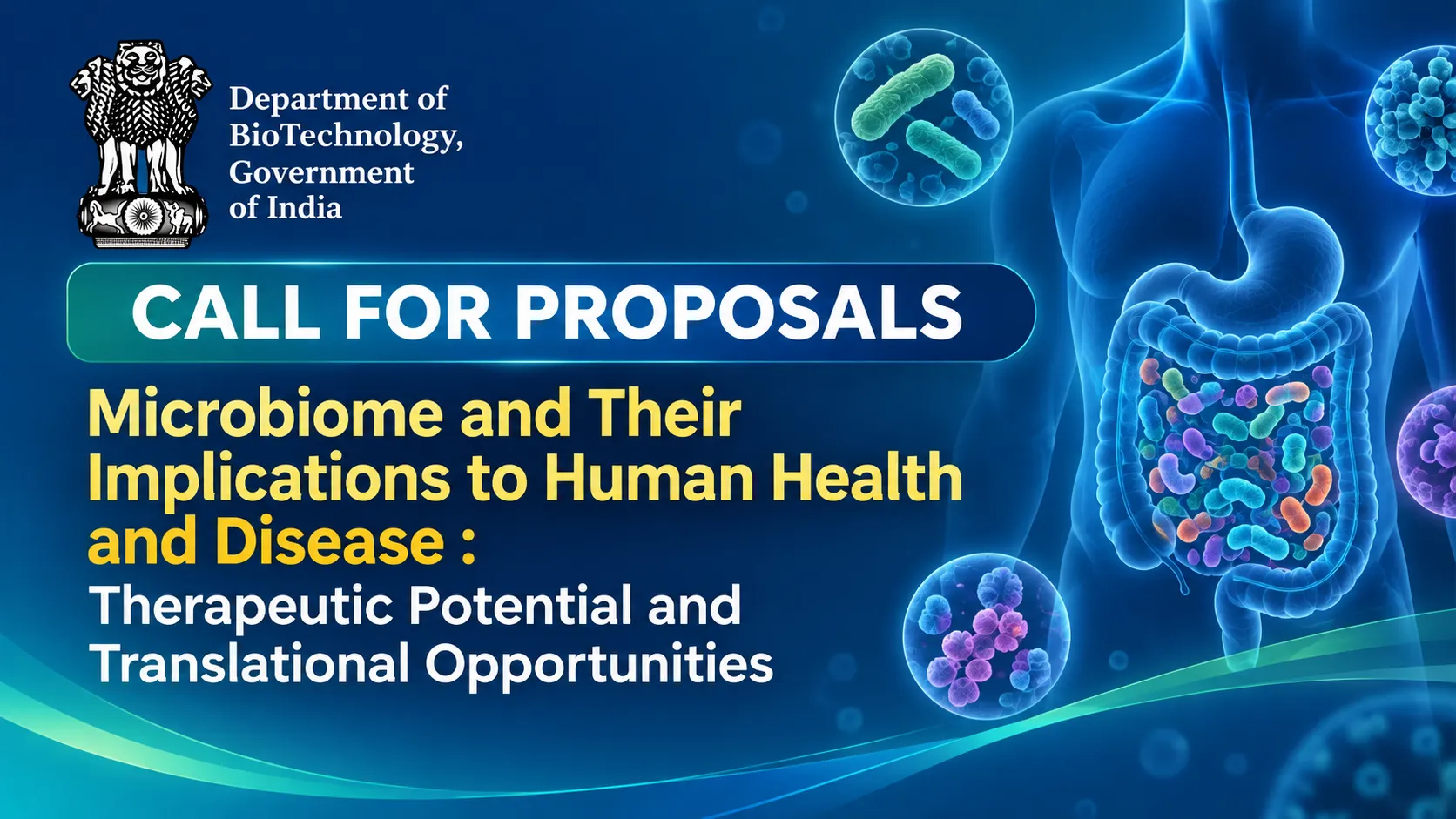
Recognizing this gap, the Department of Biotechnology (DBT), invites proposals under the theme “Microbiome and their implications to human health and disease: Therapeutic potential and translational opportunities,” focused on translating already-established microbiome discoveries into therapeutic products.
Purpose : With the aim of strengthening India’s research capacity to develop innovative solutions for the growing burden of non-communicable and lifestyle diseases, this initiative focuses on advancing microbiome-based interventions and next-generation biotherapeutics. The overall objective of the call is to support the translation of existing microbiome based discoveries into evidence-based biotherapeutics with a clear pathway to clinical and public health applications.
The Department of Biotechnology (DBT) invites proposals for the development of Microbiome-Based Biotherapeutics taking into consideration of following points :
A. Development of probiotic, prebiotic, postbiotic, synbiotic, and other microbiome- based interventions for prevention and treatment of non-communicable diseases, including but not limited to:
i. Lifestyle disorders (e.g., obesity, diabetes, metabolic syndrome).
ii. Non-Alcoholic Fatty Liver Disease (NAFLD) iii. Urinary tract diseases
iv. Neurological and neuropsychiatric disorders
B. Microbiome based bio-theraputics targeting skin related disease
C. Mycobiome (fungal microbiome) based bio-therapeutics targeting fungal diseases
D. Development of microbiome-based biomarkers for disease prediction, early diagnosis, and risk stratification
Implementation Strategy : Given the multidisciplinary nature of microbiome research and its translational potential, the Department seeks to foster integrated national research networks by bringing together complementary expertise across basic, clinical, and translational sciences. Such a consortium-based approach will facilitate collaborative research, resource sharing, and validation across institutions, thereby accelerating the development of clinically relevant microbiome-based therapeutic technologies. Consortia demonstrating end-to-end capability - from already established Proof-of- concept to product development and commercialization - shall be encouraged.
Who Should Apply?
Proposals are invited from Investigators from the recognized Academic Institutions, Universities/Colleges, National Laboratories, Medical Institutions and Research Organizations recognized by DSIR.
Criteria for proposal submission :
a. Investigator must hold a regular position in an academic and scientific institution
b. All proposals must adhere to statutory regulatory requirements. Proposals involving human participants, human biological samples, or animal studies must indicate the applicable regulatory approval pathway – including IEC/IAEC certificates and CDSCO approval, as relevant – to be secured prior to initiation of the concerned work package.
c. Proposal should clearly mention the existing Proof-of-Concept/discovery being translated, and outline the research hypothesis, rationale, objectives, detailed & complimentary work plan, deliverables and expected outcomes.
d. Proposals that solely describe associations between the gut microbiome, diet, and health – or that propose exploratory/discovery-stage work without an existing Proof-of-Concept and a defined therapeutic end point - will not be considered under this call.
e. Investigators shall submit only one proposal against this Call where financial support is sought. In the event that a PI submits or is included as a funded Investigator in more than one proposal, only one proposal shall be considered for evaluation, and all other proposals shall be rejected. Accordingly, the Project Coordinator shall ensure that no PI included in the consortium has submitted or is participating as a funded Investigator in any other proposal under this Call.
f. Proposal must clearly define the role of each collaborator. The role of collaborator must be complementary in nature rather than repetitive/independent.
Funding modalities
a. Every proposal should be submitted by a Project Coordinator who will be the lead PI responsible for project management and be the central contact point from the consortium for communication with Department (multi-centric proposals may include no more than 5 components eligible to draw funding).
b. Given the existing national capacity, proposals that are infrastructure-intensive will not be prioritized for funding.
c. Projects will be supported for an initial period of up to three years, extendable by two additional years, subject to generation of promising research outcomes.
d. Continuation of funding shall be subject to satisfactory achievement of predefined milestones and periodic review.
Grant Component
a. GIA-Capital (Non-Recurring Budget): Equipment & Other Accessories (only for essentially required equipment)
b. GIA-General: Manpower (as per DST norms), Consumables, Contingencies, Travel (Domestic only), Others (if any with proper justification) & Overheads as per DBT guidelines
Proposal Submission and Review Process :
a.The proposal should be uploaded electronically (only by the lead PI i.e. Project Coordinator) on the DBT eProMIS portal (under the Public Health and Nutrition Division) on or before 15-10-2026.
b.Incomplete or wrongly filled proposal which lacks essential information/ documents will be summarily rejected.
c. Proposal submitted through e-mail will not be entertained.
d.Proposals received after the last date of submission will not be considered.
General Conditions
a. Based on the scientific merit, thematic relevance, technological requirements, and complementary expertise, DBT may recommend restructuring of the proposal, including reconstitution of the consortium and its participating institutions, wherever considered necessary.
b. All aspects of the RFP, including funding, review, evaluation, and consideration of support, will be governed by the applicable policies, guidelines, and prevailing norms of DBT.
c. Financial support for proposals recommended under this Call shall commence from FY 2026–27 and shall be subject to the availability of budgetary allocations and the continuation of the relevant scheme of the Department.
d. Intellectual property arising from the projects supported under this call shall be governed by DBT’s applicable IP policy for publicly funded research.
Note : This call supports translation of already-established microbiome discoveries into biotherapeutics. It does not support new discovery, exploratory profiling, or association-level research (diets/microbiome/disease correlation studies without a defined therapeutic end-point)
For any queries related to this call, please contact:
Dr. Rajesh Ghangal, Scientist 'D',
Department of Biotechnology,
Ministry of Science and Technology,
Government of India, New Delhi- 110003
Email: rajesh.ghangal@dbt.nic.in
In case of any technical difficulties in the eProMIS portal, please contact eProMIS portal administrator on the email ID: epromis.dbt@nic.in
Last date of submission of proposals is 15-10-2026.
See All B.Pharm Alerts M.Pharm Alerts M.Sc Alerts Ph.D Alerts
See All Other Jobs in our Database
Subscribe to Pharmatutor Job Alerts by Email