Pursuant to the Agreement between the Swiss Federal Council and the Government of the Republic of India on Cooperation in the Fields of Science and Technology”, concluded on 10 November 2003, the Indo-Swiss Joint Research Programme (ISJRP) was initiated by the Indian and Swiss governments in order to further develop the bilateral cooperation in scientific and technological areas of strategic relevance to both countries.
The programme supports cutting-edge research that brings together faculty and young researchers from Switzerland and India. The current call for Joint Research Projects (JRPs) is as per the Letter of Intent (LoI) signed between the Indian Council of Medical Research (ICMR), Department of Biotechnology (DBT), Government of the Republic of India and the Swiss National Science Foundation (SNSF), Switzerland and financed by the Swiss State Secretariat for Education, Research and Innovation (SERI) in Switzerland, the Department of Biotechnology (DBT) and the Indian Council of Medical Research (ICMR) in India based on the principles of reciprocity, parity and balanced activities. An Indo-Swiss Joint Committee on Science and Technology defines the strategic goals and orientations of the programme.
Funders involved
The Swiss National Science Foundation (SNSF), Switzerland, the Department of Biotechnology (DBT) and the Indian Council of Medical Research (ICMR) in India jointly launch a call for Joint Research Projects (JRPs).
Joint Research Projects (JRPs)
Grants for JRPs are aimed at promoting collaborative projects with clearly defined goals, involving at least one partner based in Switzerland and one based in India. Applications should describe ambitious research and propose innovative approaches. The research is to be carried out at the research facili- ties involved. Reciprocal visits and short stays in Switzerland for researchers from India and vice versa are also included within the scope of a JRP.
Project duration : The duration of the JRPs is up to four years. However, proposals with a duration of less than three years will be considered as ineligible.
The joint proposal must include all the details of both Indian as well as Swiss components; failing this, the proposal will be considered as ineligible.
Research field
The joint Indo-Swiss call aims to support interdisciplinary and multidisciplinary research projects within the broad framework of One Health. The One Health approach is understood as a holistic, collabora- tive, multisectoral strategy that acknowledges the inseparable links between human, animal, vegetal and environmental health. Its overarching goal is to achieve a sustainable balance among these do- mains, thereby promoting global well-being through coordinated action across disciplines. Research proposals may be submitted for financial support on diverse One Health topics, including :
• Disease pathogen research
• Zoonotic diseases and spillover dynamics
• Antimicrobial resistance (AMR) diagnostics
• Medical devices addressing One Health challenges
• Technology-enabled surveillance
• Development of alternatives to antibiotics and novel therapeutics
• Vector-borne diseases
• Host-pathogen interaction studies
• Environmental and ecosystem health assessments
• Climate change impacts on health
Research proposals are expected to demonstrate a clear One Health perspective. This requires mean- ingful integration of at least two of the three One Health domains - human, animal, ecosystem - and active collaboration across relevant sectors such as public health, veterinary medicine, environmental sciences, and agriculture. Proposals should explicitly describe how integrated concepts, data, meth- ods, or interventions will be developed and used, while also highlighting the added value of Indo-Swiss collaboration.
Eligibility
Each proposal for a JRP must have at least one applicant based in Switzerland and one applicant based in India; they are the contact persons on the Swiss1 and the Indian side respectively. They bear the responsibility for the technical and administrative coordination as well as the timely delivery of sci- entific and financial reports. Each applicant can only submit one proposal. The call is open to re- searchers from all eligible research institutions in Switzerland and India.
Eligibility criteria in Switzerland
Applicants requesting funding must meet the eligibility requirements of the SNSF. The SNSF Funding Regulations, the General implementation regulations and the Regulations on Project Funding are ap- plicable or applicable mutatis mutandis where not stated otherwise. Applicants can submit a proposal to the joint bilateral call even if they hold another SNSF grant or have applied for one. Moreover, grantees of this JRP may submit proposals to all SNSF funding schemes during the funding period of a JRP, provided that there is no substantial thematic overlap. Please note that the present call is not in conflict with the restrictions applicable to the SNSF’s national project funding in accordance with Article 13 of the Regulations on Project Funding. Ambizione grantees can contact the SNSF office to check their eligibility. Project partners as described in Article 11.2 of the SNSF Funding Regulations are not entitled to re- ceive funds from the SNSF if their affiliated institution is located in India
Eligibility criteria in India : DBT and ICMR
• Any Indian National holding a regular position in any Indian academic and scientific research institutions (Govt./Private) may apply. This call is open to all applicants eligible for Government of the Republic of India funding. The research institutions must be recognized by DSIR as a Scientific and Industrial Research Organization (SIRO). Private R&D performing institutions and NGOs/VOs/Trust (s) should have experience of at least 3 years in scientific research, teaching, training and extension activities Private institutions/ NGOs should also be registered with Darpan Portal of NITI Aayog. There must be at least one Co-investigator from each partic- ipating institute and either one of the PI or Co-PI should have remaining service in co-terminus to the duration of the project.
• Number of proposal submission for Indian investigators as PI is limited to one proposal while they can involve as Co-PIs in maximum of two proposals.
• Public/ Private Research Organizations must have a well established research support system for basic and applied research and submission of proof of establishment under Indian statue; recognition documents and registration at Government of India’s Public Finance Management System (PFMS) – pfms.nic.in shall be obligatory.
• Regulatory and ethical matters should be followed as per Govt. of India norms
Applications involving ineligible applicants, from either India or Switzerland, will result in the whole application being withdrawn or, alternatively, its non-consideration under SNSF Regulations.
Funding
JRP proposals contain two separate budgets: one budget in INR for the Indian applicant(s) (paid by the DBT or ICMR depending on the field of research and according to its rules) and one budget in CHF for the applicant(s) based in Switzerland (paid by the SNSF according to its rules). The available budget for this Call will enable the funding of up to 10 projects, provided that a sufficient number of scientifically sound and high-quality proposals are submitted. The funding per project must be in line with the respective regulations in India and Switzerland, respectively. Both the Swiss and the Indian budget must be submitted in the SNF portal (a PDF is to be uploaded for the Indian budget. The relevant details can be found in the portal)
Eligible costs in Switzerland
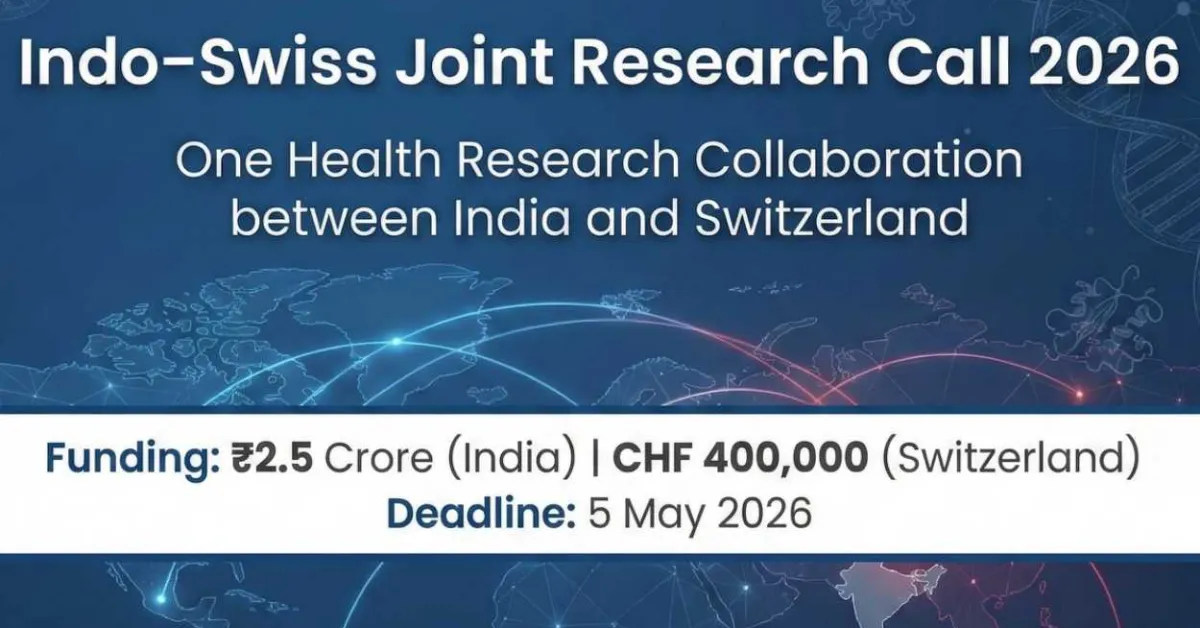
The maximum permissible budget for a project is CHF 400’000 for four years.
• Personnel costs (salaries within the salary ranges and rates set by the SNSF and social security contributions of scientific and technical employees); please note that the salaries of applicants are not eligible costs;
• Material costs that are directly related to the research work, namely material of enduring value, expendable items, field expenses, travel expenses, third-party charges or computing time;
• Direct costs incurred through the use of research infrastructure linked to the research work;
• Costs for granting access to research data (Open Research Data, max. CHF 10’000 per project);
• Costs for the organisation of conferences and workshops in connection with the funded re- search;
• Costs for national and international cooperation and networking activities carried out in connection with the funded research. The SNSF regulations apply to the Swiss budget (see also the guidelines). However, overhead costs are not admissible. Please note that costs for open access publications can be requested separately via the OA platform of the SNSF. However, costs for Open Research Data (ORD) must be taken into account at the time of submission of the application. They cannot be covered by a supplementary grant.
Eligibility costs in India : DBT and ICMR
The Indian side can fund equipment, manpower, consumables, contingencies, travel (local and inter- national), overhead and other (outsourcing, meetings, workshops etc.). The proposal may be consid- ered for funding support for 4 years with a maximum budget limit up to 25 million INR (Rs. 2.50 Crores) by DBT and ICMR. Equipment budget in the proposal should not be more than 30% of the total budg- et.
Visiting costs between Switzerland and India
When budgeting visits between the Swiss and Indian partners, expenses related to international travel are to be charged to the budget of the visiting side and the living expenses (local hospitality etc.) to the budget of the hosting side. Overseas health/medical insurance should be included in the budget of the visiting side. A maximum of one research visit per year and per person is permitted for research per- sonnel for a short duration of up to two weeks. Travel and accommodation costs are subject to the regulations of the respective countries
Submission
Proposals are to be jointly prepared by Swiss and Indian applicants. They must be submitted via the SNF Portal. Hardcopies will not be accepted. Neither the SNSF nor the DBT or ICMR will be held re- sponsible for non-submission of a proposal.