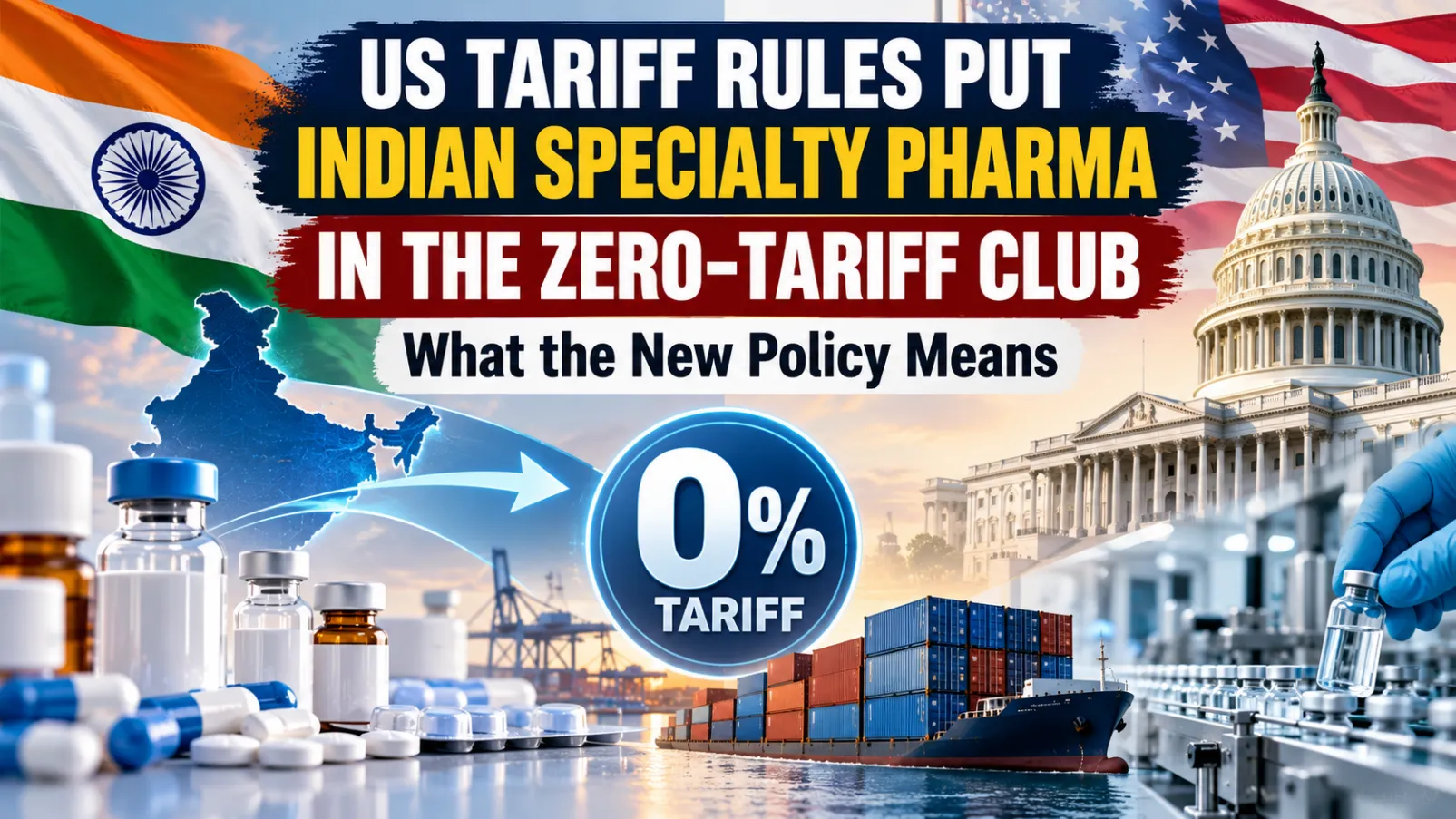
The United States has issued new guidance explaining how certain specialty pharmaceutical products and associated pharmaceutical ingredients can qualify for a zero percent tariff under the country's latest pharmaceutical import tariff framework.
The guidance, issued by the U.S. Department of Commerce's Bureau of Industry and Security (BIS) and published in the Federal Register on September 23, 2026, is particularly significant for the global pharmaceutical industry because India is among the jurisdictions specifically listed as eligible for the tariff adjustment.
However, the policy does not mean that all medicines or pharmaceutical products exported from India to the United States will automatically receive a zero tariff.
India Included Among Eligible Jurisdictions
The Federal Register notice lists the jurisdictions eligible for the specialty-pharmaceutical tariff adjustment under Presidential Proclamation 11020.
The list includes: Argentina, Bangladesh, Cambodia,Ecuador, El Salvador, European Union, Guatemala, India, Indonesia, Japan, Jordan, Malaysia, North Macedonia, Republic of Korea, Switzerland and Liechtenstein, Taiwan, Thailand, United Kingdom, Vietnam
The Commerce Department also states that the list may be changed through a future Federal Register notice. For Indian pharmaceutical companies exporting qualifying specialty products to the U.S., the inclusion of India is therefore an important development.
Which Pharmaceutical Products Can Qualify for Zero Tariff?
The new guidance defines several categories of pharmaceutical products that may receive the zero-percent tariff treatment when the required conditions are satisfied.
These include:
1. Orphan Drugs: The policy covers drugs or biological products where all approved indications are designated as orphan indications for rare diseases or conditions. This distinction is important. A product does not qualify simply because it has one orphan indication if its other approved indications do not fall within the orphan category.
2. Nuclear Medicines: Nuclear medicines covered by the definitions in U.S. regulations are included. The definition encompasses radioactive drugs and radioactive biological products, including certain products used in nuclear medicine applications.
3. Plasma-Derived Therapies: The policy includes biological products derived from human whole blood or plasma.
4. Fertility Drugs: Drugs and biological products used for the treatment of infertility are included, including medicines approved for treating ovulatory dysfunction in women seeking pregnancy.
5. Cell Therapy Products: The definition includes cellular immunotherapies, cellular cancer vaccines and other autologous or allogeneic cellular products approved for therapeutic indications. It also covers certain hematopoietic and stem-cell products.
6. Gene Therapy Products: Products intended to modify or manipulate gene expression or alter the biological properties of living cells for therapeutic use are included.
7. Antibody-Drug Conjugates: The notice defines antibody-drug conjugates as combination products consisting of a small-molecule drug payload and an antibody or antibody fragment connected through a chemical linker.
8. Medical Countermeasures: Certain drugs and biological products used to diagnose, prevent or treat diseases or conditions caused by chemical, biological, radiological or nuclear threats are included. The definition also covers certain qualified countermeasures and pandemic, epidemic and security countermeasure products.
9. Animal Healthcare Products: The zero-tariff framework also covers qualifying animal healthcare products. This includes veterinary pharmaceuticals and certain animal-health biologics such as vaccines, bacterins and diagnostic products regulated by the USDA Center for Veterinary Biologics.
The Commerce Department emphasizes that these definitions are specifically for determining eligibility for the tariff adjustment under Proclamation 11020 and should not be treated as general FDA or regulatory definitions.
Does This Mean All Indian Medicines Will Have Zero Tariff?
No.
This is one of the most important points for Indian pharmaceutical exporters. The inclusion of India in the eligible-jurisdiction list does not by itself make every pharmaceutical product exported from India eligible for a zero tariff. The zero-tariff provision applies to the specialty pharmaceutical categories identified in the Presidential Proclamation, subject to the applicable conditions.
The Federal Register notice also states that, at present, the Section 232 pharmaceutical tariffs do not apply to generic pharmaceutical products and associated ingredients. This means Indian manufacturers of conventional generic medicines should distinguish between the existing treatment of generic products and the separate zero-tariff mechanism created for qualifying specialty products.
What About the 100% Tariff on Certain Patented Pharmaceuticals?
The new guidance must also be understood alongside Presidential Proclamation 11020. That proclamation imposed a 100% ad valorem tariff on certain imports of patented pharmaceutical products and associated pharmaceutical ingredients. For companies listed in Annex III of the proclamation, the tariff became effective July 31, 2026. For other companies, the effective date was September 29, 2026.
Different tariff treatment can apply to products from certain jurisdictions and to companies that have Commerce-approved onshoring agreements.
Consequently, the new September 2026 guidance creates an important distinction between:
certain patented pharmaceutical imports subject to the Section 232 tariff and
qualifying specialty pharmaceutical products that can receive a zero-percent tariff when the relevant conditions are met.
Important HTSUS Changes
The Federal Register notice is not only about defining specialty pharmaceutical products. It also makes five technical corrections to Annex I and one correction to Annex IV of Proclamation 11020. One significant correction modifies the definition of generic pharmaceutical articles to specifically include unpatented animal-health products.
Another correction creates a new HTSUS heading carrying a zero-percent tariff for certain pharmaceutical products and associated ingredients imported solely for:
- Clinical trials
- Research and development
- Other non-commercial applications
The notice also clarifies the meaning of "pharmaceutical articles," limiting that definition to finished pharmaceutical products, their active pharmaceutical ingredients and key starting materials for those APIs.
Additional corrections address products that do not fall into those categories and incorporate HTSUS changes made on July 1, 2026.
The changes in Annex I are effective for goods entered for consumption, or withdrawn from warehouse for consumption, on or after 12:01 a.m. Eastern Time on September 29, 2026. This date is particularly important for companies assessing their U.S. import and tariff obligations under the new pharmaceutical framework.
What Indian Pharma Companies Should Watch
For Indian pharmaceutical exporters, several issues will be important:
Product classification: Companies need to determine whether the product falls within one of the specialty categories and which HTSUS classification applies.
Patent status: The distinction between patented and generic products is central to the current Section 232 framework.
Country of origin: Exporting a product from India does not necessarily mean every product automatically qualifies for the specialty-pharma zero tariff. The applicable rules must be examined product by product.
U.S. health need: Companies whose specialty products serve an urgent U.S. health need may have an additional route to request Commerce approval.
Importer documentation: CBP can request additional documentation when administering the tariff adjustment.
Regulatory definitions: The definitions in this notice are specifically intended for tariff eligibility and should not be treated as general pharmaceutical regulatory definitions.
What This Means for the Indian Pharmaceutical Industry
The September 2026 Federal Register notice creates a more detailed framework for determining how certain specialty pharmaceutical imports will be treated under the U.S. Section 232 pharmaceutical tariff regime. For India, the key development is the country's explicit inclusion among the jurisdictions eligible for the specialty-pharmaceutical tariff adjustment.
At the same time, Indian pharmaceutical exporters should not interpret the announcement as a blanket exemption for all medicines exported to the United States. The practical impact will depend on the product, patent status, HTSUS classification, country-of-origin rules and the specific requirements of Proclamation 11020.
For companies developing or exporting advanced therapies, including rare-disease treatments, cell and gene therapies, ADCs, plasma-derived products and certain fertility or nuclear medicines, the new framework could become an important consideration when assessing U.S. market access and supply-chain planning.