
In the 1970s, India was facing a silent epidemic of cataract blindness. Millions of elderly people were losing their eyesight, not because treatment was unavailable, but because it was unaffordable. Cataract surgery required replacing the cloudy natural lens with a clear artificial intraocular lens (IOL). At that time, these lenses were imported and cost nearly 100 US dollars each, far beyond the reach of poor patients.
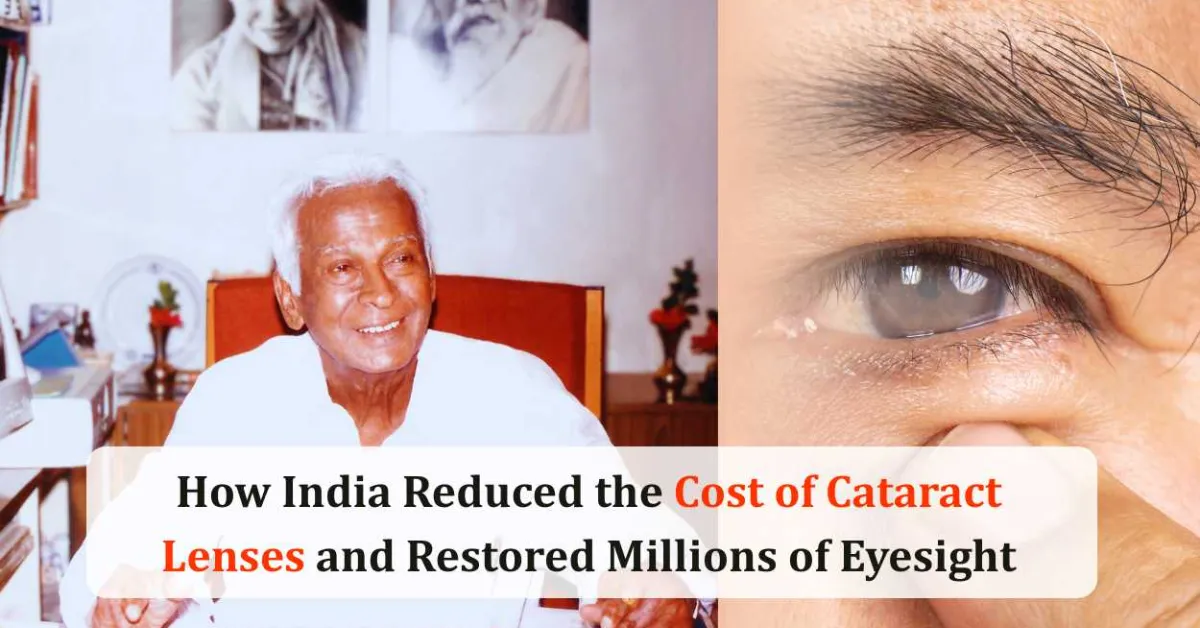
At the center of the solution was a remarkable man, Dr. Govindappa Venkataswamy, lovingly known as Dr. V.
Dr. G. Venkataswamy- The Man with a Mission
Dr. V was born in 1918 in Tamil Nadu. He worked as a government doctor and later specialized in ophthalmology. Ironically, he suffered from severe rheumatoid arthritis, which left his fingers permanently bent and deformed. Despite this physical challenge, he trained himself to perform delicate eye surgeries with extraordinary precision.
After retiring from government service at the age of 58, when most people slow down, Dr. V began his life’s greatest work. In 1976, with just 11 beds in Madurai, he founded Aravind Eye Hospital.
His dream was inspired by spirituality and service. He believed blindness due to cataract was unnecessary and that high-quality eye care should be available to everyone. He often said that service to humanity is service to God.
Under his leadership, Aravind adopted a high-efficiency model similar to an assembly line. Surgeons focused only on surgery, while trained support staff handled preparation and post-operative care. This allowed Aravind to perform a very high number of surgeries daily without compromising quality.
The Birth of Aurolab - A Bold Step
By the late 1980s, Aravind had improved surgical efficiency, but one major cost remained i.e. the intraocular lens. Imported lenses were too expensive which cost around 100 US dollars (Rs 2,500–Rs 3,000 at that time). Many patients either avoided surgery or underwent procedures without lens implantation.
Dr. V believed that if India could manufacture vaccines and medicines, it could also manufacture intraocular lenses.
In 1992, Aravind established Aurolab in Madurai as a not-for-profit manufacturing division. The name “Aurolab” reflects “Auro,” meaning light, symbolizing restoration of sight.
Starting from modest facilities, Aurolab began manufacturing rigid intraocular lenses. Within a short time, it reduced the cost of lenses from nearly 100 dollars to about 10 dollars. As production increased and technology improved, costs dropped further to just a few dollars per lens. Today, some rigid lenses from Aurolab cost as low as 2–5 US dollars.
Beyond Manufacturing - A Global Impact
Aurolab helped transform cataract surgery in India. Affordable lenses made it possible for Aravind to perform free and low-cost surgeries on a massive scale.
Aravind’s cross-subsidy model became globally recognized. Paying patients receive private facilities, while non-paying patients receive free care, but the quality of surgery remains identical.
The Aravind-Aurolab model is now studied by institutions such as Harvard Business School and public health organizations worldwide as an example of social entrepreneurship in healthcare.
What We Learn from the Aravind-Aurolab Story
The story of Aravind and Aurolab teaches powerful lessons for healthcare and society.
1. Innovation Can Reduce Cost Without Reducing Quality
Aravind proved that high-quality healthcare does not have to be expensive. By improving efficiency and producing lenses locally, they reduced costs dramatically.
2. Social Mission Drives Sustainable Impact
Their goal was not profit, but service. When healthcare focuses on patient welfare, long-term success follows.
3. Local Manufacturing is Powerful
By manufacturing intraocular lenses in India, they reduced dependency on imports and made surgery affordable for developing countries.
4. Cross-Subsidy Model Works
Patients who could afford to pay helped support free treatment for poor patients. Importantly, the quality of care remained equal for all.
5. Scale Creates Impact
By performing surgeries in large numbers and standardizing processes, Aravind achieved both efficiency and excellence.
6. Compassion + Management = Transformation
Medical skill alone is not enough. Good management, systems, and compassionate leadership can transform public health.
The Legacy of Dr. V
Dr. G. Venkataswamy’s life was not only about building a hospital. It was about building a movement to eliminate needless blindness. His dedication, discipline, and spiritual strength inspired thousands of doctors and healthcare workers.
Over the years, his extraordinary service to society received national and international recognition.
In 1973, he was awarded the Padma Shri, one of India’s highest civilian honors, for his contribution to medicine and public health. In 1987, he received the prestigious Helen Keller International Award, recognizing his outstanding efforts in preventing blindness and restoring vision to millions. In 2001, he was honored with the Dr. B. C. Roy Award, one of the highest medical honors in India, given for excellence in the medical field.
Even after his lifetime, his impact continued to be remembered worldwide. On 1 October 2018, search engine Google commemorated Dr. Venkataswamy with a special Google Doodle on his birth centenary. This global tribute introduced his inspiring story to millions of people around the world.
Dr. V passed away in 2006, but his vision lives on. Today, the Aravind Eye Care System treats millions of patients every year and continues to expand its mission across India and beyond.
His life teaches us powerful lessons :
- Age is not a barrier to starting something meaningful.
- Physical challenges cannot limit a strong will.
- Healthcare can be affordable and world-class at the same time.
- Service to humanity is the highest purpose.
Dr. V once said :
"When we grow in spiritual consciousness, we identify ourselves with all that is in the world."
Through Aravind and Aurolab, he turned that belief into action and gave the gift of sight to millions.