
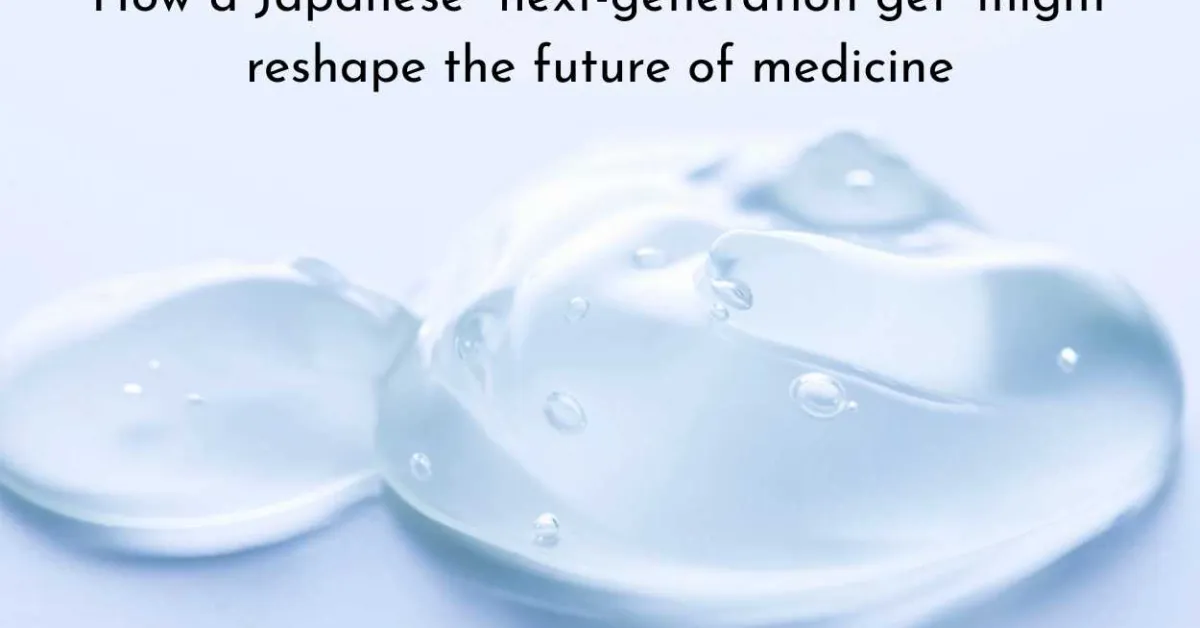
In everyday life we know gels like jelly, tofu, or soft contact lenses. But now, a Tokyo-based biotech startup claims to have developed a radical new kind of gel called tetra gel, that could transform the landscape of modern medicine.
What is tetra-gel and why is it a big deal
Gels are more than “slimy stuff.” At a scientific level, gels are materials in which long polymer molecules (chains made of thousands of atoms) form a mesh that traps water, a structure that can mimic many properties of biological tissues.
Conventional gels have irregular, unpredictable mesh structures, which make their behavior hard to control inside the human body. This lack of uniformity once led to serious complications: decades ago, when gels were used in retinal surgery, unexpected expansion caused a medical accident. Because of that instability, medical uses of gel remained limited.
According to Gellycle Co., Ltd. the startup behind this development tetra-gel offers a stable, uniform mesh structure, whose physical laws have been thoroughly verified. This means researchers can now predict and finely control key properties: how fast it solidifies (from liquid to solid), its strength, and even the size of its microscopic mesh.
Shape-shifting versatility. Tetra-gel can be molded in various forms soft sheet, viscous “slime,” or high-strength fiber depending on medical need.
Because of its predictability and versatility, tetra-gel could open the door to widespread use of gels in medicine overcoming the longstanding limitations of older gels.
Real-world possibilities: from tendons to insulin
Thanks to the new control over gel properties, a vast range of medical applications are now plausible:
Artificial tendons and ligaments: In 2023, Gellycle announced progress toward what could become the world’s first gel-based artificial tendons and ligaments. Such implants could eliminate the need for surgical tendon harvesting — for instance, in reconstructive surgeries often required by athletes — thereby reducing patient trauma, operation time, and improving quality of life.
Bleeding control (hemostatic agents): Because gels can be adapted to quickly form stable, body-compatible materials, they might be used to instantly stop bleeding, potentially replacing the hours of pressure or more invasive interventions currently needed.
Drug delivery, e.g. insulin without injections: Researchers envision tetra-gel infused with drugs (like insulin) and applied externally (e.g., on skin), where the gel gradually dissolves and releases medication. This could eliminate frequent injections, a major benefit for patients with chronic conditions like diabetes.
Regenerative medicine (organs, bones, tissues): Perhaps the most ambitious potential: instead of traditional regenerative medicine methods that grow cells or tissues in labs, which are expensive and time-consuming, doctors might one day simply inject tetra-gel (optionally with bioactive components) to regenerate organs or bones. Because tetra-gel is lab-synthesized and not biologically derived, this approach could drastically reduce cost and complexity.
In short: from reconstruction (ligaments), tissue repair (organs/bones), to advanced drug delivery, tetra-gel could underpin a new class of medical therapies.
The science behind the breakthrough
The core of the advancement lies in controlling gel structure at the microscopic level. Using synthetic polymer chemistry, the creators of tetra-gel have managed to produce a uniform mesh network, unlike previous gels whose mesh was uneven and unpredictable.
This uniformity allows scientists to predict how the gel will behave after implantation: how it will solidify, how strong it will be, how it will dissolve or remain in place, how long it will last, etc. That predictability is essential for medical safety and efficacy.
According to the CEO of Gellycle, this marks a shift from what he calls “Gel 1.0” (simple jellies) and “Gel 2.0” (stronger, more extensible gels), into “Gel 3.0”, a new generation where gels’ physical properties are no longer uncertain but controllable at will.
This scientific maturity now enables gel materials to meet what the startup calls “unknown medical needs” i.e. health issues for which there is currently no adequate treatment.
A collaborative and global approach
Gellycle has decided not to keep their new tetra-gel technology locked away, and instead they’re taking more of a platform-style approach where the material is shared openly with around forty universities and companies in Japan and even overseas.
The idea is that by letting many groups work with the gel, research moves faster and nobody has to wait for one company to figure out every possible use on its own. This kind of openness also means scientists in different fields might come up with applications that Gellycle themselves didn’t really imagine, which could speed up innovation and widen the gel’s potential in ways that are hard to predict right now.
Of course, managing so many partners can be a bit messy at times, but the main hope is that this broad collaboration will help bring tetra-gel into large-scale medical use by around 2030, not just in Japan but hopefully worldwide.
What this could mean for medicine (and for patients)
The rise of tetra-gel really seems like it could open a whole new chapter in medical materials, where gels might become just as important as implants or even some medicines we rely on today. Because the material can be shaped and controlled so precisely, doctors might be able to perform far less invasive procedures, like creating artificial ligaments or tissues without needing to take anything from the patient’s own body.
It could also make regenerative treatments a lot more affordable, since the gel can replace those complicated and expensive lab-grown cell cultures with simpler synthetic scaffolds.
For patients, this might translate into fewer surgeries, fewer injections, faster healing and hopefully less side-effects too, which honestly is something everyone would appreciate. And because many researchers and countries can work with tetra-gel at the same time, innovation might spread much quicker across borders. If everything goes the way scientists hope, a bunch of medical problems that seem almost impossible to treat right now could see real improvements within the next decade.
Challenges :
Even with all the excitement around tetra-gel, there are still plenty of questions and hurdles that need to be sorted out before it becomes a common part of medical practice.
One of the biggest concerns is long-term safety, because even though the gel uses materials like PEG that are already familiar in cosmetics and some medicines, scientists still need to understand how the gel behaves inside the body over many years. Then there’s the whole regulatory and clinical trial process, which can be pretty slow, especially for totally new kinds of implants or drug-delivery systems. Manufacturing at scale is another challenge too, since producing biomedical-grade gel that stays sterile and consistent isn’t as simple as it sounds.
And of course, doctors and patients will have to actually trust the material, which can take time when something new is being placed inside the human body. Even so, the fact that researchers have finally solved the old problem of unpredictable gel structure is a huge milestone on its own and gives a real reason to believe the rest might eventually fall into place.
Looking ahead : a new branch of science “Gel Science”
Looking ahead, the creators of tetra-gel believe they’re building more than just another medical material, they think this could spark an entirely new field they’re calling “gel science.”
Gellycle’s CEO even describes this moment as a major turning point, saying that after moving from Gel 1.0 to Gel 3.0, researchers finally have real control over the physical behavior of gels, which opens the door to solving medical problems that still don’t have proper treatments.
If the ongoing experiments and global collaborations continue to move forward as hoped, it might not be too long before things like injections, implants, tissue repair, and even regenerative medicine itself get reshaped by this new type of lab-made gel. It’s still early, of course, but the possibilities honestly feel much closer than they did just a few years ago.