
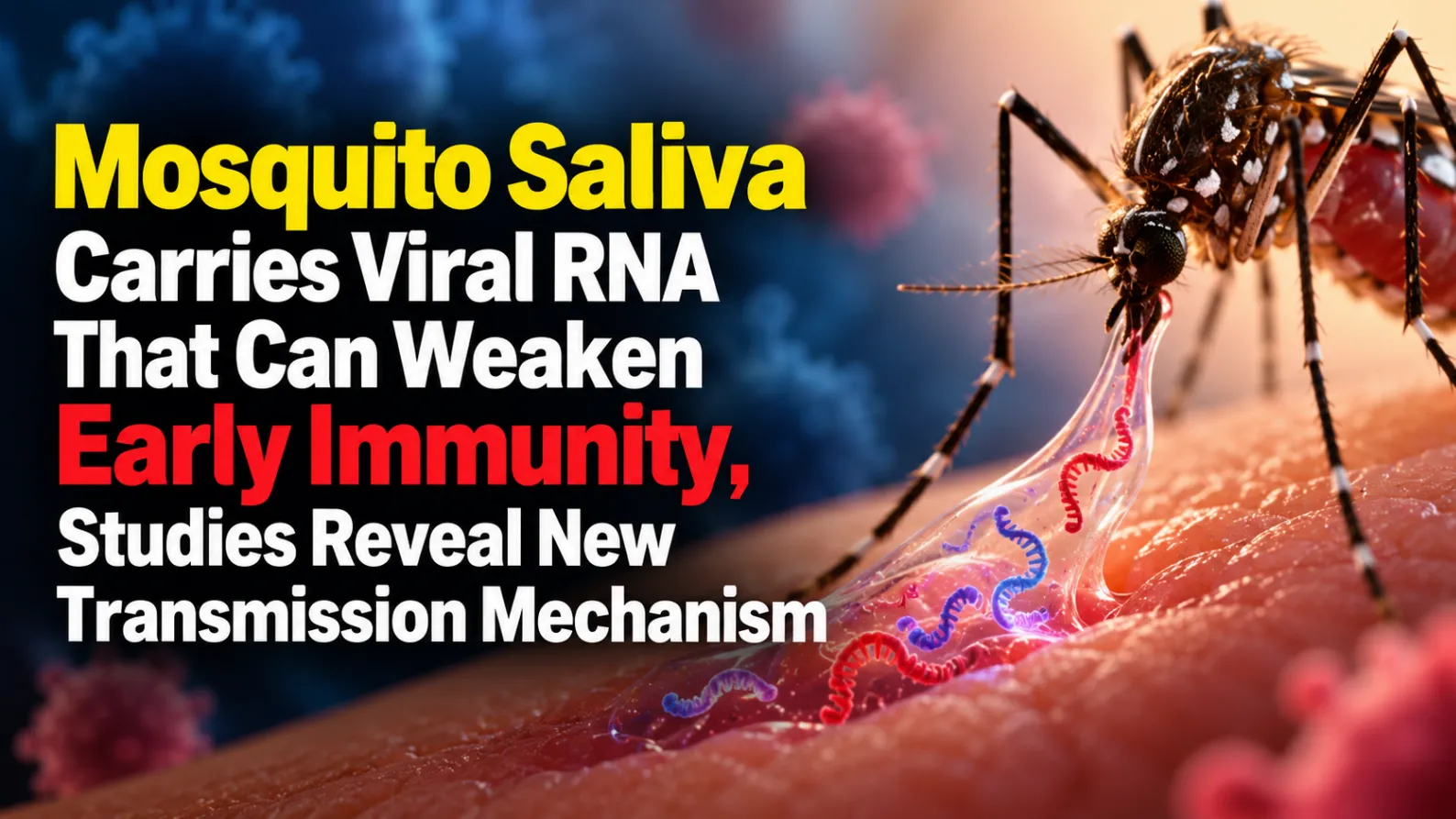
Research published in Nature Communications, alongside earlier studies on dengue and mosquito-derived extracellular vesicles, suggests that viruses may exploit molecules delivered through mosquito saliva to overcome the body's early immune defences.
Mosquito bites may do more than introduce viruses into the human body. Emerging research suggests that infected mosquitoes can also deliver viral RNA molecules through their saliva, helping mosquito-borne viruses establish infection by interfering with the body's first-line immune response.
A study published in Nature Communications on August 29, 2026, has identified a viral molecule called subgenomic flaviviral RNA (sfRNA) in the saliva of mosquitoes infected with West Nile virus and Zika virus. According to the researchers, this RNA can weaken early antiviral signalling in human skin cells, creating conditions that favour viral infection.
The findings build on earlier research demonstrating that dengue-infected mosquitoes also release sfRNA in their saliva. Additional studies have identified molecular mechanisms through which mosquitoes package viral RNA into secreted vesicles and have shown that mosquito-derived lipids can independently enhance flavivirus infection.
Together, these studies are expanding scientific understanding of how the interaction between mosquitoes, viruses and human skin influences the initial stages of infection.
Viral RNA in Mosquito Saliva May Help Viruses Evade Early Defences
The skin serves as an important barrier against invading pathogens. When a mosquito carrying a virus bites a person, the virus enters the skin, where resident cells and immune cells begin recognising the infection and initiating defensive responses.
One important component of this process is the production of interferons, signalling proteins that help neighbouring cells establish an antiviral state.
The 2026 Nature Communications study identified sfRNA in saliva collected from mosquitoes infected with West Nile virus and Zika virus. The researchers found that this RNA was associated with lipid-containing vesicles distinct from intact virus particles.
Experiments using human cells and human skin explants showed that higher concentrations of sfRNA in infectious mosquito saliva were associated with greater infection intensity. Further experiments supported a direct role for the RNA in enhancing infection.
The researchers also found that sfRNA interfered with MDA5-mediated signalling, a pathway involved in detecting viral RNA and activating antiviral immune responses.
By weakening this early defence mechanism, sfRNA may give viruses additional time to establish infection at the site of the mosquito bite.
However, the findings do not establish how frequently this mechanism determines the outcome of infection in humans under natural conditions.
Earlier Dengue Research Identified a Similar Mechanism
The discovery is supported by an earlier study published in PLOS Pathogens in March 2023.
In that research, scientists investigated dengue virus serotype 2 and found substantial quantities of sfRNA in the saliva of infected Aedes aegypti mosquitoes, a major vector of dengue.
The team detected sfRNA using several techniques, including RNA sequencing, reverse-transcription quantitative polymerase chain reaction (RT-qPCR) and Northern blot analysis.
The researchers also found evidence that the RNA was protected within detergent-sensitive compartments, believed to be extracellular vesicles. These structures can transport biological material between cells.
Experiments showed that mosquito saliva containing greater amounts of sfRNA was associated with increased viral infectivity in experimental cell systems. Introducing dengue-derived RNA into human cells also reduced aspects of the antiviral interferon response and increased viral replication under the study conditions.
The 2023 findings provided evidence that sfRNA could contribute to dengue transmission rather than functioning exclusively inside virus-infected cells.
The 2026 Nature Communications study extends this line of investigation to West Nile virus and Zika virus, providing evidence for a related transmission-enhancing mechanism across multiple orthoflaviviruses.
How Does sfRNA Work?
Subgenomic flaviviral RNA is a non-coding RNA produced during flavivirus infection. It originates from viral RNA sequences that resist complete degradation by the host cell's RNA-degrading machinery.
Unlike messenger RNA used to produce proteins, sfRNA does not primarily function as a protein-production template. Instead, it can influence interactions between the virus and the host cell.
Previous studies have linked sfRNA to several processes involved in viral infection, including interference with innate immune responses and the regulation of cellular pathways that normally restrict viral replication.
The latest research highlights an additional aspect of its activity: sfRNA can be delivered through mosquito saliva at the moment the virus enters the skin.
This potentially gives the virus an advantage at a particularly important stage of infection, when local cells are beginning to detect and respond to the invading pathogen.
PNAS Study Explains How Dengue Virus Packages RNA Into Mosquito Exosomes
A further advance came from research published in the Proceedings of the National Academy of Sciences (PNAS) in March 2026.
This study investigated how dengue virus-derived sfRNA is loaded into extracellular vesicles and released into mosquito saliva.
The researchers identified a mosquito protein called AeSyntenin that participates in the formation and secretion of these vesicles. Their experiments indicated that sfRNA can interact with AeSyntenin through structural features of the RNA molecule, promoting its selective packaging into vesicles.
Using experimental approaches that included genetic editing and protein depletion, the team investigated the role of AeSyntenin in exosome production and the salivary release of sfRNA.
The work provides a potential molecular explanation for how an RNA molecule produced during viral infection can be transported out of mosquito cells and delivered to a new host.
The study focused on dengue virus and the mosquito system examined by the researchers. Whether the same packaging mechanism operates identically across all mosquito-borne flaviviruses requires further investigation.
Mosquito Saliva May Also Enhance Infection Through Lipids
Viral RNA is not the only component of mosquito saliva attracting scientific attention.
A separate study published in Cell Metabolism in 2025 investigated sphingomyelins, a class of lipids found in mosquito saliva-associated extracellular vesicles.
The researchers reported that these lipids could alter the lipid composition of human cells and increase the accumulation of viral proteins during flavivirus infection. Their experiments indicated that sphingomyelins interfered with endoplasmic-reticulum-associated degradation, a cellular quality-control process that helps eliminate certain abnormal or unwanted proteins.
This reduced degradation of viral proteins, supporting infection in the experimental systems examined. The study also found enhanced transmission and more severe disease outcomes in mouse experiments involving the relevant salivary vesicle lipids.
These findings identify a mechanism distinct from sfRNA-mediated interference with antiviral signalling.
Taken together, the research suggests that mosquito saliva can contain multiple biologically active components that influence infection through different pathways. Some may affect immune signalling, while others can alter the cellular environment in ways that favour viral protein accumulation.
What Did the Mouse Experiments Show?
The 2026 Nature Communications research also included experiments in a mouse model of West Nile virus transmission.
The researchers reported that introducing sfRNA together with West Nile virus enhanced infection in the skin and was associated with more severe disease outcomes.
These observations support the proposed role of sfRNA as a transmission-enhancing factor. They also suggest that events occurring at the mosquito bite site may influence the subsequent course of infection.
Nevertheless, the results need to be interpreted within the limits of experimental research. Human skin explants, cultured cells and animal models provide valuable information about biological mechanisms, but they cannot fully reproduce natural infections in people.
Further clinical and translational research would be needed to determine the contribution of salivary sfRNA to infection rates, disease severity and clinical outcomes in humans.
Could These Findings Lead to New Approaches to Prevention?
The identification of sfRNA in mosquito saliva opens several potential avenues for future investigation.
One approach could involve studying whether interference with the packaging or secretion of sfRNA reduces its delivery into human skin. Another would be to investigate whether blocking the interaction between sfRNA and host immune-signalling pathways helps restore early antiviral responses.
The PNAS findings on AeSyntenin may also support research into the mosquito cellular machinery involved in releasing infection-enhancing RNA. Separately, the Cell Metabolism study suggests that salivary lipids could represent additional targets for investigation.
Because related mechanisms have been identified in studies of dengue, Zika and West Nile viruses, scientists may be able to investigate targets that act across more than one viral species.
However, these possibilities remain research directions rather than established prevention strategies. The studies do not demonstrate the safety or effectiveness of an sfRNA-blocking treatment, a new vaccine or a clinically available intervention.
Why the Research Matters
Mosquito-borne viral infections are shaped by interactions involving the virus, the mosquito vector and the person being bitten. Understanding only the virus itself may therefore leave important parts of the transmission process unexplained.
The emerging evidence on sfRNA, extracellular vesicles and salivary lipids highlights the biological activity of material delivered alongside viral particles during a mosquito bite.
The latest Nature Communications study adds evidence that sfRNA can interfere with MDA5-mediated early antiviral signalling in experimental models involving West Nile virus and Zika virus. Combined with previous dengue research, it provides a stronger basis for investigating how viral RNA in mosquito saliva influences infection.
The next challenge will be to determine how these mechanisms operate during natural mosquito bites, how broadly they apply across different mosquito-virus combinations and whether disrupting them can meaningfully reduce disease.
Until then, the findings represent an important advance in understanding the early biology of mosquito-borne infections, rather than an immediate change in clinical prevention or treatment.
References
1. Serrato-Pomar I, Medkour H, Belleville L, Jintana K, Pruvost L, Schneider N, et al. Multiple orthoflaviviruses secrete sfRNA in mosquito saliva to promote transmission by inhibiting MDA5-mediated early interferon response. Nat Commun. 2026;17(1):10323. doi: 10.1038/s41467-026-77288-4.
2. Yeh SC, Strilets T, Tan WL, Castillo D, Medkour H, Rey-Cadilhac F, et al. The anti-immune dengue subgenomic flaviviral RNA is present in vesicles in mosquito saliva and is associated with increased infectivity. PLoS Pathog. 2023;19(3):e1011224. doi: 10.1371/journal.ppat.1011224.
3. Rachenne F, Schneider N, Rey-Cadilhac F, Serrato-Pomar I, Pruvost L, Di Pietro L, et al. Dengue virus harnesses mosquito Syntenin to load and secrete viral RNA into salivary exosomes. Proc Natl Acad Sci U S A. 2026;123(12):e2520697123. doi: 10.1073/pnas.2520697123.
4. Medkour H, Pruvost L, Miot EF, Gong X, Vaissayre V, Tavadia M, et al. Sphingomyelins in mosquito saliva reconfigure skin lipidome to promote viral protein levels and enhance transmission of flaviviruses. Cell Metab. 2025;37(7):1601–1614.e11. doi: 10.1016/j.cmet.2025.05.015