
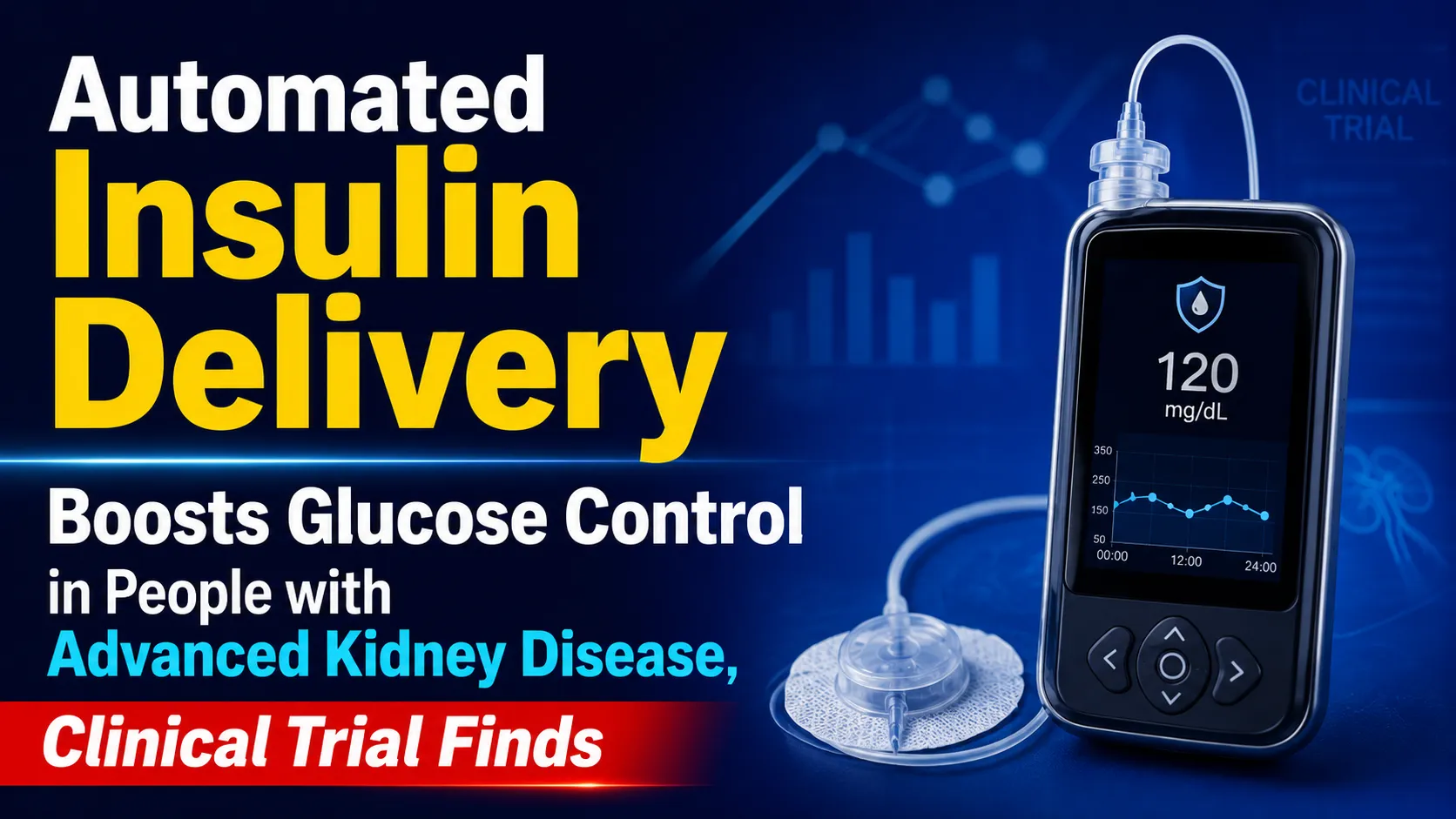
People living with diabetes and advanced chronic kidney disease (CKD) may benefit significantly from automated insulin delivery (AID) technology, according to a new international clinical trial. Researchers found that AID systems improved blood glucose control without increasing the risk of severe hypoglycaemia, offering a promising treatment option for one of the most medically complex diabetes populations.
The study evaluated the performance of a commercially available hybrid closed-loop insulin delivery system in adults with type 1 diabetes or insulin-treated type 2 diabetes complicated by advanced CKD, including individuals receiving dialysis. Investigators reported that the technology provided better glucose management than standard insulin therapy combined with continuous glucose monitoring (CGM).
A Challenging Patient Population
Managing diabetes becomes increasingly difficult as kidney function declines. Advanced CKD alters insulin metabolism, making blood glucose levels more unpredictable and increasing the risk of both hyperglycaemia and hypoglycaemia. Dialysis treatments can further complicate glucose control, leaving many patients with large fluctuations throughout the day.
Although automated insulin delivery systems have transformed diabetes care in recent years, their use in patients with severe kidney disease has remained largely unexplored.
To address this evidence gap, researchers conducted a prospective, open-label, randomized crossover trial across five tertiary hospitals in Australia and one center in Denmark.
Study Included Adults With Advanced CKD
The trial enrolled 40 adults with advanced CKD, including:
• 24 participants with type 1 diabetes
• 16 participants with insulin-treated type 2 diabetes
• 33 participants with stage 3b or higher CKD who were not on dialysis
• Four participants receiving peritoneal dialysis
• Three participants undergoing haemodialysis
Participants had a median age of 60 years and a median HbA1c of 8.0%. Most were using multiple daily insulin injections before entering the study.
Each participant completed two 8-week treatment periods: one using the MiniMed 780G automated insulin delivery system and another receiving their usual diabetes care with real-time continuous glucose monitoring.
Significant Improvement in Time Spent Within Target Glucose Range
The primary endpoint was the percentage of time glucose levels remained within the recommended target range of 3.9-10.0 mmol/L during the final three weeks of each treatment period.
Researchers observed a substantial improvement with automated insulin delivery.
Median time in range increased from 60% during usual care to 73% with automated insulin delivery, representing an average improvement of 13.7 percentage points. This translates to approximately 3.3 additional hours each day spent within the recommended glucose range.
The system also significantly reduced:
• Time spent above the target glucose range
• Mean glucose levels
• Glucose variability
• Overall glycaemic risk
No Increase in Hypoglycaemia
One of the major concerns in people with advanced kidney disease is hypoglycaemia, as declining kidney function reduces insulin clearance and increases susceptibility to dangerously low blood sugar.
Importantly, the study found that automated insulin delivery did not increase hypoglycaemia.
Time spent below glucose targets remained very low throughout the trial, and rates of severe hypoglycaemia were similar between treatment approaches.
Only one episode of severe hypoglycaemia occurred during the usual-care phase, while no severe episodes were linked to automated insulin delivery.
Greater Benefits Seen in Type 1 Diabetes
Although both diabetes groups experienced improved glucose control, the benefits were more pronounced among participants with type 1 diabetes.
For these individuals, time in range increased by approximately 19 percentage points, whereas participants with type 2 diabetes experienced an improvement of about 5 percentage points.
Researchers suggest that the larger benefit in type 1 diabetes likely reflects greater baseline glucose variability and complete dependence on insulin therapy.
Technology Was Feasible Despite Medical Complexity
The study population represented a medically vulnerable group.
Many participants were classified as pre-frail, several had mild cognitive impairment, and numerous participants had multiple diabetes-related complications.
Despite these challenges, researchers found that most participants successfully learned to use the automated insulin delivery system following structured education and clinical support.
Interestingly, the investigators noted that even participants with significant physical limitations—including legally blind individuals—were able to safely operate the technology.
Safety Findings
During the study, serious medical events occurred in both treatment periods because of the participants' underlying illnesses rather than the insulin delivery system.
Researchers reported :
• No serious adverse events attributed to the automated insulin delivery device
• One diabetic ketoacidosis episode during the AID phase that resulted from an acute heart attack and was considered unrelated to the device
• Similar numbers of hospital admissions during both treatment periods
• One participant died from a cardiac event unrelated to the study intervention
Approximately one-quarter of participants required hospital admission during the trial, highlighting the substantial medical burden carried by this population.
Quality of Life Remained Stable
The researchers also evaluated patient-reported outcomes, including :
• Treatment satisfaction
• Sleep quality
• Diabetes-related emotional distress
• Fear of hypoglycaemia
• Cognitive performance
• Frailty
Most of these measures remained stable throughout the study. Treatment satisfaction improved during both study periods, likely reflecting access to continuous glucose monitoring and intensive diabetes education.
Researchers Highlight Future Potential
The investigators concluded that automated insulin delivery is both feasible and safe for people with diabetes complicated by advanced chronic kidney disease.
While acknowledging limitations—including the relatively small sample size, short study duration, and limited number of dialysis participants—they believe the findings support broader evaluation of automated insulin delivery in this high-risk population.
Future studies involving larger and more diverse patient groups, longer follow-up periods, and additional insulin delivery systems are expected to further clarify the long-term benefits of this technology.
If confirmed in larger trials, automated insulin delivery could become an important strategy for improving glucose management while reducing the daily burden of insulin dosing in people living with both diabetes and advanced kidney disease.