
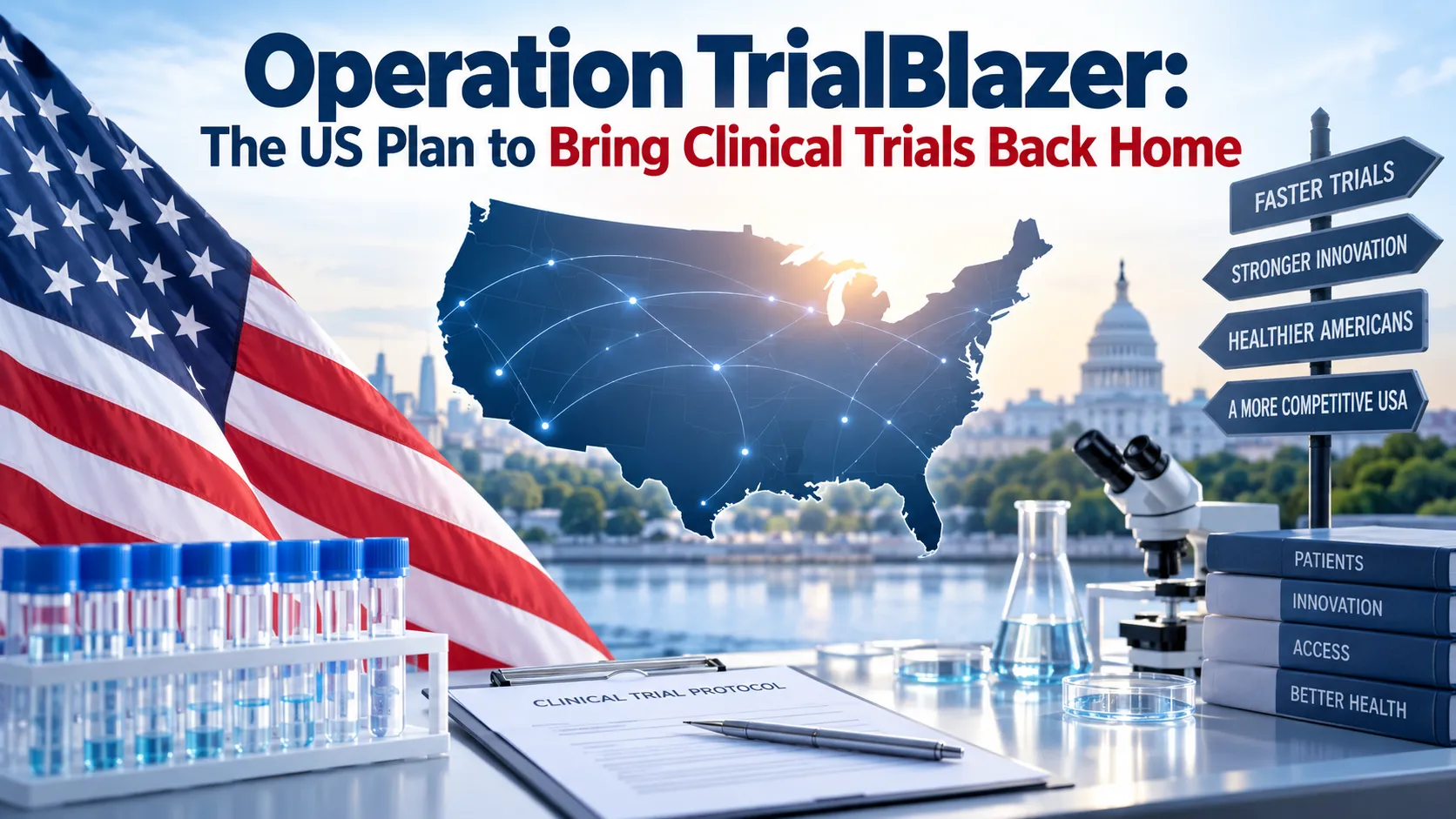
Operation TrialBlazer is a coordinated, department-wide initiative launched by the US Department of Health and Human Services (HHS) on June 22, 2026, aimed at restoring America's leadership in clinical research. It's not a single program but an umbrella strategy pulling together the FDA, NIH, NCI, NCATS, ARPA-H, and the Office of the Inspector General (OIG), each contributing reforms, funding, or new pilot programs toward one goal: making the US the fastest, most attractive place in the world to run a clinical trial again, especially early-phase (Phase I) studies.
HHS Secretary Robert F. Kennedy Jr. framed it bluntly: America built a regulatory system that pushed too much clinical research overseas, and TrialBlazer is meant to reverse that.
Why It Was Launched
The core driver is competition with China. A few data points HHS and industry watchers have flagged:
- China's share of global Phase I trials overtook the US back in 2021.
- In 2024, China surpassed the US in total registered clinical trials for the first time, over 7,100 trials, roughly 39% of the global total.
- Projections suggest drugs developed by Chinese companies could account for 35% of FDA approvals by 2040 if current trends continue.
- The National Security Commission on Emerging Technology warned the US has a "critical window, measured in years, not decades" before it permanently cedes ground in biomedical innovation, with knock-on effects for military, geopolitical, and economic standing.
Speed Comparison - Why China Wins Right Now
The gap TrialBlazer is trying to close comes down to one blunt number: a Phase I trial in China takes an average of seven months, compared to 17 months in the US, according to GlobalData/Deallus analysis. That's not a marginal edge, it's roughly two and a half times faster.
Drivers behind China's speed:
- Lower operating costs for sponsors and sites
- Streamlined, centralized regulatory review
- Direct government subsidies supporting biotech infrastructure
- Two decades of sustained, government-backed investment in clinical trial capacity, treating biotechnology as a strategic national priority
For sponsors, especially smaller biotechs, the calculation becomes simple: even accounting for perceived risk in data quality or oversight, the time and cost savings of running first-in-human studies in China can outweigh the advantages of staying in the US. That's the exact behavior TrialBlazer is designed to reverse.
How It Works - The Mechanisms
1. Expedited IND Pilot Program
The FDA is running a pilot pairing drug sponsors with qualified research institutions for rolling, institution-partnered Phase I IND development, aimed at fewer clinical holds and better-quality submissions, particularly for smaller sponsors without deep regulatory infrastructure. Applications opened roughly a month after launch.
2. Clarified Phase-Appropriate CMC Expectations
Tighter guidance on Chemistry, Manufacturing, and Controls (CMC) documentation for first-in-human trials, cutting down on over-submission that was adding 6–12 months of unnecessary delay before a trial could even begin.
3. Updated "Substantial Evidence" Standards
New guidance endorses relying on one adequate, well-controlled pivotal trial plus confirmatory evidence in appropriate settings, alongside expanded use of master protocols (basket, umbrella, platform designs), reducing the need for multiple sequential studies.
4. IRB Reform
A structural fix: under the current model, some Institutional Review Boards wait for an IND to take effect before reviewing the clinical protocol, which delays initiation for single-site trials, even though IRB review remains an important patient-safety safeguard. TrialBlazer targets this sequencing bottleneck specifically.
5. Support for Ultra-Rare Disease Development
FDA is supporting more flexible approaches for ultra-rare and highly individualized therapies, including early regulatory engagement and innovative trial designs that can generate both safety and effectiveness evidence where appropriate.
6. Building on Existing FDA Guidance
TrialBlazer isn't a sudden pivot, it builds on guidance the FDA had already been issuing: Monoclonal Antibodies nonclinical safety guidance (Dec 2025), New Approach Methodologies guidance (March 2026), and Oncology Biologics nonclinical safety guidance (May 2026).
7. AI and Modernization Tools
The initiative leans on AI-assisted trial design as part of accelerating early-stage study planning.
Congressional & Legislative Angle
TrialBlazer isn't happening in isolation, Congress is moving on a parallel track:
- Some US congressmembers have called for legislation that would prohibit the FDA from accepting, reviewing, or considering certain clinical data generated in China to support an IND, citing concerns over patient safety standards, human rights, and independence from government influence.
- The FDA has separately asked Congress to create a formal expedited IND pathway through its fiscal year 2027 budget request, essentially asking lawmakers to codify what the pilot program is currently testing administratively.
- A bipartisan House bill introduced in June 2026, the Biotech Investment National Security Act (BINSA), proposes adding biotechnology, including pharmaceutical development, biologics manufacturing and clinical research, to the sectors subject to U.S. outbound investment screening, potentially bringing certain U.S. investments and licensing deals involving Chinese biotechnology companies under Treasury Department review.
Together, these signal that TrialBlazer is one prong of a broader US strategy, combining domestic regulatory reform with restrictions aimed at limiting reliance on China-generated clinical data.
Where and Who
- Origin: Washington, D.C., announced by HHS, executed jointly through FDA, NIH, NCI, NCATS, ARPA-H, and OIG.
- Scope: Applies across the full US clinical trial ecosystem, pharmaceutical sponsors, academic medical centers, and research institutions partnering with sponsors.
- Rollout timeline:
- June 22, 2026 - Official announcement and roadmap released.
- June 24, 2026 - FDA publishes the Expedited IND pilot proposal/RFI.
- August 24, 2026 - extended public-comment period closes.
- September 15, 2026 - FDA launches the Expedited IND Pilot Program and opens applications.
- October 30, 2026 - application deadline.
- December 18, 2026- FDA expects to select the first cohort.