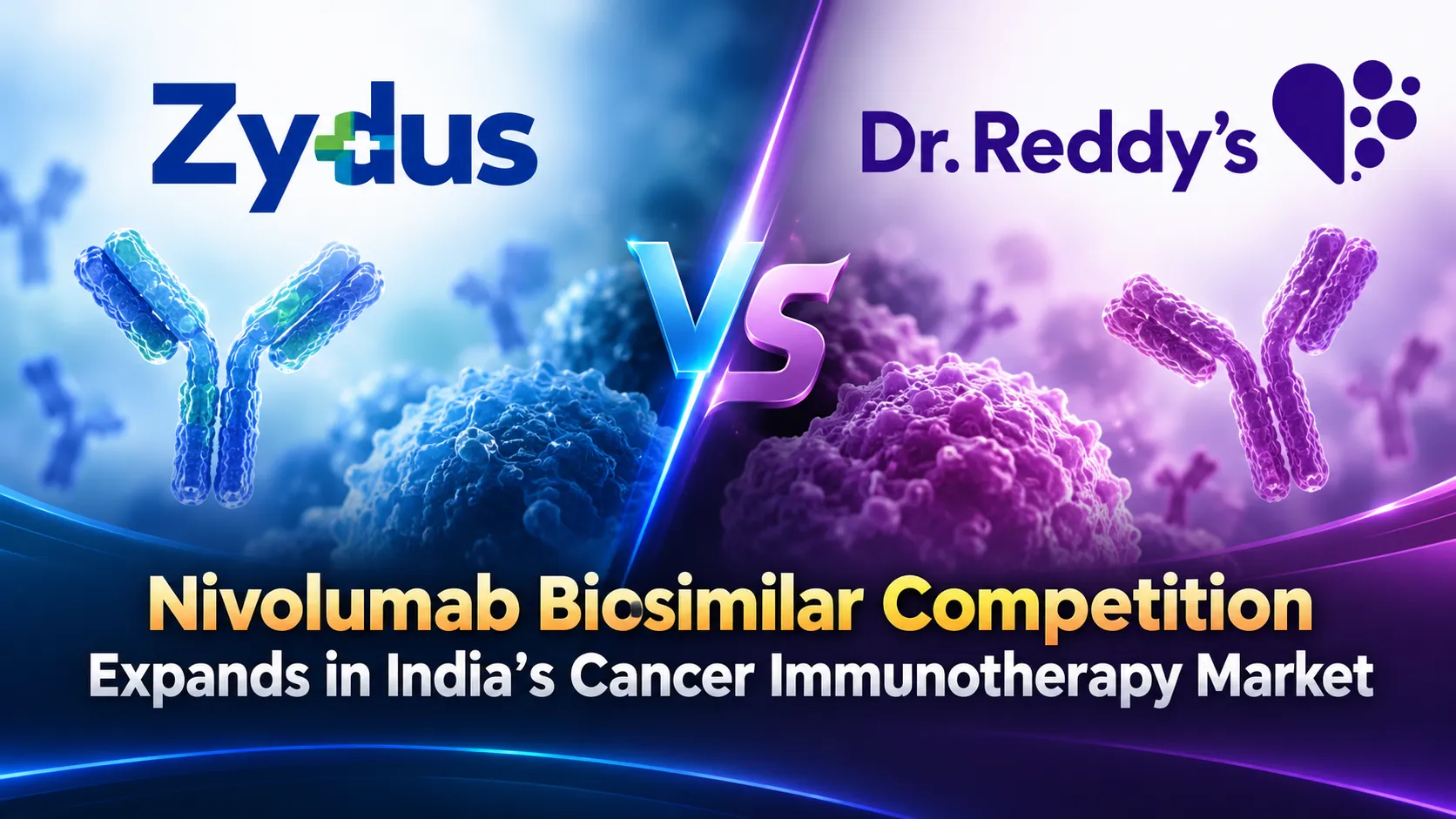
Zydus Lifesciences launched Tishtha in January 2026, becoming the first company to introduce a nivolumab biosimilar in India. Dr. Reddy’s Laboratories entered the market with NIVORZ in September 2026, adding another Indian-developed option for patients requiring cancer immunotherapy.
India’s cancer immunotherapy market is witnessing increased competition as domestic pharmaceutical companies expand their presence in advanced biologic medicines. Zydus Lifesciences and Dr. Reddy’s Laboratories have now launched biosimilar versions of nivolumab, an immunotherapy used in the treatment of multiple cancers.
Zydus introduced its product, Tishtha, in January 2026, while Dr. Reddy’s Laboratories announced the launch of NIVORZ on September 15, 2026. The developments mark an important step in the growth of India’s biosimilar immuno-oncology segment.
Zydus launched Tishtha in January 2026
On January 22, 2026, Zydus Lifesciences announced the launch of Tishtha, which the company described as the world’s first nivolumab biosimilar.
The product was launched in two strengths, 40 mg and 100 mg, priced at ₹13,950 and ₹28,950, respectively. According to the company, these prices were approximately one-quarter of the cost of the reference medicine.
Nivolumab is marketed internationally by Bristol Myers Squibb under the brand name Opdivo. In India, the reference medicine has also been marketed under the brand name Opdyta.
Zydus stated that Tishtha was developed and manufactured in India and was intended to improve access to immuno-oncology treatment by reducing the financial burden associated with cancer therapy.
The launch followed a patent-related legal dispute with Bristol Myers Squibb. In January 2026, a division bench of the Delhi High Court set aside an earlier interim restraint, allowing Zydus to proceed with sales subject to safeguards, including maintaining detailed sales accounts.
Dr. Reddy’s enters the market with NIVORZ
On September 15, 2026, Dr. Reddy’s Laboratories announced the launch of NIVORZ, its nivolumab biosimilar, in India.
The launch marks the company's entry into the Indian biosimilar immuno-oncology market and expands its oncology portfolio.
According to the company, NIVORZ was developed and manufactured entirely in-house at its biologics facility in Bachupally, Hyderabad. The product received approval from the Drugs Controller General of India (DCGI) across 12 cancer indications, spanning solid tumours and haematological malignancies.
The company reported that NIVORZ was evaluated through a multi-country clinical development programme involving 288 patients, including 252 patients in India and 36 in Russia. According to Dr. Reddy’s, the programme demonstrated comparable efficacy, safety, pharmacokinetics and immunogenicity to the reference nivolumab.
NIVORZ is available in three vial presentations: 40 mg/4 mL, 100 mg/10 mL and 240 mg/24 mL.
The company has positioned the product as part of its strategy to expand access to biologic therapies and strengthen its presence in immuno-oncology. Its September launch announcement did not disclose the product’s price.
What is nivolumab and how does it work?
Nivolumab is a monoclonal antibody that targets the PD-1 immune checkpoint. By blocking this pathway, it can help restore the immune system’s ability to recognise and attack cancer cells.
The medicine is used in several cancer treatment settings, depending on the approved indication and clinical circumstances. These include certain cases of non-small cell lung cancer, renal cell carcinoma, melanoma, classical Hodgkin lymphoma, urothelial carcinoma, colorectal cancer and other malignancies.
Nivolumab is an immunotherapy rather than a conventional cytotoxic chemotherapy medicine. Its use depends on the cancer type, disease stage, treatment history and applicable clinical guidelines.
A biosimilar is a biologic medicine demonstrated to be highly similar to an approved reference biologic, with no clinically meaningful differences in safety, purity and potency under the applicable regulatory framework.

Sources : Official company announcements and launch reports. Prices and product presentations may change; consult current prescribing information and company communications.
What does the entry of two Indian companies mean for the market?
The entry of Dr. Reddy’s creates a second domestic commercial offering in the nivolumab biosimilar segment following Zydus’s launch.
Potential for increased competition
With two Indian pharmaceutical companies marketing nivolumab biosimilars, competition may increase around pricing, distribution, hospital access and physician engagement. However, the actual impact on prices will depend on commercial decisions and market uptake.
Affordability becomes a key issue
Zydus has publicly disclosed prices for Tishtha that it says are approximately one-quarter of the reference medicine’s cost. Dr. Reddy’s has not disclosed a price in the cited launch announcement, so a direct price comparison cannot yet be made from these sources.
Domestic biologics manufacturing gains visibility
Both launches highlight the capabilities of Indian pharmaceutical companies in developing and manufacturing complex biologic medicines. Dr. Reddy’s specifically stated that NIVORZ was developed and manufactured in-house at its Hyderabad facility.
Patient access will depend on more than launch prices
The availability of additional products may create more options for hospitals and clinicians. However, broader patient access will also depend on treatment costs across the full course of therapy, availability, reimbursement, clinical suitability and access to oncology services.
Conclusion
The launch of Tishtha by Zydus Lifesciences and NIVORZ by Dr. Reddy’s Laboratories marks a significant development in India’s nivolumab biosimilar market. Zydus established the first commercial offering in January 2026, followed by Dr. Reddy’s in September.
The next development to watch will be how the two products compete on pricing, availability and adoption across oncology centres. Their entry may strengthen the role of Indian pharmaceutical companies in the domestic immuno-oncology market, although the extent of any resulting improvement in affordability and patient access will need to be assessed using actual market data.