
The A.P. Public Service Commission came in to existence on 1st November, 1956 with the formation of the State of Andhra Pradesh. Before this, there was Andhra Public Service Commission in the Andhra State and Hyderabad Public Service Commission in the Hyderabad State. Andhra Service Commission came in to existence only in 1953 after the bifurcation of composite Madras State into Andhra and Madras States.
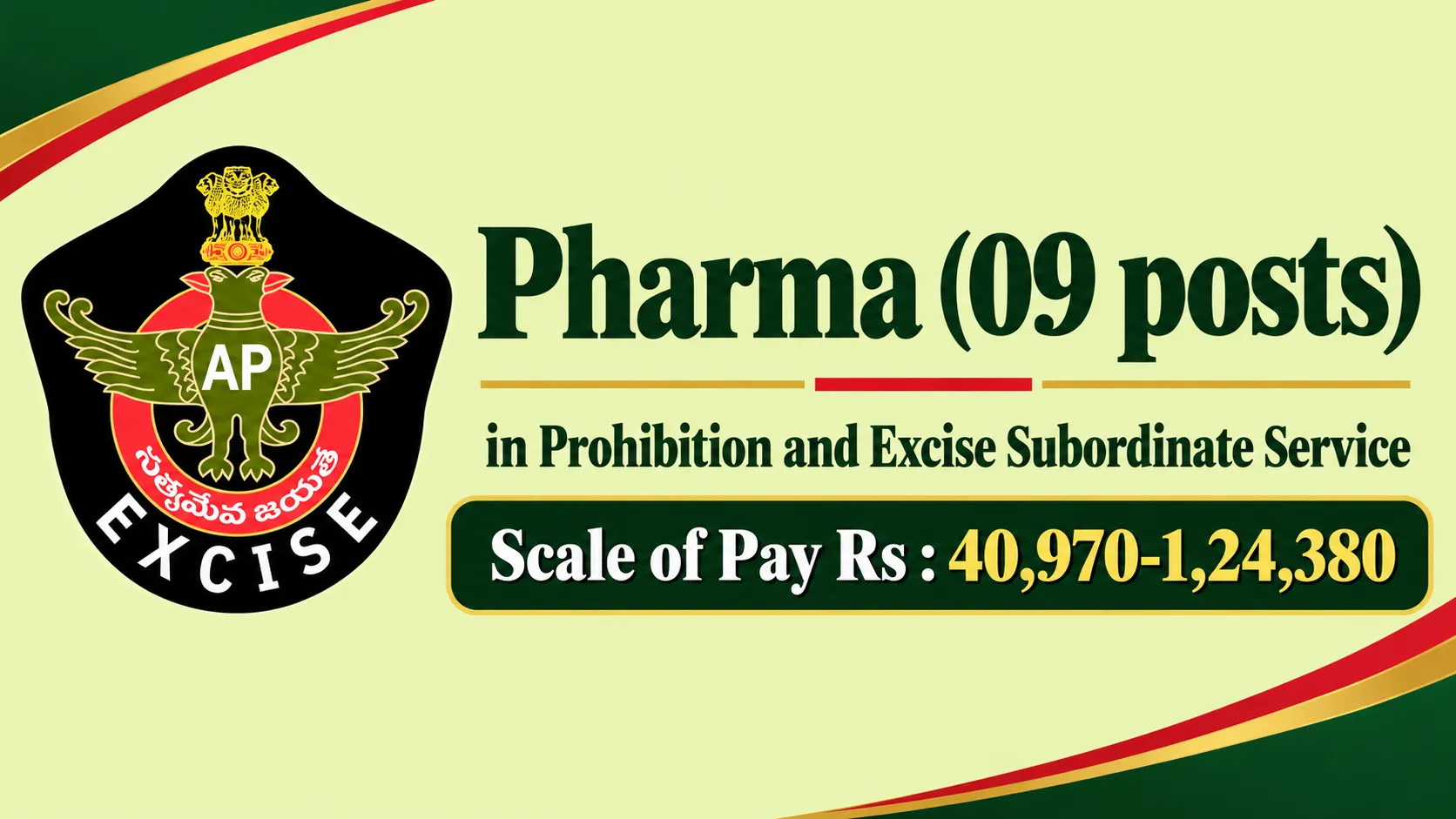
Post : Assistant Chemical Examiner in A.P. Prohibition and Excise Subordinate Service
Applications are invited online through Commission’s Website (psc.ap.gov.in) from eligible candidates from 06/11/2026 to 26/11/2026 up to 11:59 P.M for Recruitment to the post of Assistant Chemical Examiner in A.P. Prohibition and Excise Subordinate Service. The desirous eligible candidates shall apply online after satisfying themselves as per the terms and conditions of this Recruitment Notification. The details of provisional vacancies are hereunder and the number of vacancies are subject to variation on confirmation being received from the concerned Department.
No of posts : 09
Age as on 01/07/2026 : 18-44
Minimum & Maximum Age will be reckoned as on 01/07/2026.
Scale of Pay Rs : 40,970-1,24,380
Educational Qualification : Applicants must possess the requisite Educational Qualification as on the date of Detailed Notification and Must hold a Bachelor's Degree in Science with Chemistry or B.SC.(Pharmacy) of any University in India established or incorporated by or under a Central Act, a Provincial Act or a State Act or the institutions recognised by the University Grants Commission or an equivalent Qualification.
IMPORTANT
(i) Applicants/Candidates should read the Commission’s Detailed Notification and other instructions carefully before applying for this Recruitment and enter the particulars properly in the Online Application Form.
(ii) Applicants/Candidates have to submit applications only through online mode. Any application sent through any mode other than the prescribed online mode will not be entertained under any circumstances.
(iii) Applicants/Candidates are advised to submit their applications through online well in advance of the last date to avoid last- minutes rush.
The examination for this recruitment shall consist of a single-level examination only, and no Screening Test shall be conducted, irrespective of the number of applications received. The examination shall be conducted in online (CBRT) mode. In case the single-level examination is conducted in multiple sessions, the Commission will adopt a process of normalisation of marks, wherever considered necessary and applicable, in accordance with the methodology and procedure decided by the Commission.
Written Examination (Objective Type) (Degree Standard)
PAPER-I
Subject : General Studies & Mental Ability
No. of Questions : 150
Duration (Minutes) : 150
Maximum Marks : 150
PAPER-II
Subject : Concerned Subject (Degree Standard) – Chemistry or Pharmacy
No. of Questions : 150
Duration (Minutes) : 150
Maximum Marks : 150
TOTAL MAXIMUM MARKS : 300
NEGATIVE MARKS : As per G.O.Ms. No. 235, Finance (HR-I, Plg & Policy) Dept., Dt. 06/12/2016, each wrong answer will be penalized with 1/3rd of the marks prescribed for the question.
SYLLABUS
PAPER - I
GENERAL STUDIES AND MENTAL ABILITY
1. Major Current Events and Issues pertaining to International, National and State of Andhra Pradesh.
2. General Science and its applications to the day to day life Contemporary developments in Science & Technology and Information Technology.
3. History of India - emphasis will be on broad general understanding of the subject in its social, economic, cultural and political aspects with a focus on AP and Indian National Movement.
4. Geography of India with focus on Andhra Pradesh.
5. Indian polity and Governance: constitutional issues, public policy, reforms and e-Governance initiatives.
6. Indian Economy and planning
7. Sustainable Development and Environmental Protection
8. Disaster management: vulnerability profile, prevention and mitigation strategies, Application of Remote Sensing and GIS in the assessment of Disaster
9. Logical reasoning, analytical ability and logical interpretation.
10. Data Analysis: Tabulation of data Visual representation of data Basic data analysis (Summary Statistics such as mean, median, mode and variance) and Interpretation.
CHEMISTRY SECTION-A: (INORGANIC CHEMISTRY)
1.1 Atomic structure: Schrodinger wave equation, significance of and quantum numbers and their significance, radial and angular probability, shapes of orbitals, relative energies of atomic orbitals as a function of atomic number. Electronic configurations of elements; Aufbau principle, Hund’s multiplicity rule, Pauli exclusion principle.
1.2 Chemical periodicity: Periodic classification of elements, salient characteristics of s,p,d and f block elements. Periodic trends of atomic radii, ionic radii, ionization potential, electron affinity and electro-negativity in the periodic table.
1.3 Chemical bonding: Types of bonding, overlap of atomic orbitals, sigma and pi-bonds, hydrogen and metallic bonds. Shapes of molecules bond order, bond length, V.S.E.P.R. theory and bond angles. The concept of hybridization and shapes of molecules and ions.
1.4 Oxidation states and oxidation number: Oxidation and reduction, oxidation numbers, common redox reactions, ionic equations. Balancing of equations for oxidation and reduction reactions.
1.5 Acids and bases: Bronsted and Lewis theories of acids and bases. Hard and soft acids and bases. HSAB principle, relative strengths of acids and bases and the effect of substituents and solvents on their strength.
1.6 Chemistry of elements:
i) Hydrogen: Its unique position in the periodic table, isotopes, ortho and para hydrogen, industrial production, heavy water.
ii) Chemistry of ‘s’ and ‘p’ block elements: Electronic configuration, general characteristics properties, inert pair effect, allotrophy and catenation. Special emphasis on solutions of alkali and alkaline earth metals in liquid ammonia. Preparation, properties and structures of boric acid, borates, boron nitrides, borohydride (diborane), carboranes, oxides and oxyacids of nitrogen, phosphorous, sulphur and chlorine; interhalogen compounds, polyhalide ions, pseudohalogens, fluorocarbons and basic properties of halogens. Chemical reactivity of noble gases, preparation, structure and bonding of noble gas compounds.
iii) Chemistry of ‘d’ block elements: Transition metals including lanthanides, general characteristic properties, oxidation states, magnetic behaviour, colour. First row transition metals and general properties of their compounds (oxides, halides and sulphides); lanthanide contraction.
1.7 Extraction of metals: Principles of extraction of metals as illustrated by sodium, magnesium, aluminum, iron, nickel, copper, silver and gold.
1.8 Nuclear Chemistry: Nuclear reactions; mass defect and binding energy, nuclear fission and fusion. Nuclear reactors; radioisotopes and their applications.
1.9 Coordination compounds: Nomenclature, isomerism and theories of coordination compounds and their role in nature and medicine.
1.10 Pollution and its control: Air pollution, types of air pollution, control of air and water pollution, radioactive pollution.
SECTION-B: (ORGANIC CHEMISTRY):
2.1 Bonding and shapes of organic molecules: Electronegativity, electron displacements-inductive, mesomeric and hyperconjugative effects; bond polarity and bond polarizability, dipole moments of organic molecules; hydrogen bond; effects of solvent and structure on dissociation constants of acids and bases; bond formation, fission of covalent bonds; homolysis and heterolysis; reaction intermediates-carbocations, carbanions, free radicals and carbenes; generation geometry and stability; nucleophiles and electrophiles.
2.2 Chemistry of aliphatic compounds: Nomenclature alkanes-synthesis, reactions (free radical halogenation) - reactivity and selectivity, sulphonation-detergents; cycloalkanes-Baeyers’ strain theory; alkanes and alkynes-synthesis, electrohilic addition; reactions, Markownikov’s rule, peroxide effects, 1-3-dipolar addition; nucleophilic addition to electron- deficient alkenes; polymerization; relative acidity; synthesis and reactions of alkyl halides, alkanols, alkanals, alkanones, alkanoic acids, esters, amides, nitriles, amines, acid anhydrides, -unsatuarated ketones, ethers and nitro compounds.
2.3 Stereochemistry of carbon compounds: Elements of symmetry, chiral and achiral compounds. Fischer projection formulae; optical isomerism of lactic and tartaric acids, enantiomerism and diastereo-isomerism; configuration (relative and absolute); conformations of alkanes upto four carbons, cyclohexane and dimethylcyclo-hexanes their potential energy D,L and R,S notations of compounds containing chiral centers; projection formulae-Fischer, Newman and sawhorse of compounds containing two adjacent chiral centers; meso and dl-isomers, erythro and threo isomers; racemization and resolution; examples of homotopic, enantiotopic and diasteretopic atoms and groups in organic compounds, geometrical isomers; E and Z_notations. Stero-chemistry of SN1, SN2,E1 and E2 reactions.
2.4 Organometallic compounds: Preparation and synthetic uses of Grignard reagents, alkyl lithium compounds.
2.5 Active methylene compounds: Diethyl malonate, ethyl acetoacetate. ethyl cyanoacetate-applications in organic synthesis; tautomerism (keto- enol).
2.6 Chemistry of aromatic compounds: Aromaticity; Huckel’s rule; electrophilic aromatic substitution-nitration, sulphonation, halogenation (nuclear and side chain), Friedel-Crafts alkylation and acylation, substituents effect; chemistry and reactivity of aromatic halides, phenols, nitro, diazo, dia-zonium and sulphonic acid derivatives, benzyne reactions.
2.7 Chemistry of biomolecules: (i) Carobhydrates: Classification, reactions, structure of glucose, D,L-configuration, osazone formation; fructose and sucrose; step-up step-down of aldoses and ketoses; and their interconversion, (ii) Amino acids: Essential amino acids; zwitterions, isoelectric point, polypeptides; proteins; methods of synthesis of -amino acids. (iii) Elementary idea of oils, fats, soaps and detergents.
2.8 Basic principles and applications of UV, visible, IR and NMR spectroscopy of simple organic molecules.
SECTION-C: (PHYSICAL CHEMISTRY)
3.1 Gaseous state: Deviation of real gases from the equation of state for an ideal gas, Vander Waals and Viril equation of state, critical phenomena, principle of corresponding states, equation for reduced state. Liquification of gases, distribution of molecular speed, collisions between molecules in a gas; mean free path, specific heat of gases.
3.2 Thermodynamics:
(i) First Law and its applications: Thermodynamic systems, states and processes work, heat and internal energy, zeroth law of thermodynamics, various types of work done on a system in reversible and irreversible processes. Calorimetry and thermo¬chemistry, enthalpy and enthalpy changes in various physical and chemical processes, Joule-Thomson effect, inversion temperature. Heat capacities and temperature dependence of enthalpy and energy changes.
(ii) Second Law and its applications: Spontaneity of a process, entropy and entropy changes in various processes, free energy functions, criteria for equilibrium, relation between equilibrium constant and thermodynamic quantities.
3.3 Phase rule and its applications: Equilibrium between liquid, solid and vapours of a pure substance, Clausius-Clapeyron equation and its applications. Number of components, phases and degrees of freedom; phase rule and its applications; simple systems with one (water and sulphur) and two components (lead-silver, salt hydrates). Distribution law, its modifications, limitations and applications.
3.4 Solutions: Solubility and its temperature dependence, partially miscible liquids, upper and lower critical solution temperatures, vapour pressures of liquids over their mixtures, Raoult’s and Henry’s law, fractional and steam distillations.
3.5 Colligative Properties: Dilute solutions and colligative properties, determination of molecular weights, using colligative properties.
3.6 Electro-chemistry: Ions in solutions, ionic equilibria, dissociation constants of acids and bases, hydrolysis, pH and buffers, theory of indicators and acid-base titrations. Conductivity of ionic solutions, its variation with concentration, Ostwald’s dilution law, Kohrausch law and its application. Transport number and its determination. Faraday’s laws of electrolysis, galvanic cells and measurements of their e.m.f., cell reactions, standard cell, standard reduction potential Nernst equation, relation between thermodynamic quantities and cell e.m.f., fuel cells, potentiometric titrations.
3.7 Chemical kinetics: Rate of chemical reaction and its dependence on concentrations of the reactants, rate constant and order of reaction and their experimental determination; differential and integral rate equations for first and second order reaction, half-life periods; temperature dependence of rate constant and Arrhenius parameters; elementary ideas regarding collision and transition state theory.
3.8 Photochemistry: Absorption of light, laws of photochemistry, quantum yield, the excited state and its decay by radiative, non-radiative and chemical pathways; simple photochemical reactions.
3.9 Catalysis: Homogeneous and heterogeneous catalysis and their characteristics, mechanism of heterogeneous catalysis; enzyme catalysed reactions (Michaelis-Menten mechanism)
3.10 Colloids: The colloidal state, preparation and purification of colloids and their characteristics properties; lyophilic and lyophobic colloids and coagulation; protection of colloids; gels, emulsions, surfactants and micelles.
PHARMACY
i) History of Pharmacy: Code of ethics in Pharmacy, Posclogy; Principles of dispending of mixtures, emulsion, powers and suppositories; Different types of Incompatiabilities.
ii) Pharmacy Act; Drugs and Cosmetics Act and Rules; Drugs price control order including amendments.
iii) Methods of Sterilization and test for sterility; Preparation of vaccines, Sera and Anti-toxins; Manufacture of Penicillin and Streptomycin.
iv) Methods of classification of crude drugs; Adulteration and evaluation of crude drugs.
v) Pharmacognosy of Senna, Digitalis, Ispaghula, Cinchona, Cinnamon, Renwolfia, Podophyllu, Ergot Cod liver oil and Geletin.
vi) Principles, instrumentation and applications of colorimetry. Spectrophotonetry, fluorimetry, gas chromatography and High performance liquid chromatography.
i) Theory and applications of rheology (Newtonian and Non-Newtonian); Colloidal and interfacial phenomenon and their applications; Coarse dispersion (emulsions and suspensions)
ii) Physics-Chemical, formulation and biological factors effecting drug absorption.
iii) Formulation, technology and qualify control of tablets, capsules, liquid crias, aerosols, creams and ointments, injectables and sustained telease medicaments.
iv) Structure activity relationship, synthesis, chemical nomenclature and uses of following classes of drugs - hypnotics and Sedatives; tranquilizers; Analgesics and Antipyretics; Anti-inflammatory drugs; Diuretics; anti-hypertensives and Chemotherapeutic Agents.
v) Pharmacology of Local anesthetics; Diuretics; Hormones; Hyperglycemic agents; Anti-histamines; Drugs acting on central nervous system; Adrenergic and Cholinergic drugs and Cardio¬vascular agents.
vi) Pharmacokinetic and Pharmacodynamic drug interactions with suitable examples; Teratogenicity; Drug-induced diseases.
Syllabus for Computer Proficiency Test
PART-A
1. INTRODUCTION TO COMPUTERS: Introduction to Computers - Components and their classification - Peripheral devices and their purpose. Input Devices - Keyboard, Mouse, Scanner, Lighten, Touch screens, Joystick, Micro phone, Scanner, Digital camera, Bar code reader, Biometric sensor. Output Devices: Display devices, Printers, Monitor, Speaker, Plotter, Secondary Storage Devices - Feature- Driven Development (FDD), Magnetic tape, Universal Serial Bus(USB), Pen Drives, Disks - The Role of input Processing / output processing devices - Computing Concepts - Data - Information
- Random - Access Memory (RAM) - Read-Only Memory(ROM)
- Control Unit - Memory Unit - Arithmetic Logic Unit(ALU).
2. COMPUTER SOFTWARE TYPES: System Software, Application Software, Embedded software, Proprietary
Software, Open source software (their purpose and characteristics only).
3. OPERATING SYSTEM: Purpose of operating system, Single User and Multi User Operating Systems with Examples.
4. WINDOWS OPERATING SYSTEM: Interfacing Graphical User Interface (GUI), Differences between Character User Interface (CUI) and Graphical User Interface(GUI) - working With Files and Folders - More About Files - Running An Application Through the File Manager - Running an Application Through the Program Manager - Setting up of Printer, Webcam, Scanner and other peripheral devices.
5. LINUX/MAC OS (only basic concepts): Introduction to Linux
- Features and advantages of Linux, File handling commands, directory handling commands - User Management - File permissions Macintosh Apple Computer (MAC) OS - Introduction - Advantages of Macintosh Apple Computer (MAC) OS. Basics commands.
6. INTERNET CONCEPTS (only basic concepts): Minimum Hardware and Software Requirements for a system to use internet, Communication Protocols and Facilities - Various browsers - What is Internet Protocol (IP) Address - Steps required in connecting system to network - Uploading and Downloading Files from Internet
7. ELECTRONIC MAIL (only basic concepts): Sending and receiving mails, Basic E-Mail Functions, Using your word processor for E-mail, Finding E-Mail Address, Mailing Lists and lists Servers.
8. WORLD WIDE WEB (only basic concepts): WWW advantages of the Web - how to navigate with the Web - Web Searching.
PART -B
1. OFFICE SUITE: MSOFFICE or any open source office like Libre Office /Apache Open Office Neo office for Windows/Linux/Macintosh Apple Computer (MAC)OS.
2. GETTING STARTED WITH OFFICE: Introduction to Office Software- Starting and Exiting the Office Applications - Introducing the Office Shortcut Bar - Customizing Office Shortcut Bar.
3. FILE OPERATIONS IN THE OFFICE: Common Office Tools and Techniques - Opening An Application - Creating Files - Entering And Editing Text - Saving Files - Opening Files - Closing a File - Exiting The Application - Managing Your files With the Office Applications.
4. TOOLS IN THE OFFICE APPLICATIONS: Key Combinations - Cut, Copy and Paste - Drag And Drop Editing - Menu Bars And Toolbars - Undo and - Redo - Spell Checking - Auto
Correct - Find and Replace - Help And The Office Assistants - Templates and Wizards.
5. WORD PROCESSING (MS WORD or its equivalent in Libre office /Apache Open Office / Neo office for Windows/s/Linux/Mac OS): Starting Word
• Title Bar - Menu Bar - Format Bar - Standard Bar - Ruler - Workspace Area - Scroll Bar - Status Bar - Different Toolbars - Option a Menu Bar - Creating New Document When Word is Running - Opening Pre existing Documents When Word is Running - Designing Your Document - Typing Text - Selection text - Deleting Text - Formatting text and document - copying and moving - Saving Document - Page Setup - Properties of a document - Undo-Redo-Cut-Copy a Document - Pasting a Document - Print Preview - Printing - Select All - Find - Replace - Go To - Four Different View Of A Document - Normal, Web Layout, Print Layout, and Outline Layout- Document Map - Full Screen - Zoom - Objects - Page Break - Header and Footer - Page Number - Auto Format - Auto Text - Inserting Date And Time - Working With Header, Footers- footnotes-Fields-Symbols-Caption Cross Reference-Index- Tabs-Table and Sorting - Working With Graphics - Inserting Pictures - Modifying Pictures - Word Art - Inserting Chart - Inserting Files - Hyper Linking - Bookmark - Using Different Fonts - Paragraph - Bullets Borders and Shading-Columns- Drop Cap-Theme-Change Case Background-Frames-Style- Spelling And Grammar - Set Language - Word Count - Auto Summarize - Auto Correct - Merge Document - Protect Document - Envelopes And Labels - - Templates, Wizards And Sample Documents - drawing Tables - Merge Cell - Spilt Cells
- Spilt Table - Table Auto Format - Auto Fit - Sort - Formula - Arrange All-Split- Micro Soft Word Help - Macros - Custom Toolbars - Keyboard Shortcuts - Menus - Mail Merge.
6. SPREAD SHEET (MS Excel or its equivalent in Libre Office / Apache Open Office / Neo office for Windows/Linux/Mac OS):
Features Of Excel - Excel worksheet - Selecting Cell - Navigating With The Mouse And Keyboard - Entering And Editing Text - Text Boxes - Text Notes - Checking Spelling - Undoing And Repeating Action - Entering And Editing Formulas - Referencing Cells - Order Of Evolution in Formulas
- Copying Entries And Equations To Minimize Typing - More Auto Fill Examples - Creating Custom Fill Lists Protecting And Un Protecting Documents And Cell - Creating A New Worksheet - Excel Formatting Tips And Techniques - Moving cell - Copying Cells - Sorting Cell Data - Insertion Cells Inserting As You Paste - Deleting Parts Of Worksheet - Clearing Parts Of A Worksheet - Excel Page Setup - Changing Column Width And Row Heights - Auto Format - Manual Formatting - Using style - Format Code Alter A Number's Appearance - Format Painter Speeds-Up Format Copying - Changing Font Size And Attributes - Adjusting Alignments - Cantering Text Across Column - Using Border Buttons And Commands - Changing Color And Shading - Inserting And Removing Page Breaks - Hiding Rows And Columns - Rearranging Worksheet - Entering Formula - Excel Functions
- Inserting Rows And Columns - Saving A Worksheet - Printing A Worksheet - Printing Tips For Large Excel Project - Parts Of A Function - Functions Requiring Add-ins - Function Wizard - Example Of Functions By Category - Organizing Your Data - Excel's Chart Features - Chart Parts And Terminology - Instant charts with The chart wizard - Creating Chart On Separating Worksheets - Resizing And Moving Charts - Adding Chart Notes And Arrows - Editing Charts - Rotating 3-D Charts - Printing Charts - Deleting Charts Setting The Default Chart Type - Creating Trend Lines Data Map - Working With Graphics in Excel - Creating And Pacing Graphic objects - Resizing Graphs - Possible Sources Of Excel Graphics - Creating and Running Macro - Sorting Excel Data - Adding Subtotals To Databases - Customizing Excel - Customizing Workspace - Comma Separated Value (CSV) File format - Using Worksheet As Databases.
7. PRESENTATION SOFTWARE (MS Power Point or its equivalent in Libre Office/Apache Open office/Neo office for Windows/Linux/Mac Os): Introduction - Starting Presentation Software - Views in Presentation Software - Slides - Terminology - Color Schemes - Formatting Slides - Creating a Presentation - Using the Auto Content Wizard - Masters- - Using a Template - Creating a Blank Presentation - Working with Text in Power Point - Adding Slides Editing And Working Text - Working in Outlaying view - Spell checking - Finding And Replacing Text - Formatting Text - Aligning Text - Developing Your Presentation - Importing images From The Outside World - The Clipart Gallery - Drawing in Presentation software- Bringing A Presentation to Life - Inserting Objects in Your Presentation - Inserting A Picture - Working With Graphics - Multimedia in Power Point - Animating The Objects, Pictures, Graphics, - Enhancements to the Slide Show Showing Slides Out Of Order Printing Presentation Elements - Finalizing The Presentation - Assigning Transitions And Timings - Setting The Master Slide - Setting Up The Slide Show - Running The Slide Show.
Assessment Pattern :
Part-A: Test may be designed to assess the candidate by means of MCQs. (20%of Total Marks)
Part-B: A computer based assessment test where they need to:
1. Prepare a model document and organize the same in a formatted manner. This should cover evaluating the typing speed, organizing the document and covering several other aspects such as inserting tables, inserting Images/WordArt, mail merge, etc.)
2. Evaluating typing speed (25% of Total Marks)
(This may be made mandatory for qualifying based on the norms existing)
3. Organizing and inserting different objects (15% of Total Marks)
4. Prepare an Excel Sheet to fill with data and format the sheet, merging/splitting cells, formulae for calculation in the cells, conditional formatting, preparation of different graphs based on the data. (20% of Total Marks)
5. Prepare a Power Point presentation using the standard layouts available and filling different slides with content (Formatted text, images, tables, transition effects, animation etc.).
(20% of Total Marks)
Applications are invited online through Commission’s Website from eligible candidates from 06/11/2026 to 26/11/2026 up to 11:59 P.M
Assistant Chemical Examiner : More Info | Apply Online
See All B.Pharm Alerts M.Pharm Alerts M.Sc Alerts Ph.D Alerts
See All Other Jobs in our Database
Subscribe to Pharmatutor Job Alerts by Email