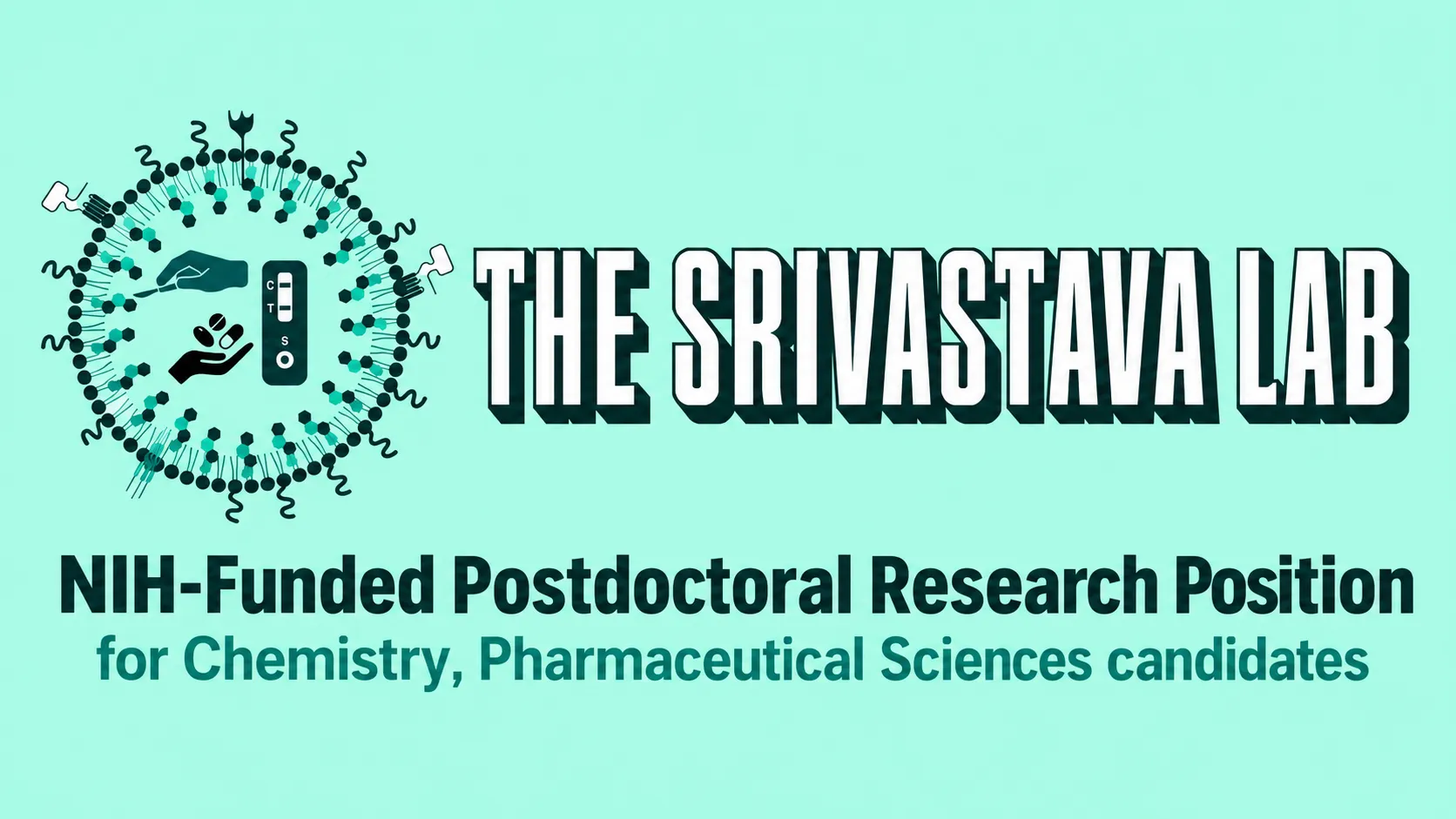
The Srivastava Lab at Texas Tech University seeks a highly motivated Postdoctoral Research Associate to join an NIH NIGMS MIRA-funded research program developing polymeric nanomaterials and ultrabright near-infrared-II (NIR-II) probes for biomedical imaging. This is a research position for a scientist expected to contribute independently from the outset, lead experimental projects, publish high-quality work, and help shape new directions within the program. The position is available immediately, and candidates will be interviewed on a rolling basis. Preference may be given to candidates who can begin the appointment within the desired timeframe. Visa sponsorship may be considered for qualified candidates in accordance with Texas Tech University policies.
NIH-Funded Postdoctoral Research Position in NIR-II Bioimaging
Key Research Activities :
• Lead development of polymeric and nanoparticle systems for biomedical imaging, including polymer synthesis and functionalization, nanoparticle synthesis and nanoformulation, nanoprecipitation, self-assembly, and physiochemical, optical characterization.
• Design and execute biological evaluation across 2D/3D in vitro models and in vivo mouse studies, including toxicity, cellular uptake, confocal imaging, tumor implantation/injections, fluorescence/NIR/NIR-II imaging, pharmacokinetics, biodistribution, and tissue-level analysis.
• Independently plan experiments, troubleshoot technically demanding workflows, analyze quantitative data, and move projects from concept through publication.
• Lead manuscripts and presentations, mentor junior researchers, contribute intellectually to collaborative projects, and help establish new experimental capabilities.
Minimum Qualifications
Applicants Must Meet All :
• Ph.D. completed (or expected before the start date) in Bioengineering/Biomedical Engineering, Chemical Engineering, Materials Science, Chemistry, Pharmaceutical Sciences, Mechanical Engineering, or a closely related field.
• Demonstrated record of peer-reviewed research productivity, including first-author/co-first-author or equivalent lead- author publications; accepted or in-press manuscripts may be considered.
• Demonstrated experimental independence: ability to design studies, execute technically demanding research, troubleshoot failures, interpret data, and communicate results in manuscripts and presentations.
• Applicants should demonstrate substantial hands-on expertise in at least TWO of the following FOUR core technical areas :
(1) Polymer and surfactant synthesis: synthesis, characterization of polymers, amphiphiles, and surfactants, including PEGylated lipids and polymer-brush architectures; (2) Nanoparticle synthesis and nanoformulation: formulation, self-assembly/nanoprecipitation, optimization, and physicochemical characterization of polymeric, lipid- polymer, or related nanosystems;
(3) In vitro 2D and/or 3D studies: mammalian cell culture, cytoxicity/biocompatibility, cellular uptake, mechanistic assays, 3D culture or physiologically relevant models, and confocal/fluorescence imaging; and
(4) In vivo studies: mouse handling and injections, tumor models/implantation, fluorescence/NIR/NIR-II or IVIS- type imaging, pharmacokinetics, biodistribution, organ/tissue collection, and tissue-level analysis.
• Strong scientific writing, communication, organization, and ability to work effectively in a multidisciplinary research environment.
Highly Desired / Preferred Expertise :
• Candidates with complementary expertise that bridges materials development (polymer, surfactant and/or nanoparticle synthesis) with biological evaluation (in vitro and/or in vivo studies) will be especially competitive. Experience independently moving a platform from formulation through biological validation is highly desirable.
• Evidence of research leadership, including mentoring junior researchers, developing new methods, leading collaborations, or substantive participation in grant-driven projects.
Why Join the Srivastava Lab?
A postdoctoral position in the Srivastava Lab is designed as a transition toward scientific independence - not simply additional technical training. Postdoctoral researchers are expected to take substantial intellectual ownership of their projects and develop a recognizable research identity.
• Own and lead projects from experimental design through publication, with freedom to develop new questions, methods, and collaborations within the NIH-funded program.
• Receive authorship that reflects scientific leadership, including opportunities for co-corresponding authorship when the postdoctoral researcher provides substantial intellectual leadership.
• Work directly with the PI on scientific strategy, manuscripts, grant development, and career planning while gaining experience in building new research directions rather than only working within an established pipeline.
• Develop broad interdisciplinary expertise spanning polymer synthesis, nanoparticle engineering, 2D/3D in vitro biology, NIR-II/fluorescence imaging, and in vivo translation, while mentoring graduate and undergraduate researchers.
• Leave with a clearly identifiable body of work, strong lead-author publications, research-leadership experience, grant- development exposure, and an independent scientific direction for the next stage in academia, industry, or other research-intensive careers.
Application Instructions : Candidates must submit their formal application through the Texas Tech University employment portal. Please include all materials requested in the official job posting. Prospective applicants are welcome to contact Prof. Indrajit Srivastava at indrajit.srivastava@ttu.edu with questions regarding research fit or the position. Applications will be reviewed on a rolling basis until the position is filled.